
Nicolas Party’s new solo exhibition, ‘Clotho’, launches at Hauser and Wirth’s Savile Row Gallery in London from October 14th until December 20th 2025. Here Party will show new pastel portraits and the colourful landscapes which have become recognisable as familiar in his works.
Nicolas is originally of Swiss origin but now lives in New York and Brussels. He is successfully promoted as an artist who works across mediums having gained a MFA at Glasgow School of Art, Scotland, in 2009, and is widely exhibited today, showing paintings, sculptures, murals, installations and pastel drawings. Recognisable by the slick vivid colour combinations in his work, Party’s practice seems to be the product of a varied mix of influences and techniques with suggested references to notable historic art practitioners, with a modern twist.
Museum visits and research by Party led to discovery anew of experimental processes formed in the past, including oil paint on copper plate techniques used by seventeenth century artists in the Northern Renaissance. Rembrandt created experimental pieces using this method between 1629 and 1630, where a smooth surface was perfect for painting finite details over an under-layer of fine gold leaf, as can be seen in his works, ‘Old Woman Praying’ which is a portrait of his mother, and a self-portrait of 1630, now hanging in the National Museum, Stockholm, following the painting’s successful rescue from a robbery. Many innovative experiments in surface were carried out by this superb artist who died in poverty in 1669, aged 63. Party has also experimented with durable base surfaces for his pastel works on walls and often quotes references to other artists from history in conversation, relating how these influences and experiences have contributed to his own practice. The need to consistently provide verification of sources may possibly be prompted by promotions or media pressure in interviews, requiring Nicolas to explain his influences and works to the public wherever he exhibits.
There are clearly theatrical aspects to Party’s practice where his work could draw parallels with the rapidly produced temporary backdrop pieces used in stage productions, site-specific, both Party’s pieces and production backdrops are created with immediacy in situ, specifically designed for their impactful visuals. Larger and brighter can be powerful in art, although it may expose a lack of the in-depth and the personal. Party’s paintings, where no figurative aspects or landscapes are painted from life, show a compatibility to graphic fantasy creation, which could be cited as an influence, albeit effectively presented within these alternative formats where, today, the ability to be ‘out there’, relevant and impactful within the Art World has never been more important for sponsorship and success where financial gain and reward can be of a premium. Perhaps this is something Party has retained from his historical investigations from the art of both Rubens and Carriera, for example, seeing how profitable it is to be sought after as an artist, as both were financially solvent and successful in their respective lifetimes. Party’s smaller works are now selling near a starting price of £40,000.
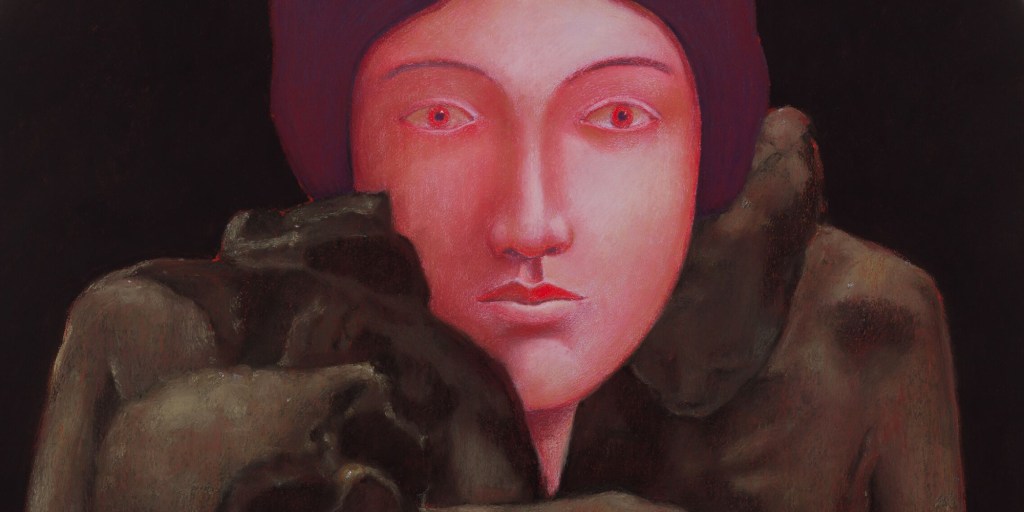
Images courtesy of the Holburne a d Hauser & Wirth
As a boy, Party produced street art and Graffiti making rapid bold statements in public places where speed was an important element of completion and today he continues to enjoy working at pace on large walls, usually with pastels, for rapid results. There followed an uncertain career route progression for Nicolas following study at Art School where a continuous Fine Art route was unclear to him at that time, feeling at odds with the idea of conceptual art he consequently trained in Graphic Design and as a 3.D Animator, the bold influences of which are evident within his work today, where colourful graphic imagery and impactful design are clearly important.
Considerations of Influences which may be present in Party’s practice prompts a comparison to smooth surface spray-painting and air-brushing techniques used freely in graffiti art, but not used in Party’s work today, or a nod to the simplicity in Japanese Fine Art practices and posters, and the renowned clay ‘NO’ masks of theatre performance, specifically created with minimal detail, smooth and blank, where characterisation may be beautified or disturbing in equal measure, and could resonate with the large colourful head sculptures and stylized faces in Party’s works. The graphic works of Kohei Sugiura may also be noted, where fine Japanese mask-work combined with blended and simplified imagery pose similarities. Spaces are important to Party, where he enjoys planning potential exhibitions and making best use of space for his shows and murals in a theatrical way, aiming to maximise the viewer experience. Party’s practice displays conflicting historical influences converging in his work, plus a background in 3.D animation, graphic design, graffiti art and fine art, and a possible awakening that art can be so much more than an energetic response. For me, un-ease exists where an artist redraws the works of other artists, albeit in admiration or for fun, but then uses that redraw to support own additional statement pieces. Fine artists have long since ceased the practice of copying other artists’ work as a means of learning, or anything else, where originality of personal concept is respected, even where its use may be seen as an effective public statement. However, that poses the moral question of whether any historical artworks in the public domain can be seen as fair game for other purposes.
Similarly, it could be argued that there are contradictions in style relating to alleged artistic influences. Many are creators that we all admire, but some seem at odds with Nicolas’s works. The artist argues that there are no prominent pastel artists today working solely in pastel. Notable pastel societies obviously exist, but the point here is unclear. Party, although working in pastel himself, is a multimedia artist, as are numerous achievers in the skill of pastel who also enjoy creating in other media. Craftsmanship in any one media does not indicate that the artist would be any less proficient in a different medium, as we see with artists of the calibre of Degas, Cassatt and Valloton, amongst others. An attempt to pigeon-hole the life, times and skills of past great artists seems somewhat unnecessary and unwelcome, as clearly they all excelled in pastels and also in paint. Perhaps Odilon Redon came close to being a sole pastel master with his superb sensitive obsession with that medium, or Rosalba Carriera with her innovative pastel techniques in an age of powdered faces and powdered wigs, where one could say that pastel seemed like the obvious choice in chalky atmospheres where innovative techniques were required to convey the sitters of that age.
Artists inevitably equate their own works to their contemporaries and to artists throughout history, possibly as a means of assessing their own quality of progression and personal achievement status. However, persistent century-hopping across the smorgasbord of choice options throughout the long history of art with its open availability, dipping in and out to suit, could indicate personal indecision or substituting the projections of time for originality of thought and development within present contexts. It could be argued that speed, energy, time restraints and the need for immediate results satisfaction in public display are possibly the enemy to fostering development within the Arts. Party sites among his numerous influences names such as Felix Vallotton, Pablo Picasso, Giotto di Bondone, Rene Magritte and Georgio Morandi amongst numerous others. For me, the sensitivity and intimacy of the heartfelt paintings, woodcuts and writings of Vallotton’s works is hard to see in Party’s practice, albeit strong colour choices are partially evident, and both Vallotton and Party began life in Lausanne Switzerland, but there the similarity ends fro me, as painting style, technique and ethos are very different. Similarly, I would argue that the gentle empathetic pieces of Morandi’s art are incompatible with the bold imagery in Party’s works. Giotto and Magritte are sited as influences in Portraiture, but perhaps forms and style comparisons are closer to contemporary painters like Salvatore Mangione, known as Salvo, for example, who also similarly lauded the works of old masters, with Raphael being named as an influence for him. And just maybe, after a long day of creating Artworks, perhaps there is no need for any comparison at all, and it’s okay to say, this work is my own.
Party’s use of strong colour contrasts within his works show a dynamism which is his own, and his innate drawing skills are utilised more fully in sensitive original pieces, the painting of his baby for example, where he has included fine detail absent in his other expansive works, and the fine textures of clothe and fur being introduced into new pieces. It seems to me that Party is newly on the road to his own self-discovery as an artist, be that in pastel or another medium, where clearly the impactful creation of his ‘shows’ gives enormous pleasure, and possibly, the best is yet to come.
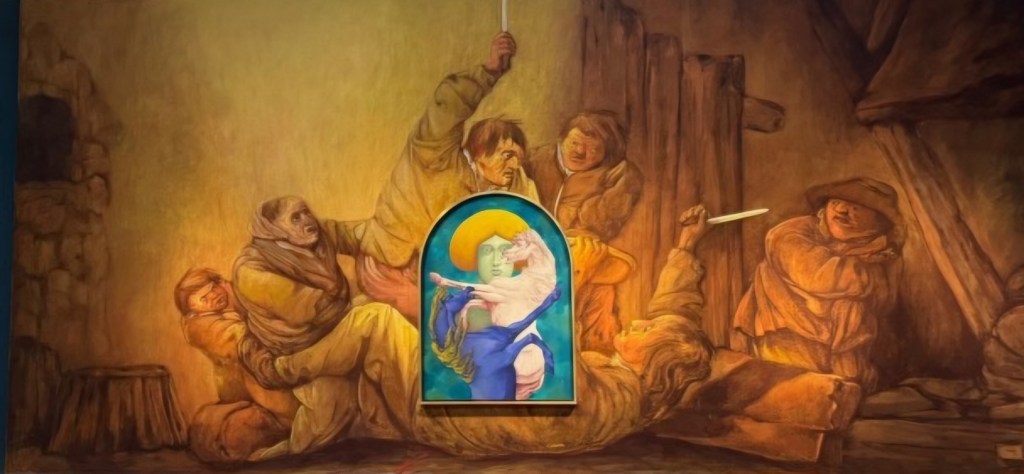
Previous artwork by Party was on display in August 2025 at the Holburne in Bath UK. This was more of an appetiser for the full banquet of his larger upcoming shows in London and globally. In the Holburne Party had re-drawn ‘A Brawl Between Peasants’ by Benjamin Gerritsz Cuyp (1612-1652) on a large wall in the Picture Gallery featuring a central addition ‘Portrait with Two Horses’, and this exhibition, named Copper and Dust, served as an introduction to this new exhibition at Hauser and Wirth in London where his latest original pieces will be shown.
Deanna de Roche 2025

 ART HUB
Leave a comment