
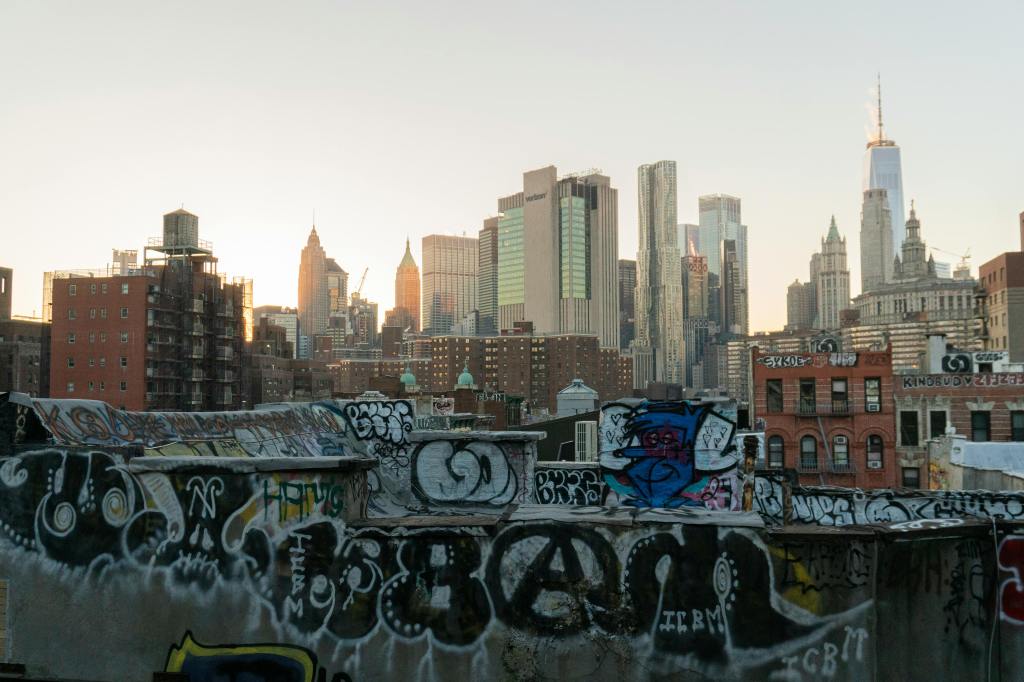
New York, late 1990s. The city is shrouded in smoke, dirt, and stench. Crumbling buildings are covered with layers of graffiti, and the streets are flooded with victims of homelessness. Everywhere you look, you can see the decay and aftermath of the great crisis. Once a great metropolis, it is now a shadow of its former self.
In the middle of that mess we meet Hank. In high school he was a rising baseball star but the injury in a car accident cut his career. Now his interests are beer, watching his favourite ex-sport and his girlfriend Yvonne. When Hank was ending his night shift at a bar he certainly wasn’t eager for the mess he received, from his next-door-friend Russ. His neighbour wasn’t planning on putting Hank as a target in a hunt between Russian Mafia, Puerto Rican thug and Jewish gangsters. Russ simply wanted someone to look for his cat, and unfortunately that person was Hank.
“One small favor, one big problem”
This is the outline of the plot of both the currently released film Caught Stealing and the book of the same title. The screenplay for the film adaptation was written by the author of the original, Charlie Huston. The book, or rather the trilogy it begins, is not well known worldwide, but in America, especially among New Yorkers, it has achieved cult status. The story of Hank Thompson has resonated with many with its portrayal of youthful rebellion, searching for one’s own path, and building one’s life. All this is wrapped up in the attractive packaging of the unusual and crazy adventures of an unlucky and unruly hero. Also, it’s a kind of time capsule of the absurdity of life in New York in the 1990s.
At the helm of this adaptation is Darren Aronofsky. Although I am very fond of the director’s work, I have not always found it to my taste. Some of his films at certain points veered too heavily into exaggerated drama and symbolism. At least to me, this often seemed unnecessary and over-the-top. However, at other times, the explicitness of the director of Black Swan and The Whale was an asset in the issues he addressed. One thing is certain: since his debut with Pi and Requiem for a Dream, the director has served us one dark, gloomy story after another and has not been afraid of heavy and difficult topics.
However, this feature is different from the rest of his oeuvre. Here, the director steps out of his comfort zone and completely turns his style upside down. One of the main inspirations for the directorial language of this film was After Hours. And just like Scorsese back then, Darren is now creating a work that is the opposite of his filmography. He makes a film that is crazy, wild, full of creativity, and one in which the director’s enjoyment is evident at every moment.
“Small town boy, big city problems”
The style of this film is more reminiscent of the films of Guy Ritchie, the Coen brothers, or the Safdie brothers. It is rough, rebellious, and even youthful. It is meant to convey the punk rock nature of the shown era. Such a 180-degree turn could, of course, end in failure, but the director comes out of this attempt successfully. Aronofsky uses all his skills and film knowledge to best convey the crazy rollercoaster ride that is the original novel. In doing so, he creates an extraordinary illusion of the last years of the 1990s.
In creating this illusion, he is aided by the cinematography of his close collaborator, Matthew Libatique. One of the key elements of success here is color. The hues, although faded, multiply on the screen, contrasting and clashing with each other. In this way, they perfectly portray the visual decay, filth, and repulsive gaudiness of the years of shame of the United States.
The director has perfectly captured the image of a city where behind every door there is “another eccentric weirdo.” The set design, costumes, image of the city, and locations all work together, and, supported by a wonderful rock guitar soundtrack, create an atmosphere that almost spills out of the screen. The icing on the cake are the two WTC towers, which rise above New York in the background of almost every wide shot.
“2 Russians, 2 Jews and a Puerto Rican walk into a bar”
But despite all this, the film fits perfectly into the filmography of the NY director. Despite all the energy, vulgarity, and madness, Aronofsky remains faithful to what is most important in his films. Underneath all this atmosphere are extremely down-to-earth characters. In line with the artist’s previous works, the film deals with topics such as coping with addiction, coming to terms with the past, and overcoming trauma. His characters are extremely human, three-dimensional, and simply tangible. This is largely thanks to the director’s unique talent for directing actors. Vincent D’Onofrio and Liev Schreiber create a wonderful dynamic as the Hebrew Hitmen duo, Zoe Kravitz is magnetic and extremely charismatic, and Matt Smith is a volcano of British punk energy that never stops bubbling. Each member of the cast contributes to the creation of this colorful world. At the center of it all is Hank, played by Austin Butler. Since his role as Elvis, he has been on the rise, and this role cements his status as a frontrunner of the young actors. Butler has an energy and charisma that brings to mind Brad Pitt. I think it’s now safe to say that he is a new movie star.
Caught Stealing is a bold and extremely creative film. The director throws us into the punk rock and crazy world of the twilight of the 20th century, and thanks to his skillful handling of an unconventional story and smooth pacing, he keeps us hooked until the very end. The film is not afraid, as usual for this filmmaker, to explore difficult, uncomfortable topics and offer empathy and opportunities for reflection within them. At the same time, thanks to the director’s aforementioned courage in changing styles, this feature gains a freshness. The director achieves a unique balance between bluntness and subtlety. For me, it is not only one of the best films of the year, but also Darren Aronofsky’s best work.


 ART HUB
Leave a comment