
The whole world is one.
I create a world which connects all things : many stories and myths where flowers, animals and humans interweave, through time and space. The sensuality of life spreads out, embracing even irony and humour.
My paintings depict a “utopia” in which the world of men, the world of objects and the natural world mingle without hierarchy. Despite the differences on the surface, I think all things are deeply connected, like plants whose roots touch each other.
– Kanaria

Can you tell us a little about your background and how your journey as an artist began?
I was born in 1987 in Osaka, Japan. After graduating from Tama Art University in 2011, I worked as an artist in Tokyo for three years before moving to France, where I obtained a DNSAP from the Ecole nationale supérieure des Beaux-Arts de Paris in 2017 and completed the university’s Post Diplôme at the same university in 2018.
During my final year at Tama Art University, I decided to hold a solo exhibition at a rented gallery, which, quite unexpectedly, sold out.
The fact that my work sold out made me realise that it wasn’t just about my issue anymore… and I decided to become an artist. I felt so strongly about it that I decided to become an artist.

Your artistic statement mentions creating a world that connects everything. Could you elaborate on how you incorporate this concept into your work?
I believe that everything is connected. Even things that seem unrelated at first glance are in fact all connected. For example, the butterfly that just passed in front of me in Tokyo and the snow falling in New York. For example, your best friend Mister A, whom you have never met, and my eraser. People, animals, nature and matters.
I think my work reflects this idea, and I also sometime consciously try to depict various creatures, people, etc. as if they are floating or melting together.

How did your experiences at Tama Art University and École nationale supérieure des Beaux-Arts de Paris shape your artistic style and philosophy?
In Japan, where I was born and raised, animistic thinking was natural, and I had the idea that animals, trees, stones and even individual grains of rice have a god, or spirit, or life in them, just like humans. This may have been the basis for the idea that everything is connected.
In France, where I spent seven years, I learnt that it is okay to have a less formal, freer style. Also, unlike Tama Art University, where I majoured in oil painting, at Beaux arts there were no majors, so I was able to learn a variety of techniques, including printmaking, ceramics and animation.


You have participated in several artist residencies. How have these experiences influenced your work and your approach to art?
I stayed for a year at the Cite internationale des arts in Paris, where there were so many artists and curators from all over the world, and I got to know them, talk to them and sometimes perform with them. It gave me a lot of freedom and variety of options for my future work as an artist. I am still friends with some of the artists whom I met at that time.
Direct influences include: the studio was so large that I could paint large oil paintings (270 cm wide), the experience of being able to do oil paintings and ceramics in the same studio, and being able to work on different materials simultaneously without worrying about time (I could paint in oil, make ceramics during breaks, draw during those breaks, and then work on the oil paintings again).
During my residency at Cabane Georgina in Marseilles, the colours of the sea and sky seen from the premises were so beautiful that every day I renewed my sensitivity to colour and light. The colours of the works produced during the residency became more vibrant and many of the motifs encountered in Marseilles appeared.

Could you describe your creative process, particularly how you begin with a milky white first layer of oil paint? What significance does this initial layer hold for you?
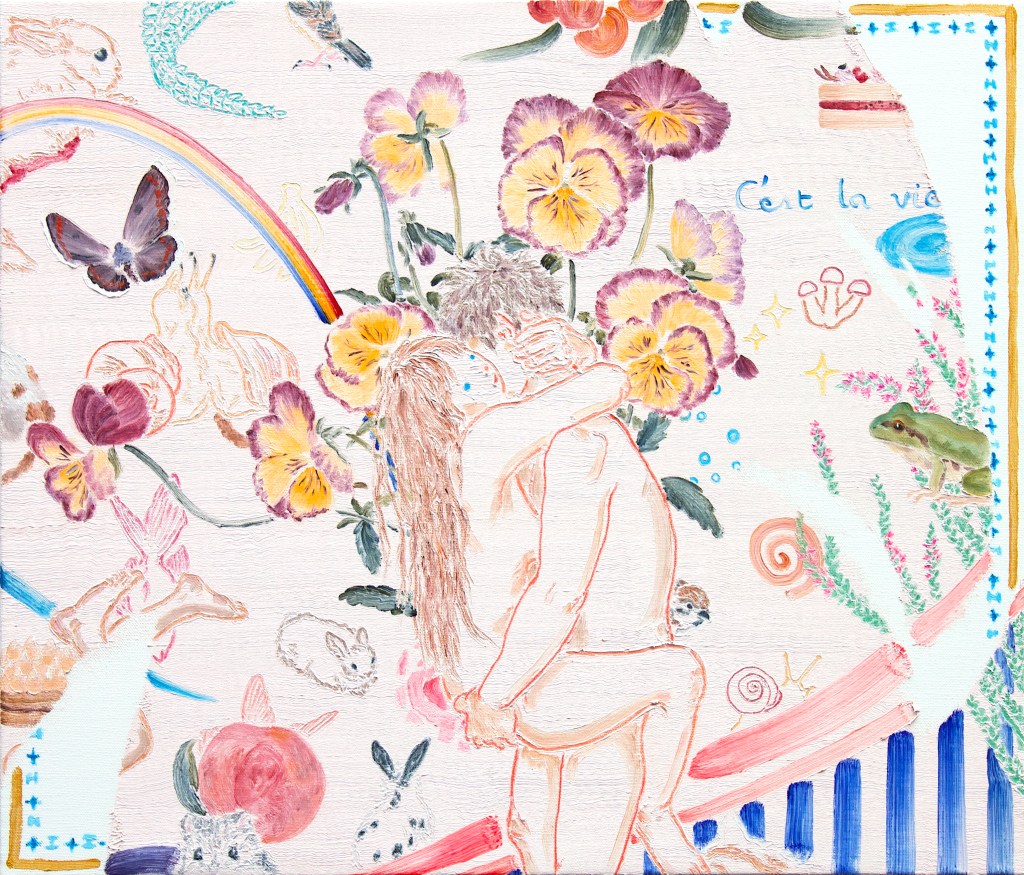
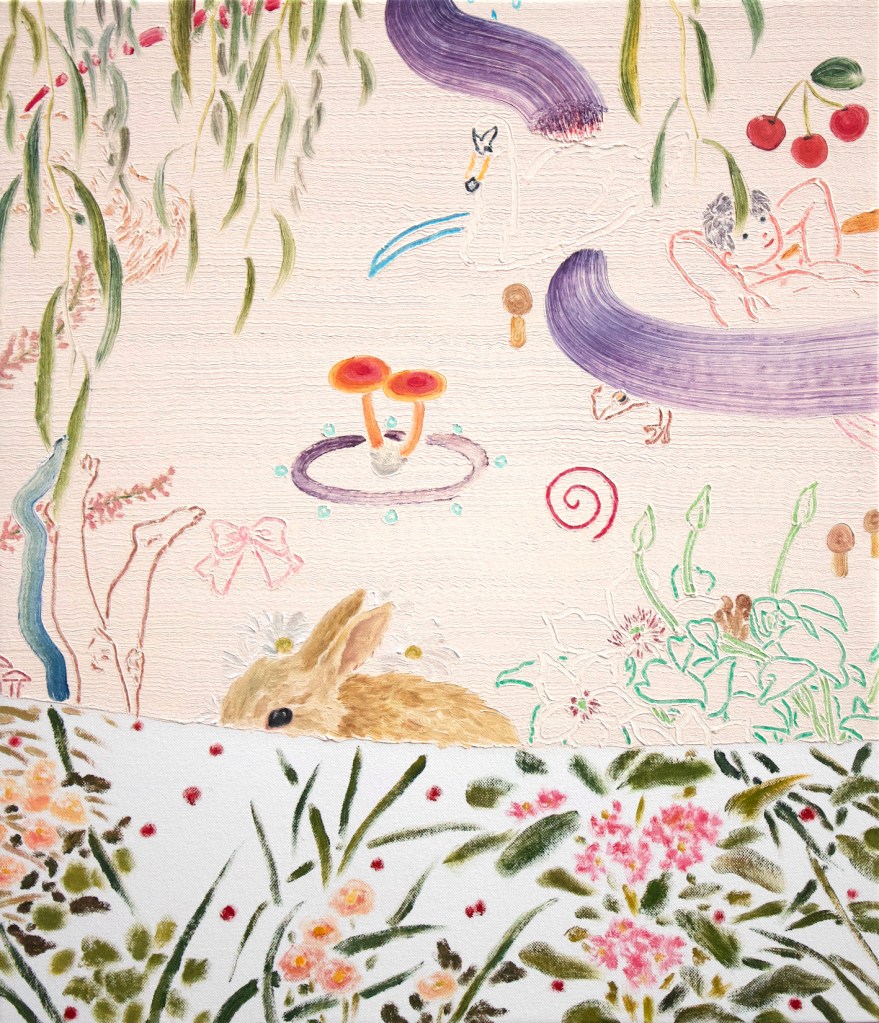
I used the technique of making a ground with thicker paint and then depicting it with oil paint and colored pencils before that layer dried, because I wanted it to blend in with the canvas. Then I tried to make it like the color of my own skin. The soft, soft, warm milky white, like in a dream, matched the theme of the work I wanted to express, so I started to use it often around 2010.
I do not use an esquisse, but rather improvise, mainly one-shot paintings. I have a time limit by painting before the milky white ground dries, so I paint in short bursts. For large canvas, I divide the milky-white ground into sections and paint them as if they were frescoes. At this time, too, I do not have an esquisse or a plan of what the painting will look like, so I proceed with my imagination for the parts that I cannot see. When I finish a painting, I always think, “This is how it came to be….”


Your work often includes multiple stories and myths interwoven through time and space. What inspires these narratives, and how do you decide which elements to include in a piece?
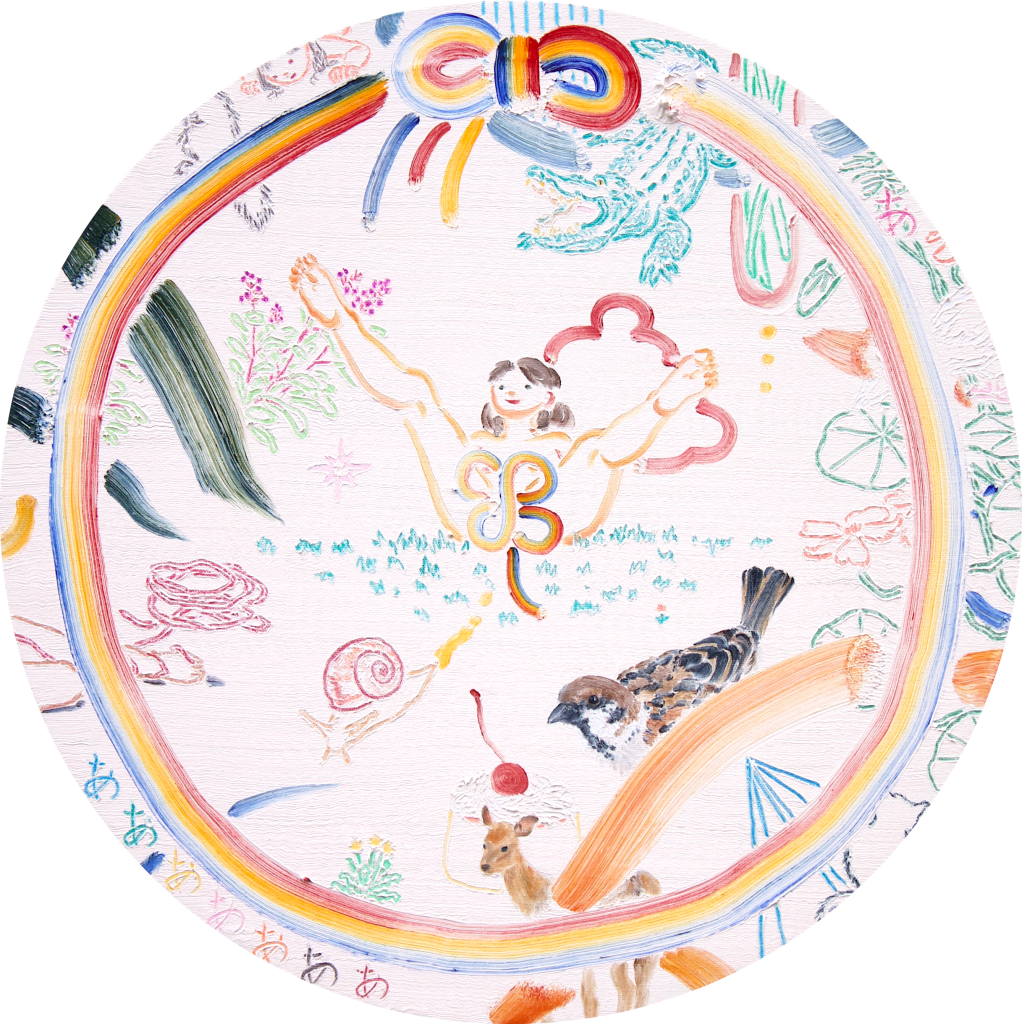
There are many different myths and beliefs in the world, and there are many similarities, different yet often appearing important motifs. I intentionally use motifs that have various meanings in diverse lands, such as snakes, apples, the sun, rabbits, etc., and at the same time, I use them without meaning.
During the period when I was working on the theme of Solomon’s Song of Songs, I painted many deer, and after meeting a homeless man who lived with a rabbit, I often used rabbits as a motif.
I create a mixture of meaningful and meaningless things, with or without a story, reality and dreams.
This is not because I want to show only a specific direction, but because I want to complete my work with a blank space, leaving room (space, scope, margin?) for imagination.
How do you see the relationship between irony, humor, and sensuality in your art?
Irony, humor, and sensuality are spread throughout my work in a mixture. I think they are unconsciously manifested from my everyday thinking.

Your paintings depict a utopia where different worlds mingle without hierarchy. How do you achieve this sense of unity and interconnectedness in your compositions?
I don’t believe in a relationship between rats and humans, such as which is superior, or that humans can control nature.
I believe that everything is necessary, that they coexist, and that there is no hierarchy.
In terms of oil painting technique, I think that by finishing the milky white ground before it dries, it naturally blends and harmonizes.
Could you describe a typical day in your workshop? What is your creative process like from concept to completion?
When creating, there is rarely any special preparation or eschewing. While mixing paints and kneading clay, I begin to create, thinking spontaneously, “What shall I make today? (When I make an animation, I think about the story to some extent and count the number of frames.)
I have to take into account the time required for the paint and clay to dry, so I think about when I will complete the work, but I don’t know what will happen at the end until I finish it.
The process of production is, I want something long and narrow, yellow here…a banana! I want something round here… a droplet! There are association games such as umbrella…rain…frog…etc., and sometimes there is a story, such as this girl is looking at this child…and this child is looking at that boy…and so on.
Kanaria’s solo exhibition, Birth, will be showcased at Zen Foto Gallery in Tokyo from July 19 to August 10. This exhibition promises to be a captivating exploration of her unique artistic vision, offering visitors an immersive experience into her creative world. Don’t miss the opportunity to witness Kanaria’s compelling work in person.



 ART HUB
Leave a reply to ysef44c461594f1 Cancel reply