

In the realm of modern art, few movements exemplify harmony, order, and conformity as vividly as geometric abstraction. Rooted in Neoplasticism, a groundbreaking art direction of the 1920s, this aesthetic was pioneered by Dutch artists Piet Mondrian and Theo van Doesburg. The core of Neoplasticism lay in the strategic use of vertical and horizontal lines, effortlessly partitioning canvases into squares and rectangles of various sizes. A minimal color palette, featuring primary hues (red, yellow, blue) and “non-colors” (black, gray, white), defined this influential movement.
These revolutionary ideas found their voice in the pages of “De Stijl” magazine, with Mondrian continually simplifying his work with each subsequent publication. His unwavering goal was to eliminate all representational forms, forsaking figurative art and decorative elements.
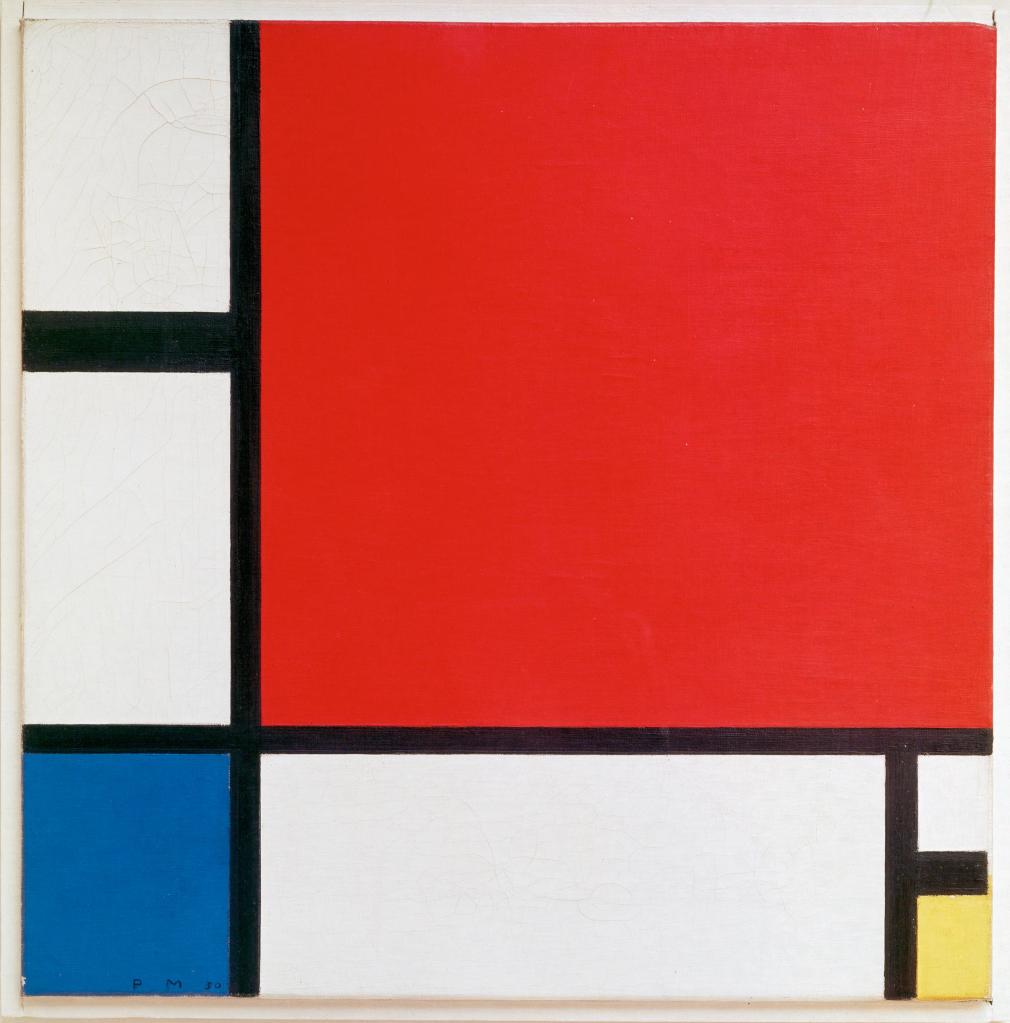
Mondrian’s “Composition with Red, Blue and Yellow”: A Neoplastic Masterpiece
In 1930, Mondrian unveiled his iconic “Composition with Red, Blue and Yellow.” This artwork marked a seismic shift in abstract art by introducing geometric precision into abstraction. Influenced by Cubism, Mondrian’s creation featured distinct geometric divisions—white background, intersecting black lines, and a limited palette of three colors. This composition drew inspiration from the Theosophical system, which emphasized harmony emerging from opposing forces—active and passive, vertical and horizontal—uniting these opposites under the banner of harmony.
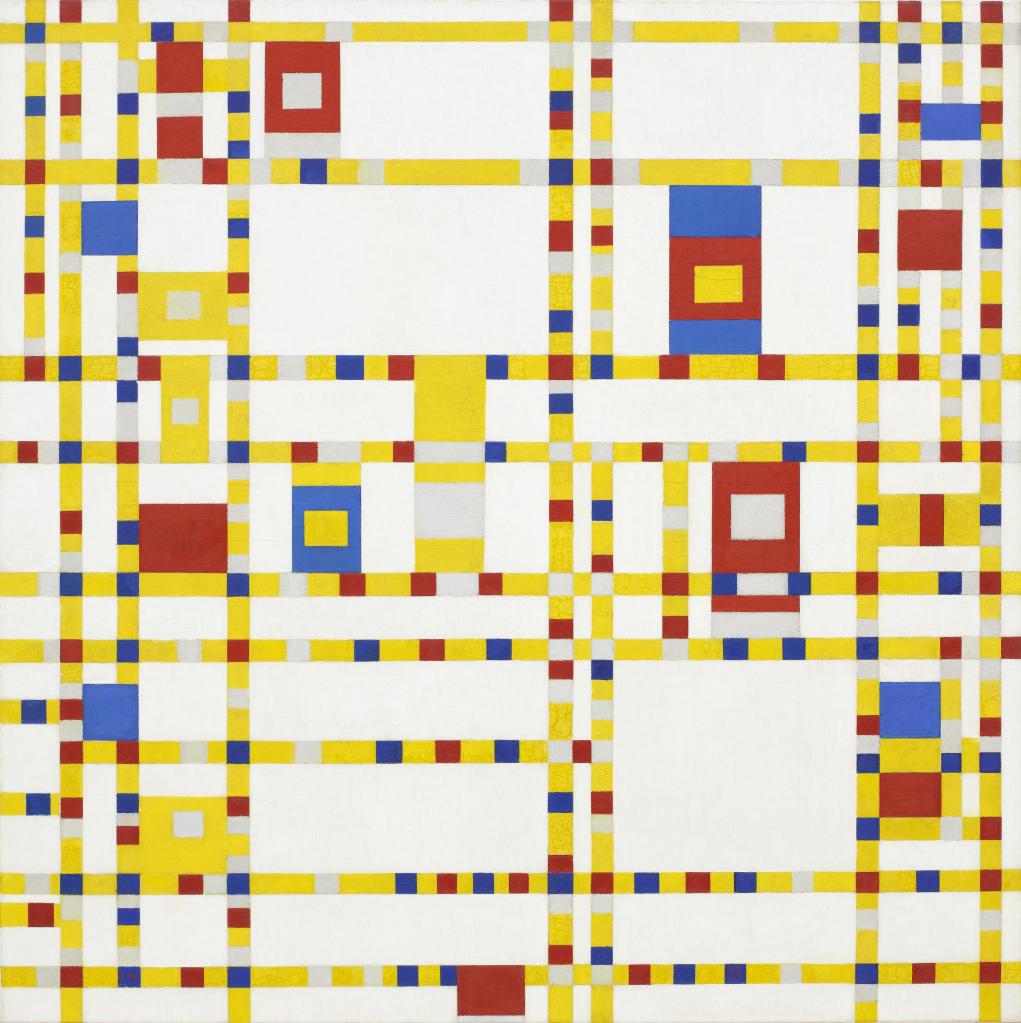
“Broadway Boogie Woogie”: A Glimpse into Mondrian’s American Rhythm
Mondrian’s later masterpiece, “Broadway Boogie Woogie,” emerged as an ode to the lively tempo of New York City. This phase of his work reflected the pulse of the city’s streets and American music, particularly the blues. Gone were the black lines, replaced by yellow stripes composed of colored rectangles, echoing the rhythmic grid of Manhattan’s streets, bustling yellow cabs, and twinkling street lights.
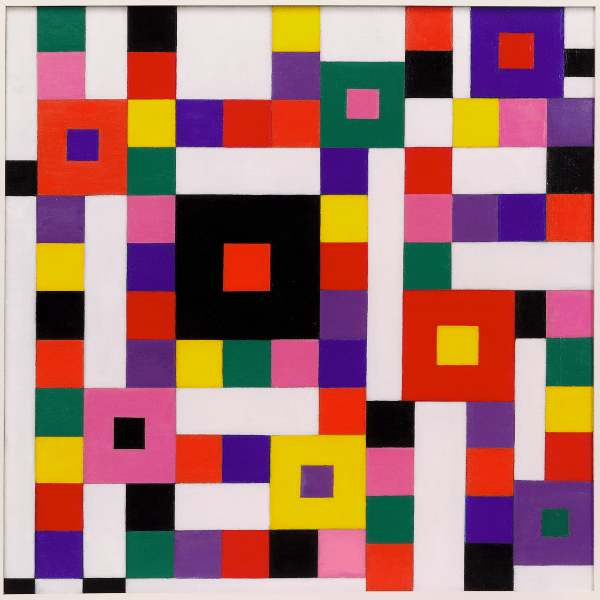
Charmiona von Wiegand: A Neoplastic Disciple with a Spiritual Twist
Charmiona von Wiegand, a devotee of physical beauty and spirituality, had the privilege of befriending Mondrian during his exile in the United States. Influenced by Mondrian, she embarked on her journey into abstract art. While she adhered to the Neoplastic straight lines and tape technique, her compositions possessed greater freedom, symmetry, and a broader color palette. Over time, she delved deeper into Eastern religion and culture, infusing her art with Indian, Egyptian, and Chinese influences, adorning her works with intricate symbols.
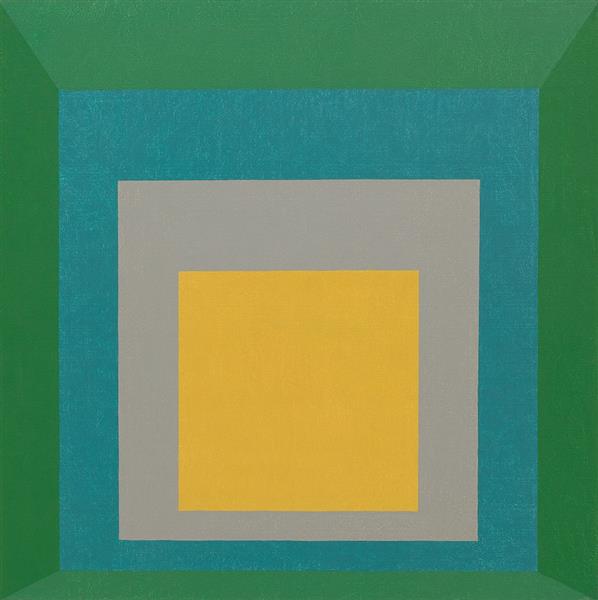
Josef Albers: Master of Color Exploration at the Bauhaus
The Bauhaus, a hub of artistic innovation, produced Josef Albers, an artist deeply enamored with color. His meticulous records of color numbers and manufacturers on the backs of his works attest to his fascination. Albers’ most renowned series, “Homage to the Square,” featured squares of varying sizes layered with three or four color planes. This exploration allowed him to dissect the interplay of colors with each layer, all set against a backdrop of cool, pure colors. Albers’ series became a captivating exploration of color’s role in achieving three-dimensionality within abstract art.
In conclusion, the world of geometric abstraction offers a spectrum of interpretations, even within the confines of Neoplasticism. Mondrian sought maximal simplification and elimination of object forms, von Wiegand aimed to infuse spirituality into abstraction, while Albers dedicated himself to the intricate dance of colors. Their distinctive works demonstrate the boundless potential of geometric abstraction, united by a foundation of educated order and harmony.



 ART HUB
Leave a comment