
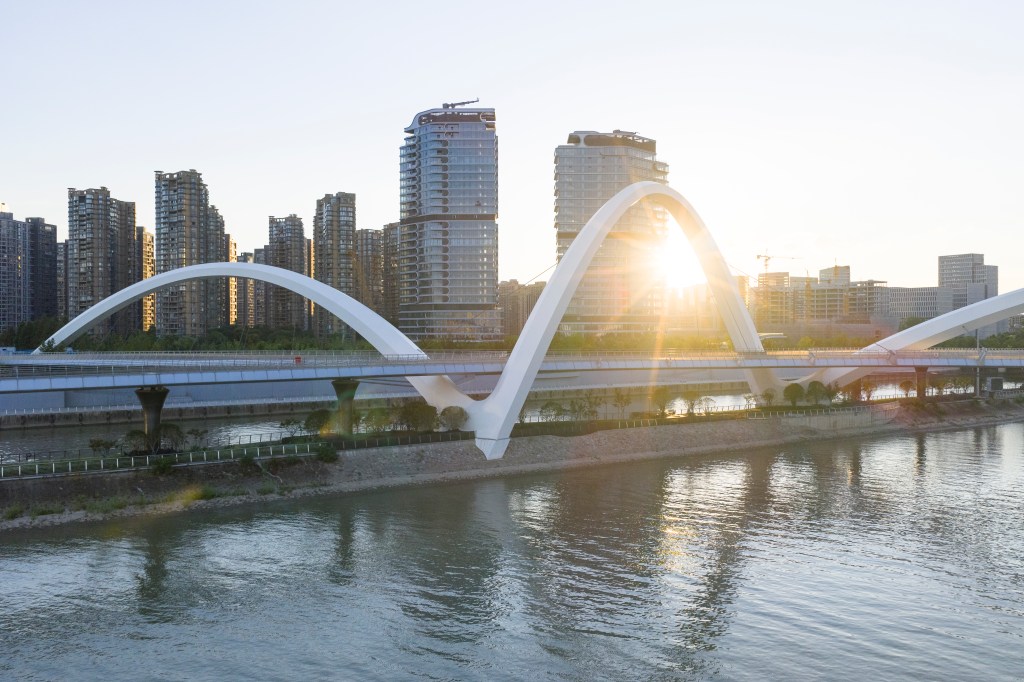
UK-based Zaha Hadid Architects has revealed their latest architectural marvel: the Grand Canal Gateway Bridge, a gracefully curving footbridge in Hangzhou, China. The bridge is designed to weave around a trio of striking white arches, forming the centerpiece of the Seamless City masterplan, which integrates a park, housing, and civic and commercial districts.

Drawing inspiration from Hangzhou’s centuries-long history of silk embroidery, the design incorporates a sinuous structural system that intertwines and overlaps, creating both an aesthetic statement and structural support. Two curved pathways form the pedestrian and cyclist walkways, bending over a central concrete island that divides the canal’s north and south waterways. At the midpoint, the paths extend perpendicularly to two viewing piers, offering multiple vantage points to observe the Qiantang River and its famous Silver Dragon tidal bore.


“Balancing ecological sensitivity with civic ambition, the bridge allows visitors to safely experience the raw power and spectacle of nature,” Zaha Hadid Architects explained. The design emphasizes interaction with the environment, creating a bridge that is as much a viewing platform as it is a crossing.
Construction utilized prefabricated modular elements to minimize disruption to canal traffic and reduce build time. The bridge is set to open to the public later this year, providing both a functional connection and a visual landmark within Hangzhou’s urban landscape.

The Grand Canal Gateway Bridge adds to Zaha Hadid Architects’ impressive portfolio of ambitious infrastructure projects, which includes the Danjiang Bridge in Taiwan, poised to become the world’s longest single-tower, cable-stayed bridge, and a dual-arch bridge in Chengdu for vehicles and pedestrians. Photography for the project was captured by Xue Liang.

With its combination of structural ingenuity, cultural homage, and ecological awareness, the Grand Canal Gateway Bridge represents a striking example of how contemporary architecture can merge heritage, functionality, and artistry.

 ART HUB
Leave a comment