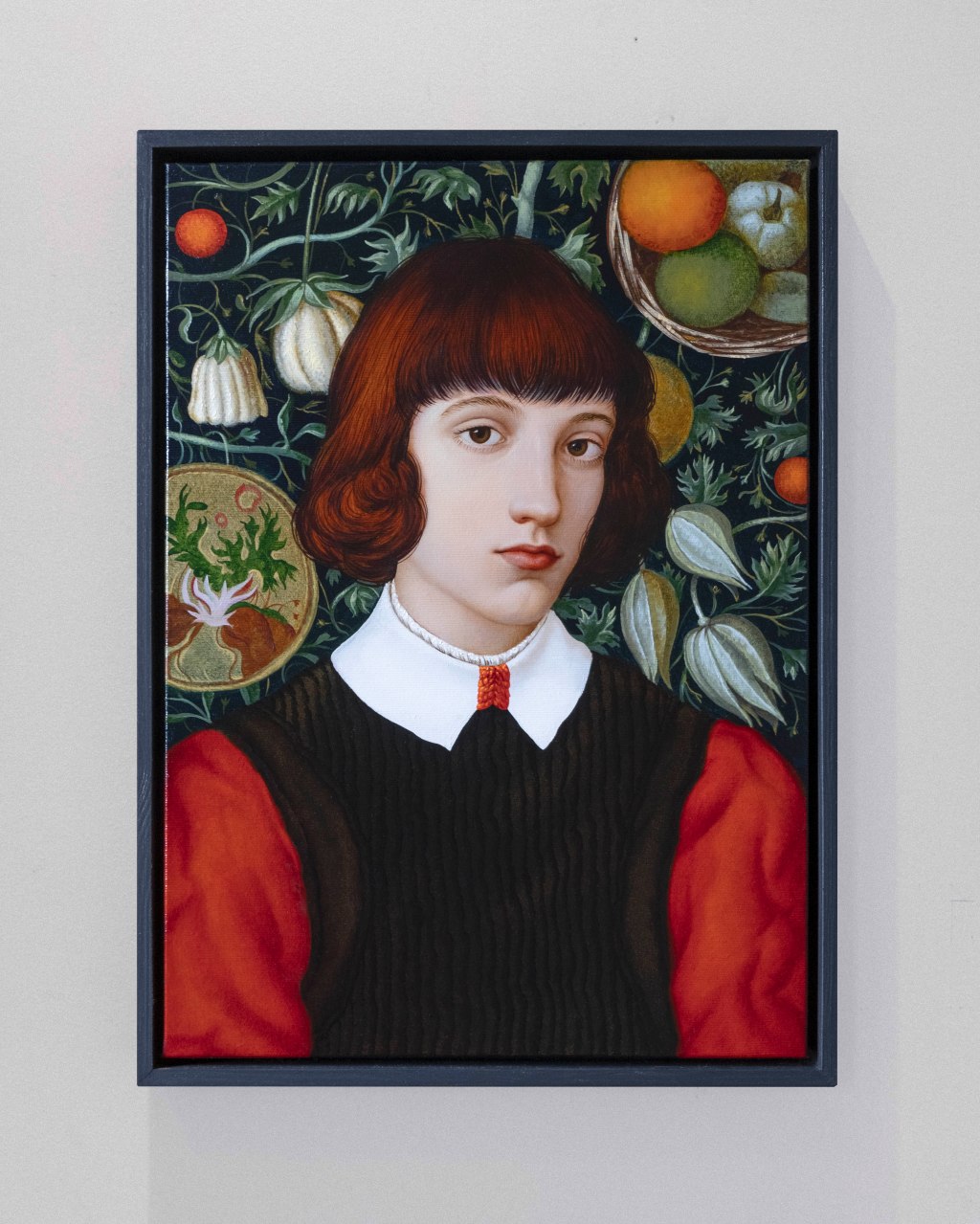
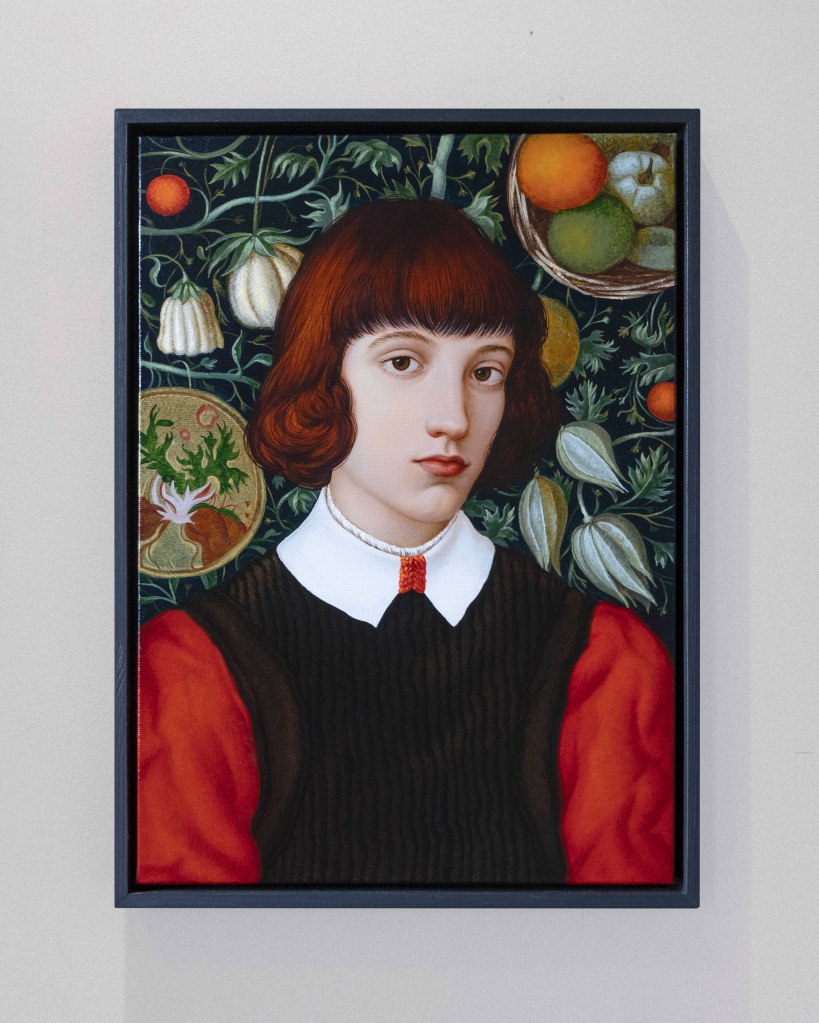
Elen Bezhen is a painter working in the genre of figurative art. Her work focuses on the relationship between nature and humanity, with a particular emphasis on the feminine image. Elen was born in the North Caucasus, where her fascination with nature emerged and developed through the careful study of botany and entomology. She later moved to Moscow, where she received a classical art education at the Academy of Fine Arts. Her desire to explore a contemporary artistic language led her to study contemporary art at the Rodchenko Moscow School of Photography and Multimedia.
Elen’s admiration for the old masters, particularly the painters of the Northern Renaissance, has profoundly influenced her artistic approach. Drawing inspiration from their techniques and methods, she adapted and integrated them into her own practice, creating a unique style where tradition and modernity seamlessly converge. Over time, these techniques evolved and became an essential part of her work, enriching her paintings with texture, depth, and vibrancy. Currently, Elen Bezhen lives and works in Grenoble, France, where she continues to explore and refine her artistic expression.

1. Your paintings beautifully merge the natural world with feminine figures. What draws you to this intersection, and how has it shaped your artistic vision?
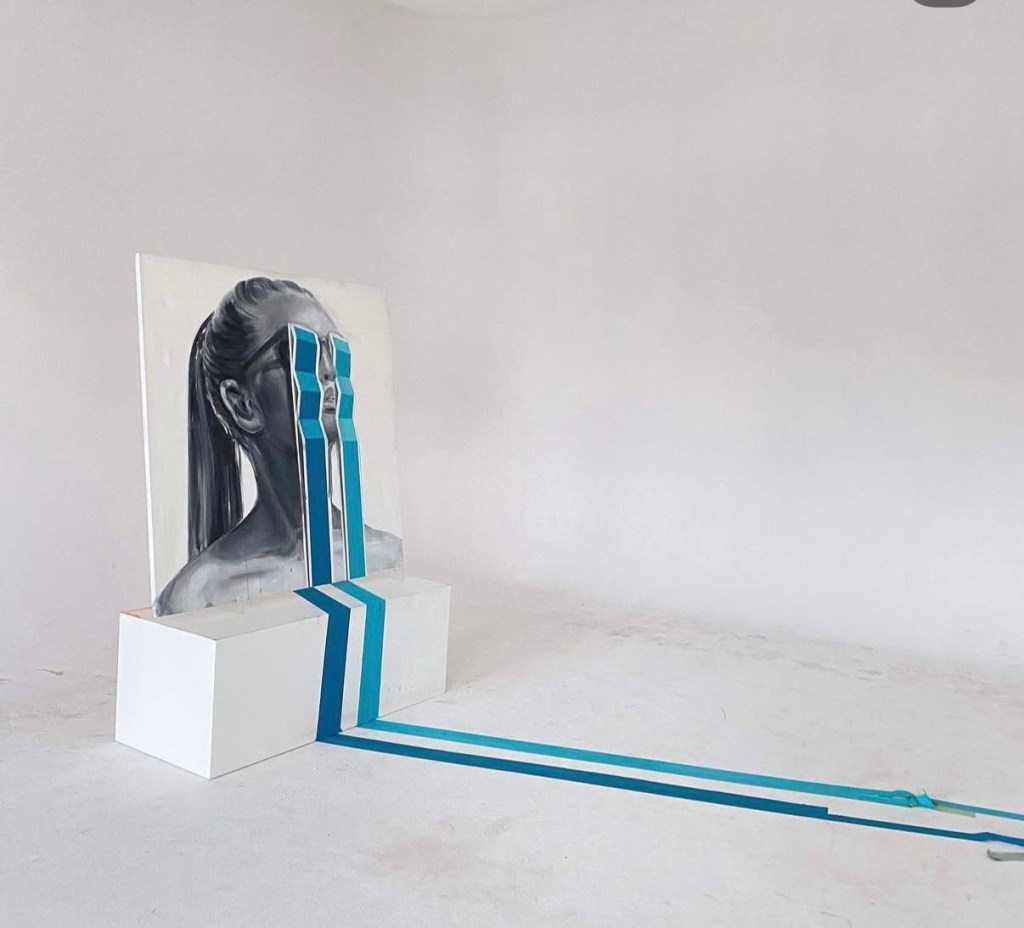
First and foremost, all of my female portraits are veiled self-portraits. I use my own image as a tool to explore themes that matter to me, and through this lens, I portray others. This approach allows me to connect the personal with the universal. Nature, as my primary source of inspiration, naturally becomes an equal participant in this dialogue. It is important for me to show how humans and nature are in constant interaction — reflecting, projecting, and transforming one another. This intersection shapes my artistic vision, where the female figure and the organic world merge into a unified image of fragility, strength, and transformation.
2. You’ve studied both classical painting and contemporary art. How do these two traditions interact in your creative process?
My artistic education began with a classical school in Russia, where I studied painting and restoration, copying the old masters. This gave me a solid technical foundation and a deep respect for the tradition of painting. Later, when I encountered contemporary art, I realized that classical form can carry highly relevant and personal meanings. Contemporary art gave me freedom of thought, an interest in conceptual approaches, and an awareness of context. I strive to make classical technique serve a contemporary idea — so that form and content do not contradict but reinforce one another. For example, I might paint a botanical study in the style of the old masters, yet embed within it a reflection on genetic modification or the Anthropocene. To me, these are not opposites, but two languages that can be incredibly powerful when combined.

3. How did your early studies in botany and entomology influence the way you observe and depict nature in your work?
The study of entomology and botany has had a significant impact on my perception and depiction of nature in art. These sciences taught me to observe plants and insects with a detailed and attentive approach, which helped cultivate an awareness of the subtle interconnections between living beings in the natural world.
4. The influence of Northern Renaissance painters is evident in your technique. What aspects of their practice do you find most inspiring, and how have you adapted them to a modern context?
I’m inspired by the Northern Renaissance artists’ attention to detail, their refined treatment of form, and their use of symbolism. I feel a deep connection to their ability to imbue everyday objects with profound meaning. What resonates with me most is their capacity to merge the real with the metaphysical — where every insect, plant, or interior object carries significance that goes beyond the visible. I’m especially drawn to how they elevate simple, ordinary forms to a level of the sacred. I adapt this approach by using classical techniques to depict fictional, hybrid forms — for instance, plants that don’t exist but seem familiar. I create an illusion of documentary precision, so that the viewer might briefly believe they’re looking at a real botanical study. This allows me to speak about contemporary realities — human intervention in nature, artificiality, and the elusive boundary between the natural and the constructed — through the visual language of the old masters.
5. Nature in your work often feels spiritual or symbolic. Do you approach it more as a subject, a metaphor, or a character in itself?
For me, nature is more of an autonomous character. I don’t simply depict it as an object or a backdrop, but try to convey its inner life, sensitivity, and mutability. In my works, nature becomes a vessel of memory, a trace of human impact, and at times — a metaphor for both fragility and resilience.
6. Has relocating from Moscow to Grenoble affected the way you work or the themes you’re currently exploring?
Moving from Moscow to Grenoble didn’t change the themes I work with — they remain rooted in nature, ecology, and the human experience. But it did shift my approach to the practice itself: I began to treat my work with greater seriousness and responsibility, paying closer attention to materials and the organization of the creative process. Living in another country gave me the discipline and focus I needed to develop my artistic language more deeply.

7. Your work feels deeply meditative and textural. Can you talk about your process — from initial concept to final brushstroke?
My process begins with observation and reflection — I capture images that emerge at the intersection of memory, scientific illustration, and personal experience. Sometimes I make sketches or collect visual references, but more often I work intuitively, guided by an internal image. This is followed by a lengthy painting stage. I use a multilayered technique, where each layer represents not only color and form, but also time, which becomes absorbed into the work. It’s important for me to convey a sense of density, stillness — almost a breath — in the surface of the canvas. For example, in my portraits I begin with a grisaille underpainting, followed by numerous translucent glazes. I mostly work with semi-transparent paints, allowing each layer to reveal glimpses of the one beneath. This technique enables me to achieve unique visual effects that cannot be replicated with alla prima painting.
8. What do you hope viewers take away from your work, especially in terms of how we relate to both femininity and the natural world today?
I would like viewers to take away a sense of the delicate connection between vulnerability and strength — both in nature and in the image of femininity. My works don’t offer direct answers, but instead invite contemplation and reconsideration: what do we consider “natural,” how do we look at the female body, at plants, at ecology. I hope that within these images, the viewer will see not only beauty, but also traces of intervention, care, and loss — and reflect on their own relationship with the world around them.

 ART HUB
Leave a comment