
The exhibition “Breaking the Silence” curated by Dina Danilovich has opened at the National Center for Contemporary Arts (hereinafter NCSM) in Minsk. Danilovich is known not only for her conceptual exhibition projects, such as “Chernobyl. Sleeper Effect” and “Anatomia”, but also as a photographer. Soon after, she launched a new exhibition project at the branch of the National Centre for Contemporary Arts on Nekrasova Street — a project significant not only for its theme, which may seem banal at first glance, “a conceptual statement on communication: how it emerges, manifests, endures, fades, and ends. Here, art serves as a tool and language of interaction, an intermediary and a medium,” but also for its introduction of new, lesser-known artists into the art scene, such as David Berezin and Veronika Chenkus, alongside already established figures like Igor Savchenko, Vadim Kachan, and Alexander Nekrashevich.
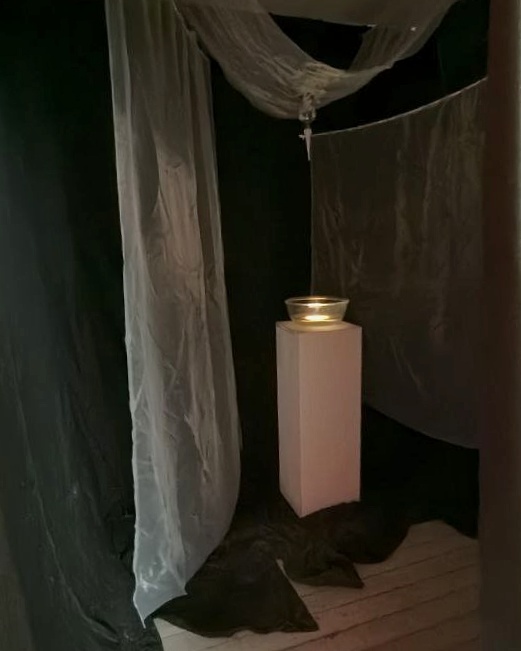

The building of the center is divided into two floors with many halls. The layout allows each hall to have its own character, with its own light, color, mood, and the weight or lightness of the objects. It is one of those instances where the theme of communication is revealed from various angles and in full, especially with the introduction of new voices in the culture. The exhibition includes video art, photography (which plays a central role), installation, painting, and—what I find particularly exciting—glass. Alexander Truskovsky, a Minsk-based artist who graduated from the BGAI Department of Monumental-Decorative Art, was given an entire hall for his works. Black walls and floor covered with shards of glass, resembling a carpet, and an artificial ceiling of torn fabric with pieces of glass suspended from it. The theatricality, spatial experience, and the viewer as part of the exhibition were central to this hall. Truskovsky was not the only artist whose glassworks were included in the exhibition. Alina Darmel, a new name, created an installation in the spirit of the NCSM (i.e., creating a spatial experience in 2m²) using glass, organza, iron, and a bowl of water. Unfortunately, the description doesn’t clarify much, but it’s very intriguing.


The next hall pulls you in like a whirlwind. The “concrete” wall of slate titled „The Holiday of Solitude” by Ilya Kozak stands at the center, chairs positioned so that one can only sit facing the wall, yet there’s no space for your feet, and you can’t talk to the person opposite to you—only to those beside you. The wall can be interpreted in different ways, but I choose to view it as a representation of a family gathering. I would define this work not only as an installation but as public art, an intervention. It would look great in a contemporary art museum collection and would speak for itself without any exhibition context. Around the perimeter of the hall are works from 1989-1994 by the conceptual photographer Igor Savchenko, who is represented by Liza Fetissova Gallery in Paris.

The monumentality of some of the works in the exhibition plays a significant role in the design of the exhibition. For example, the sculptures on red cushions by artist Olga Orsik, who explores form and volume, express her personal experiences and perceptions of nature, creating a similar effect to the wall. All the halls, thanks to such decisions, form a composition that allows one to “read” the rhythm, balance, and communication between them.
The monumentality of some of the works in the exhibition plays a significant role in the design of the exhibition. For example, the sculptures on red cushions by artist Olga Orsik, who explores form and volume, express her personal experiences and perceptions of nature, creating a similar effect to the wall. All the halls, thanks to such decisions, form a composition that allows one to “read” the rhythm, balance, and communication between them.
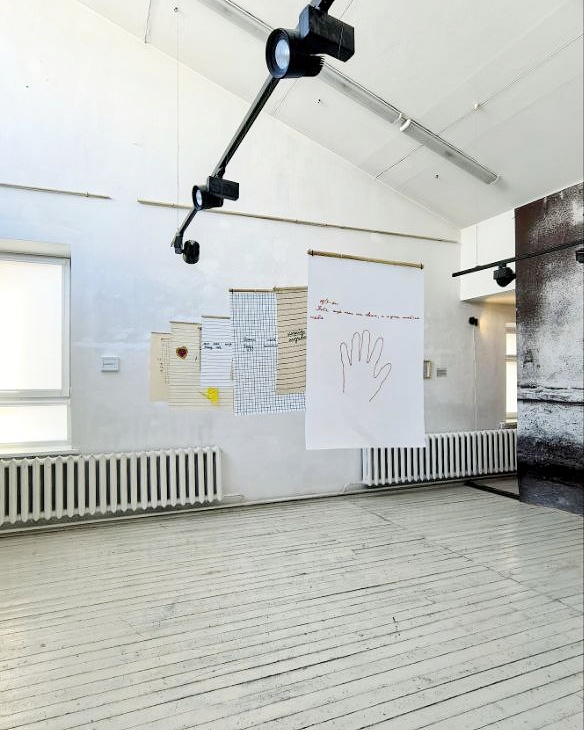

The neighboring room delights with a young, previously unknown artist. On the Belarusian art scene, there are now “hafters,” as the artist herself calls them—embroidered letters. She could be compared to Monika Drożyńska or Bettina Beres, but Elizaveta Rudometova works with the anthropology of memory:
“From city to city, from country to country, I traveled with an important thing in my life, a bright orange bag that gradually filled with envelopes and postcards. It contained all my letters from friends and relatives.”
Her works are sincere and sentimental, and in the times we live in, it is important to feel, show, and preserve not only memories but also craft traditions.

The exhibition features not only long-known photographers such as Igor Savchenko and Vadim Kachan, but also new pseudonyms. In one of the halls, photographs and diary entries by photographer Cottonyevil are displayed on a pink wall. In the next hall, also created in the spirit of the NCSM, is the installation by Alice.in.fotoland, which uses an “aquarium” with soil and an ancient plant species (a plum tree) planted in it as a “frame” for photographs:
“When the plant reaches its maximum size, it dies, giving way to a new cycle of development”.

“Breaking the Silence” is not only about the philosophy of communication but also about the existing communication between artist and artist, between artist and viewer, and about the tradition of communication, such as the one practiced by photographer Alexander Obukhovich:
“Every year, on a certain day, for many years, there was a tradition to have a photo session, and this tradition was disrupted by the frequent phenomenon in recent years—emigration of one of the relatives, friends, colleagues, lovers—each in their own way”, – which is why it is important to talk about such exhibitions, share them, and make them visible.

 ART HUB
Leave a comment