

Polish artistic textile is a field of art that owes a great deal to women. It was female artists who reinterpreted its shape and form, moving beyond tapestries that depicted reality with painterly precision. Textiles often transcended frames, came down from walls, and became independent works of art, where functionality was no longer the primary characteristic.
Jolanta Owidzka, an artist who began her artistic education in Kraków and completed it at the Academy of Fine Arts in Warsaw, created functional textiles closely linked to architecture. She collaborated with Zofia and Oskar Hansen, who are considered among the most important architects of Polish modernism. A significant moment in her career was her participation in the First International Biennial of Contemporary Textile Art in Lausanne in 1962. Poland was represented by artists associated with the Warsaw Academy of Fine Arts, including Magdalena Abakanowicz. The works presented there were extremely innovative, standing in stark contrast to French pieces, which were dominated by realism. This movement became known as the “Polish school of textile art.” What distinguished Polish textiles on the international stage? Primarily, the approach to the subject. The creator was not just a craftsman but, above all, an artist. Mastery of craftsmanship and technique allowed for greater interpretative freedom. The materials used were also unusual, including sisal, sheep’s wool, ropes, and cords. This was partly due to the realities of communist Poland, where access to other materials was limited. Owidzka particularly enjoyed creating textiles for interiors, paying special attention to the space in which they were to be placed. She balanced on the fine line between functional and artistic textiles, a distinction that was often unfairly made. Her works are timeless, imbued with great care and effort—she even dyed the fibers herself. She held numerous exhibitions, including one at Warsaw’s Zachęta Gallery. She collaborated with the airline “LOT” and participated in the São Paulo Biennial of Contemporary Art. Her works reached New York, Paris, Berlin, and Chicago. One of her most famous pieces, created in 1975, was Biele, a textile made specifically for the Victoria Hotel in Warsaw. It measured nearly twenty meters but was unfortunately destroyed.
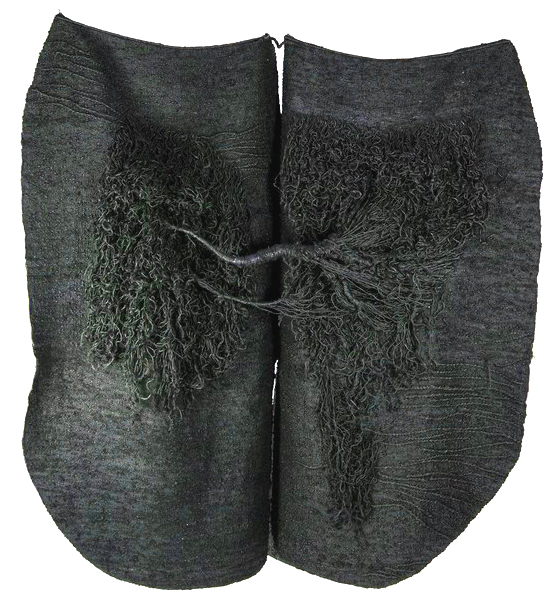
At the same São Paulo Biennial, Magdalena Abakanowicz won a gold medal for her work Composition of White Forms. This was not yet a fully spatial textile, but the raised, relief-like elements foreshadowed her future artistic direction. Her most famous three-dimensional woven forms are Abakans, named after her own surname. These are large-scale works characterized by organic shapes, made from sisal, which she dyed herself.
A notable example is January – February(1972), which resembles human lungs and their surrounding venous structures. She created unique, original forms that became her signature style, bringing her immense fame. Abakans were exhibited in cities like Chicago and New York, and in 2022, they were displayed at the Tate Modern in London. In the 1970s, Abakanowicz no longer wanted to be associated solely with textile art. She began creating spatial works using jute sacks, ropes, and wood. Her themes also evolved—she explored war trauma, life under a totalitarian regime, and motherhood, as seen in her Embryology and Pregnant series.
The two artists knew each other personally and started their education at the same institution, but they took different career paths. Jolanta Owidzka created two-dimensional textiles designed for interiors, preferring this over exhibitions. Her works were linked to architecture and had functional textile characteristics. In contrast, Abakanowicz created three-dimensional, spatial works. Despite these differences, both women made a significant contribution to the development of Polish artistic textiles. It is also worth noting that during the communist era, this art form was not subjected to the strict censorship imposed on painting and sculpture, which undoubtedly influenced the forms created at the time. Additionally, in the 1960s, Polish artistic textiles gained international recognition and continue to inspire artists worldwide.
Image sources:
- Jolanta Owidzka, Biele, https://www.vogue.pl/a/dziela-polskiej-artystki-jolanty-owidzkiej-wykonane-z-tkanin
- Magdalena Abakanowicz, January – February, https://mnwr.pl/wp-content/uploads/2020/03/abakany.jpg
- Magdalena Abakanowicz, Pregnant, https://www.moma.org/collection/works/81370

 ART HUB
Leave a comment