

In the 1920s Friedrich Murnau, a representative of German cinematic expressionism, attempted to film a classic of gothic horror literature. A distinct vision of a screen adaptation of Bram Stoker’s Dracula loomed in his mind and he could not wait patiently for all the legal issues to be signed. Convinced that acquiring the rights to the original was merely a formality, he began working on his creation.
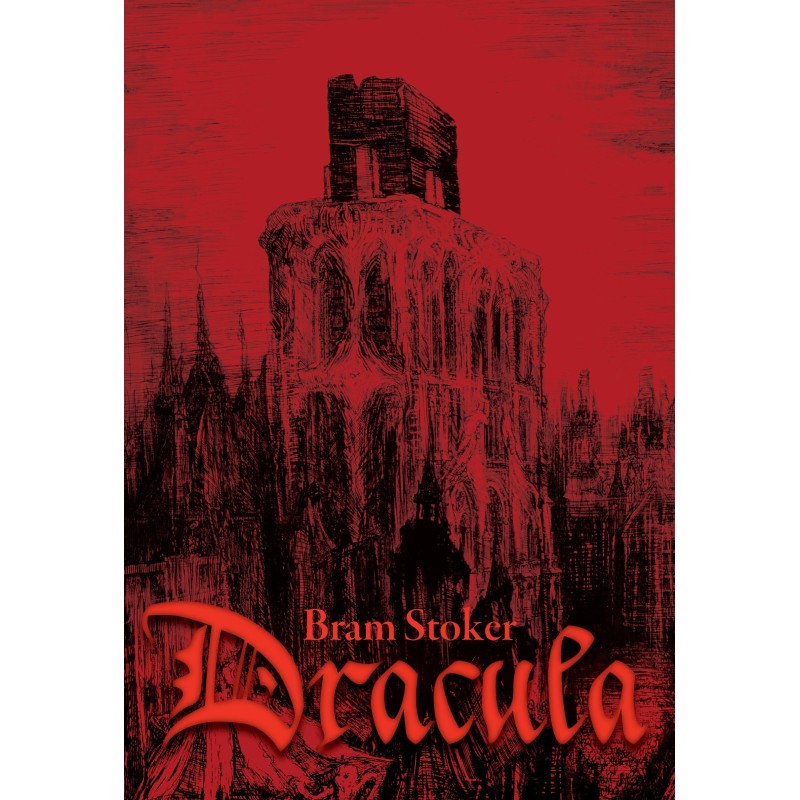
As if out of spite, the rights holders broke off talks and refused to lend the license. Murnau was left with an almost finished film that he could not legally release. Desperate, feeling that he held his masterpiece in his hands, he decided to put everything on the line. He changed the locations and names of the characters. It wasn’t a problem, since in the days of silent films all it took was to change the credits. Another advantage was that the look of the titular vampire in the director’s vision differed significantly from the original description. This way Dracula was transformed into Nosferatu.
The film turned out to be a huge hit. However, despite the changes, Friedrich’s work was a very faithful adaptation. It was not difficult to point out plagiarism, and the rights holders easily won a lawsuit against Murnau. The result was the removal of the film and the destruction of copies. We were close to losing the opportunity to experience the work in any form.
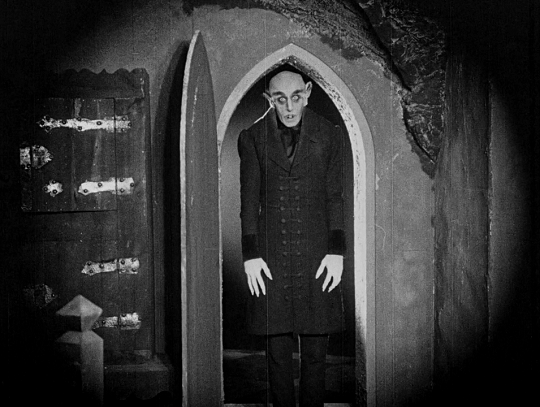
Fortunately, several copies survived and we, today, can enjoy the original Nosferatu. A film that made history and changed the face of cinema.
Today we talk about this vampire as an iconic cinematic character, but also as a “variant” of the screen adaptation of Dracula. This resulted in the creation of successive versions of Nosferatu. Although they show the same story each is different and shows the style and spirit of the times as well as sensibility of the artist behind it. I will focus on these differences below, highlighting how the artist’s vision affects the presentations of the story.
F.W. Murnau’s Nosferatu: A Symphony of Horror
A film which story I mentioned above. A work that, while being a plagiarism, became one of the best screen adaptations of Dracula and gave birth to one of cinema’s most iconic characters.
Murnau was, as I pointed out above, a representative of German Expressionism in cinema. It’s a trend that has had a remarkable impact on how movies are made today. And it is Nosferatu that is, arguably, this movement’s most prominent representative.
This film outlined and showed how important scenery and lighting can be in storytelling.
Surroundings, sets and locations in the film are full-fledged characters working together to build atmosphere and tell the story. The director uses light to build horror and tension. It is composed to create strong shadows and “draw” silhouettes out of the darkness. Many of those tricks are still used today with unchanged effect. Thus, the artists behind the production show how lighting can shape the perception of the images seen in the frame.

The biggest difference from the novel is the image of the titular Count Orlok. He is not, the stoic aristocrat as described in the book. Murnau’s vision shows an inhuman and hideous monstrosity resembling in its features a rat.
A tall, unnaturally lean figure, strangely rigid movements, hands ending with long claws, bulging eyes, a skull-like head and an elongated face in a perpetual, shiver-arousing grimace. These are traits that characterize this vampire. The director abandoned the human element of the character in favor of a dehumanized creature.

Murnau’s version stands out for its atmosphere. The whole film is kept in a strongly gothic aesthetic. The visuals are full of dark and gloomy elements emphasized by disturbing music. The artist uses the barely visible silhouette of the figure in the dark corridors and alleys to build fear. The atmosphere is so intense that you can cut it with a knife and the horror pours out of the screen.

Werner Herzog’s Nosferatu the Vampyre
In 1979 a new version: Nosferatu the Vampyre, directed by Werner Herzog, was made. At the time of the film’s creation, Stoker’s book had entered the public domain, which the director benefited from. The names of the characters return to those of the books, and Nosferatu is now Count Dracula.
The first thing that strikes you during the screening is the different style. You won’t find a gloomy gothic atmosphere here, instead the German director has struck a tone more associated with the Romantic era. It’s full of pastel colors highlighting landscapes and flat frames. The composition of many shots mimics classical paintings. The whole is meant to reflect the era not only through costumes and scenery, but also through the way it presents them.
The character of the Count is influenced in the same way. In this version he is portrayed more humanely, his apparel, although still grotesque, in proportions resembles a real person more. The same applies to his personality. Herzog has humanized Nosferatu. He is, here, a tragic figure, rejected by our world, filled with melancholy and sadness. Many scenes as well as Orlok’s behavior indicate his longing for love, closeness and understanding.
The version from 79′ shows how, despite the enormous fidelity of the transfer of the story, it can still be portrayed dramatically differently. The author approaches the tale of the vampire from a much more empathetic side. However, in doing so, he loses the unusual, dark atmosphere of the original.
Robert Eggers’ Nosferatu
The latest incarnation, which we can recently see in theaters, is the work of Robert Eggers. The young director has captured the hearts of horror fans around the world. All thanks to his unique style, which imitates old, classic horror films from the era of black and white cinema. However, he weaves in contemporary treatments and adds a unique spice to the images. As a result, he perfectly captures the spirit of the times of his stories and creates films with an unusual dense atmosphere.
So he seemed like the perfect candidate for modernizing the vampire story while preserving the classic aesthetics. It probably won’t come as a big surprise when I say that he lived up to expectations.
Eggers pays homage to the original. The director is not ashamed of his plagiaristic roots and returns to the naming from the 1922 film. The entire film draws handfuls from the aesthetics of the initial picture and also returns to the heavy, gothic and gloomy aesthetics. As in Murnau’s film, each frame is built to build horror on its own.
The character of Nosferatu itself differs on a visual level. Eggers maintains recognizable elements: a tall, slim figure, pale skin and long claws. The vampire, however, is more reminiscent of a 15th-century nobleman in appearance. Both in terms of facial features and clothing.
Despite the enormous faithfulness, the director modernizes the story and adds something from himself on the plot level. It can be said that in a way Eggers combines the characteristics of the vampire from the two previous incarnations. This version shows Nosferatu as a kind of curse. Count Orlok is a sullen, dehumanized persona devoid of positive human feelings. He is the personification of evil and death. Behind this, however, the theme of the need for intimacy continues. Nosferatu is here a symbol of temptation, the desire for betrayal in a relationship. He is an image of forbidden passion. This fits perfectly with the story of Ellen Hutter, whose husband, Thomas, leaves on business assignment. Despite the people around her, the woman is alone with her problems. It is this suppressed longing that summons the vampire from his crypt.



 ART HUB
Leave a comment