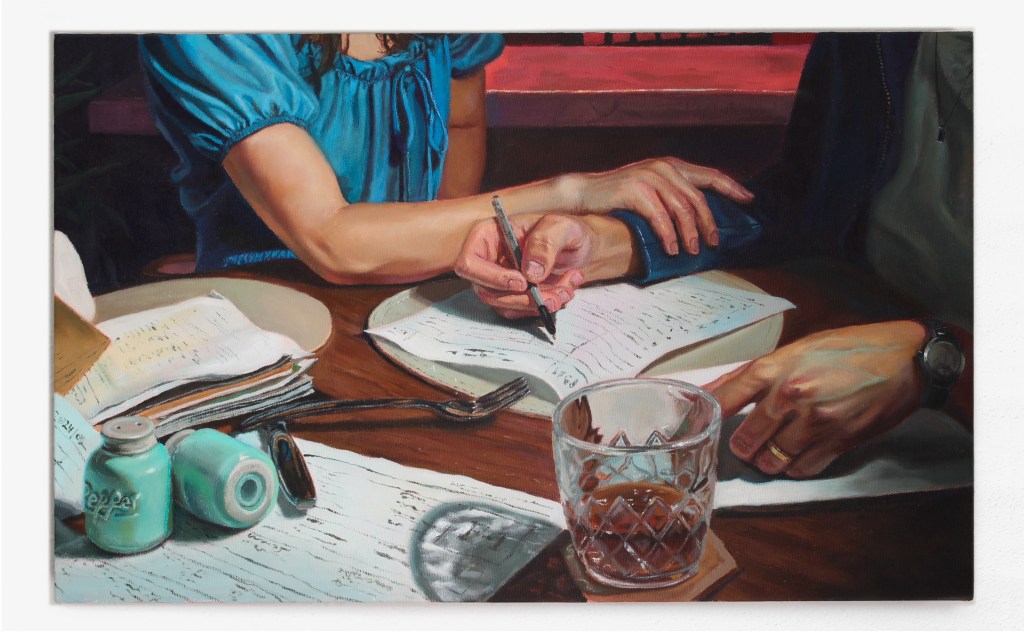
Owen Rival is an artist from Toronto, Canada and earned his BFA in Illustration at the Rhode Island School of Design in 2021. Owen Rival is an artist whose work balances between realism and surrealism, combining the everyday with introspective visions. Owen Rival stands out for his exceptional ability to capture human emotionality and the depth of experience. His works are not just aesthetic compositions, but also stories that resonate with the audience on many levels. Although he started his artistic journey relatively late, his determination and attention to technique allowed him to quickly gain recognition. I invite you to explore what Owen’s artistic journey looks like, where he draws his inspiration from, the emotions and mysteries hidden in his paintings, and his approach to painting as a tool for communication – both with himself and with the viewer.
What do your daily rituals look like – how does your day unfold, especially when you’re working on a new painting?
Great question. I have a pretty established routine. I usually wake up quite early, around 6 a.m. I make myself breakfast and do a few stretching exercises. It’s important for me because I spend most of the day sitting. If I haven’t started a new painting yet, I dedicate time to sketching and developing ideas. Once I have my paintings planned out, I usually dive straight into work. If I’m in the sketching phase, I start with a short warm-up – recently, I’ve been practicing anatomy and figure drawing to keep my hand fluid and get into the rhythm of work.
At the beginning of the painting process, I do miniatures – small sketches with basic compositions. When I find something I like, I either take or look for reference photos that help me set up the final composition. Then, I create the final drawing, which serves as a foundation for the painting. I transfer it onto the canvas and begin painting. I try to have a clear vision of how the painting should look from the very beginning – painting takes a lot of time, so I prefer to know exactly what I’m getting myself into.

You seem very aware of what you’re creating and how you plan your work. I’d like to ask, when did your journey with art begin? When did you start painting?
Surprisingly, quite late. I only became interested in art in the penultimate year of high school, in 11th grade. In 12th grade, I became fully immersed in it and quickly put together a portfolio for art school – it took me about three or four months. I was so determined that I was drawing and painting almost constantly. When I started university, I quickly realized I was a bit behind other students who had been drawing since childhood. That’s why I focused on developing technical skills – painting and realistic drawing. I spent a lot of time on this; at one point, I was doing 10–15 hours of life drawing per week. This allowed me to build a solid foundation that I use in my current work.
I didn’t develop my current style right away. During university, I was more focused on learning and perfecting my technique. It wasn’t until after I graduated that I felt I had the skills to focus on creating paintings that I truly wanted to paint. It became an obsession!
What emotions do you want to evoke in your audience?
That’s a great question. It depends on the specific painting, but in general, I want to create works that people can relate to in their own lives – that reflect what it’s like to be human in today’s world. That’s why I learned to paint realistically – I believe realism is the most accessible form of art. Even people who don’t have much exposure to art can relate to it because they see characters and situations that are close to reality.
As for the themes of my paintings, I often draw inspiration from my own life – my relationship with my wife, my inner thoughts. In my earlier works, I focused on what’s called psychological space. For example, if I were to paint myself brushing my teeth, I wouldn’t depict the scene literally. Instead, I’d think about what thoughts accompany me at that moment – maybe an inner dialogue? In one such painting, I showed my reflection in the mirror four times, symbolizing the conversation I’m having with myself.

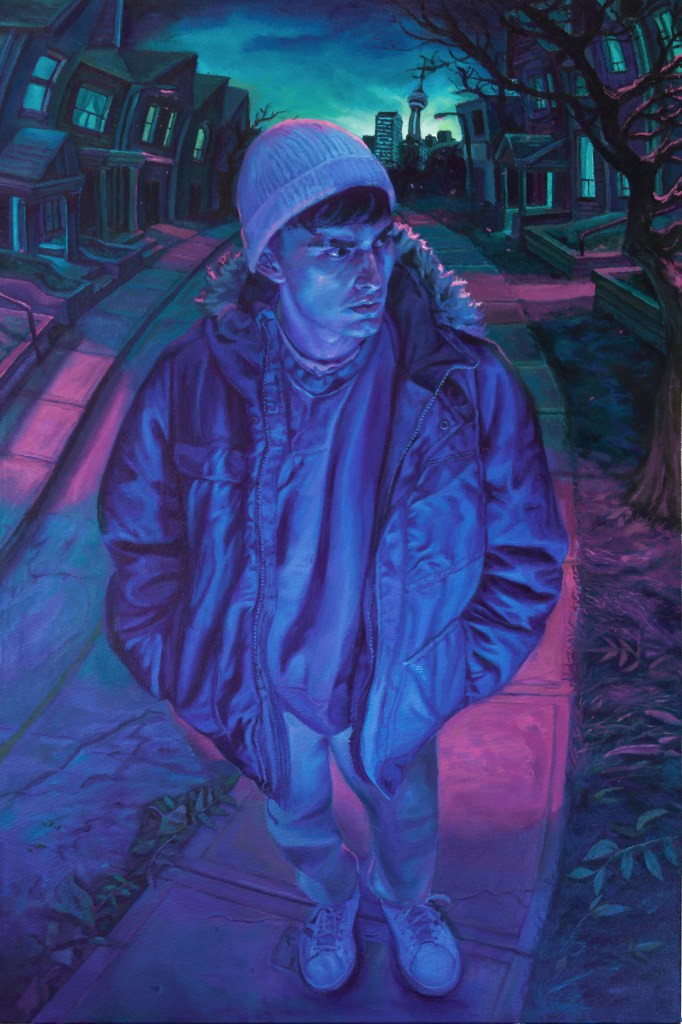
Now, in my more surreal paintings, I use symbols and unreal elements to better express feelings. For example, in one of my recent paintings, titled Lost, I tried to capture the emotion of being lost – like in a new city where you don’t know your surroundings. Instead of depicting the buildings realistically, I distorted them and added dark accents, giving them a sense of alienness. I try to make my paintings evoke emotions, but at the same time, I believe that once they are finished, they no longer belong to me – each viewer can interpret them in their own way. At the beginning of my career, I didn’t leave much room for interpretation, but now I try to do that consciously. Leaving some openness in the painting allows the viewer to see their own story in it.
You paint scenes from everyday life, but at the same time, you intertwine them with elements of surrealism. I’d like to ask you about the meaning of the painting Temptation.
I created this painting based on the theme of temptation. I thought about many different ideas because temptation can take many forms – it can relate to food, sexuality, and for many people, it can be connected to alcohol, drugs, or other addictions. Initially, I considered creating a painting depicting food as temptation, but I quickly realized that I wanted to capture the very feeling of temptation and find a metaphor for it.
For me, temptation is an emotion that builds up like magma in a volcano, until it eventually erupts. That’s why in my painting, the volcano is hot, red, fiery – symbolizing the inner tension that inevitably explodes. I also used symbols associated with temptation, such as a beautiful woman, whom I depicted as my wife. Another element is the hand emerging from the volcano, symbolizing the loss of control, as if some external force is pushing us to give in to temptation. I wanted to capture that moment just before the fall, when a person is on the brink of surrendering to their desires.
I noticed something interesting in your paintings – your gaze. I’m not sure if it’s a deliberate technique, but in most of your works, you have the same distant expression. For example, in The Calm After the Storm, your gaze seems thoughtful, even melancholic. I’m curious if this is a conscious decision or perhaps an accidental effect?
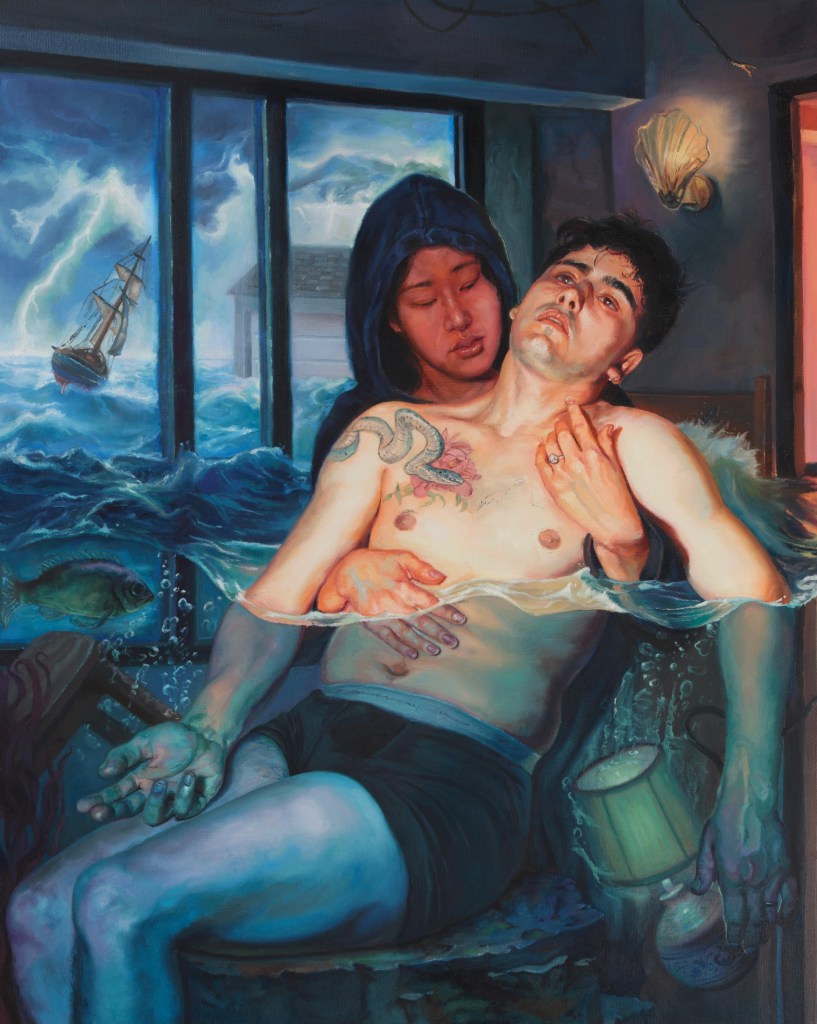
That’s a great question. My wife calls it “my painter’s face.” In my paintings, facial expressions play a big role because they can shape the interpretation and emotions of the viewer. Even when I paint myself, I sometimes treat my figure more as a character than a self-portrait.
Interestingly, many people who meet me after seeing my paintings are surprised to find that in reality, I’m much more cheerful and relaxed. However, in my work, I express that more reflective and serious side of my personality. Painting is a form of conversation with myself, so maybe that gaze captures moments of introspection.
I must admit, I’ve tried painting myself with different expressions, but it never felt as authentic. Perhaps it would be an interesting challenge to consciously change that expression in a painting.
How has your artistic journey developed since studying at the Rhode Island School of Design? How did that period influence your approach to art?
As I mentioned earlier, that’s where I learned how to draw. I was fortunate to meet professors who recognized my dedication and helped me develop my technical skills. They saw that I had an obsession with painting and drawing, that I was willing to sacrifice everything to achieve mastery.
One of my professors gave us incredibly complex assignments: “Draw a scene with five children, ten adults, two cars, spiral stairs, a house, and a dollhouse.” At first, it seemed impossible, but through persistence, I reached new levels of skill. RISD taught me to push my own boundaries.
Your approach to painting seems like a long-distance running process. What motivates you to keep working, even during the more difficult moments?
I draw motivation from several sources. First, I find immense satisfaction in seeing my own progress. Seeing how much I can improve in a relatively short time is a huge motivator for me. Second, the right pace of work is crucial. Just like in running – if you start too intensely, you might get injured and then it’s impossible to keep training. It’s the same with painting – when you work 12 hours a day for months, you burn out. I’ve found the right balance for myself – I usually paint about eight hours a day, which is equivalent to a full-time job. Sometimes I can afford more intense sessions, but I know that cannot be the standard because it negatively affects the quality of my work.
Your paintings are characterized by a strong emphasis on storytelling. What is your creative process like? Do you start with a specific concept, or do the paintings evolve during the process?
Recently, my works undergo significant changes during their creation, especially the more surreal ones. When I painted photorealistic compositions, I usually had a clear final result in mind. Now, when creating more surreal paintings, many elements come to me as I go along. I don’t always know what the final version will look like until I’ve placed certain elements on the canvas. It’s a process of editing and adjusting, where I try to make everything work together.
I have a rule not to judge my paintings right after finishing them. I let them “rest” for a few months before looking at them again. When I spend long hours on a painting, it’s hard for me to remain objective. Only after some time can I assess it from a fresh perspective.
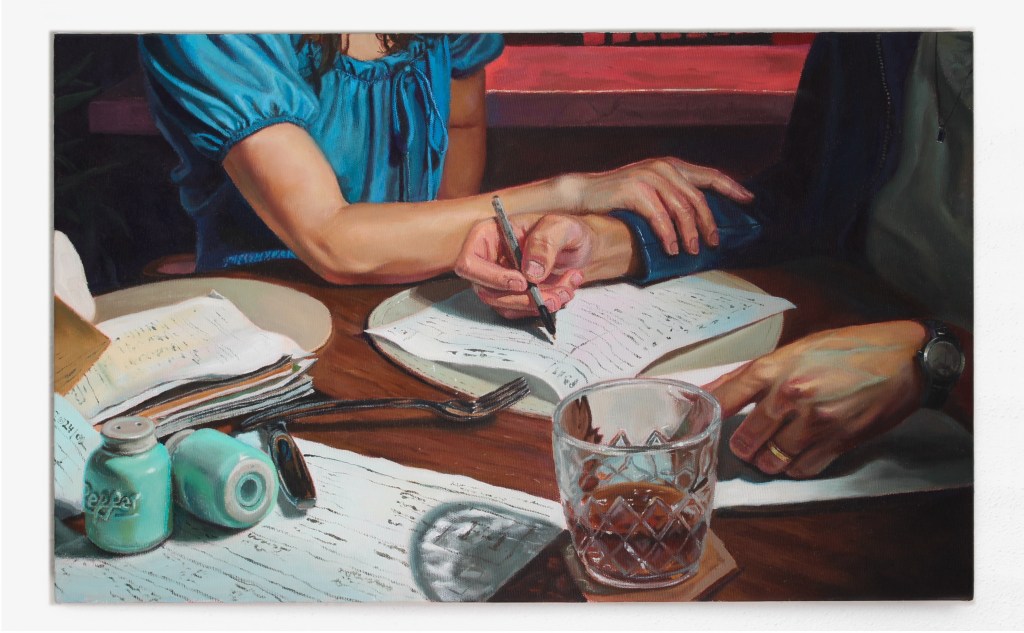
Your exhibitions, like Chronic Maintenance and Long View, highlight different aspects of your work. How do you choose pieces for your solo shows?
The process usually starts with three paintings, which don’t necessarily have to be related, but they serve as a foundation for the rest of the exhibition. I’m currently working on a new exhibition dedicated to Toronto. Although I now live in Houston, Texas (I moved here because of my wife’s medical studies), Toronto still remains an important place for me. However, it’s a city that, in some way, has become unfamiliar to me. The central theme of the exhibition is the feeling that comes with returning to a place that’s no longer what it used to be. In this project, I focus on surrealism – none of the paintings will depict reality, but rather its dreamlike reflection.
Social media have played a huge role in the careers of many contemporary artists. How has Instagram influenced your artistic journey?
Instagram basically gave me my career. I had no significant exhibition opportunities until one of my works went viral. It was a painting of my wife and me playing a video game on the couch. It received around 30,000 likes and changed the entire trajectory of my career. Social media, in a sense, has democratized the art world. In the past, gallery owners were the gatekeepers, deciding who could succeed. Now, if your art gains popularity online, you have a better chance of success.
How do you approach the opinions of your art’s viewers? Do reactions on social media influence your work?
That’s a good question. Yes, I definitely try to listen and observe how people react to my work. If someone has a strong reaction – positive, negative, or any other – I always wonder why that happened. What in the piece could have triggered such emotions?
For me, an important part of the creative process is making art that people can relate to and see themselves in. I think that Instagram, though sometimes superficial, is a space where people tend to be positive. I don’t encounter many unpleasant comments, which is great. But I believe that exhibiting works in person has enormous value. I remember hanging a painting that only showed hands and being able to observe the reactions of people who didn’t know I was the artist. This allowed me to see their genuine feelings. On social media, people sometimes hold back from expressing their true opinions because they don’t want to be rude.
Have you ever encountered negative reactions?
Yes, I remember one situation. I painted a self-portrait where I was almost completely naked, and my body was reflected in a mirror. Some people were very surprised by this. I remember one comment that said, “Why would you paint something like that?” I was surprised because, to me, it was simply art. That reaction made me realize that not everyone has to like what I create, and that’s okay.
What was the concept behind that painting?
I wanted to capture the moment between sleep and wakefulness. You know, that state when you’re falling asleep, and then suddenly you’re in the middle of a dream without realizing it’s a dream. In the painting, I used a transition – the beginning is like a cave formed by the folds of a blanket and pillows, and further along, there’s a landscape that almost looks too perfect, like from a dream. Reality is chaotic – trees grow in random ways, but in dreams, everything can be symmetrical and orderly. I wanted to show that moment of transition – the character in the painting is naked, vulnerable, just like when we sleep, and we’re most susceptible to external influences.
How do you choose the galleries you collaborate with? Do you have any dreams about places where you would like to exhibit your work?
For me, the most important thing is the type of work that the gallery presents. Before deciding to collaborate, I check if they showcase artists I admire. I’m not focused on the prestige of the place – what matters is whether my paintings align with its character. As for my dreams, I would really love to have an exhibition in South Korea. My wife’s family is from there, so it would be incredible if they could see my works in person.
When I saw your paintings, I immediately thought of Edward Hopper’s work. Who has influenced your style?

Edward Hopper is a phenomenal artist and definitely had an influence on me. If I had to name a few others, I would definitely mention Vincent Valdez, who is my mentor. His technique and use of light have had a huge impact on me.
Another artist I love is James Jean – he started as an illustrator and created comic book covers, and his sketchbooks are just amazing. Among classical artists, I’m inspired by Caravaggio – his works with light are incredible – and Bouguereau, along with other 19th- century French painters whose technique I admire. I’m also a big fan of Alfons Mucha, especially his cycle Slav Epic, which consists of huge, monumental paintings.
What advice would you give to young artists?
First of all, don’t be afraid to create what you want. Don’t wait until you reach the “right level” to start working on the pieces that are meaningful to you. It’s incredibly important to stay connected with your artistic sensitivity.
And one more thing – try working on one painting or drawing for a month or five weeks, putting in maximum effort. It teaches you to invest time in art and develop your skills. Even if the final result isn’t what you expected, this practice is crucial for growth.
Owen Rival’s work is a combination of technical precision and emotional depth, which makes his paintings captivating and thought-provoking. The artist balances between realism and surrealism with remarkable sensitivity, creating pieces that not only reflect his personal experiences but also resonate with viewers on many levels. His approach to art shows that painting is not just a craft, but also a way of telling stories and exploring human nature.
Through his consistency, passion, and constant search for new means of expression, Owen Rival proves that art is a process of continuous evolution. His works leave room for interpretation and allow viewers to find their own emotions within them. No matter which direction his work takes, one thing is certain – it will be a journey full of depth and authenticity.

 ART HUB
Leave a comment