

1. Your work delves deeply into how external forces shape concepts of dreaming and personal freedom. How has your own journey—from medical studies to art—shaped your understanding of these themes?
The shift from medical studies to art was nothing short of a metamorphosis. My early years were shaped by societal expectations—an insistence on stability that often sacrificed individuality. Medicine, while noble, felt like a relinquishment of my essence, a life governed by rules rather than exploration. Art became my rebellion, my liberation, and ultimately my sanctuary. It offered a space to wrestle with how societal constructs—institutions, norms, and media—intricately weave themselves into the fabric of personal dreams and freedoms. This duality, of confinement and liberation, defines my work, challenging the viewer to consider the fragile balance between the external and the deeply personal.
2. The enigmatic figure born from a crushed beer can is a recurring motif in your work. Could you elaborate on its origin and how it embodies themes of identity, duality, and inner conflict?
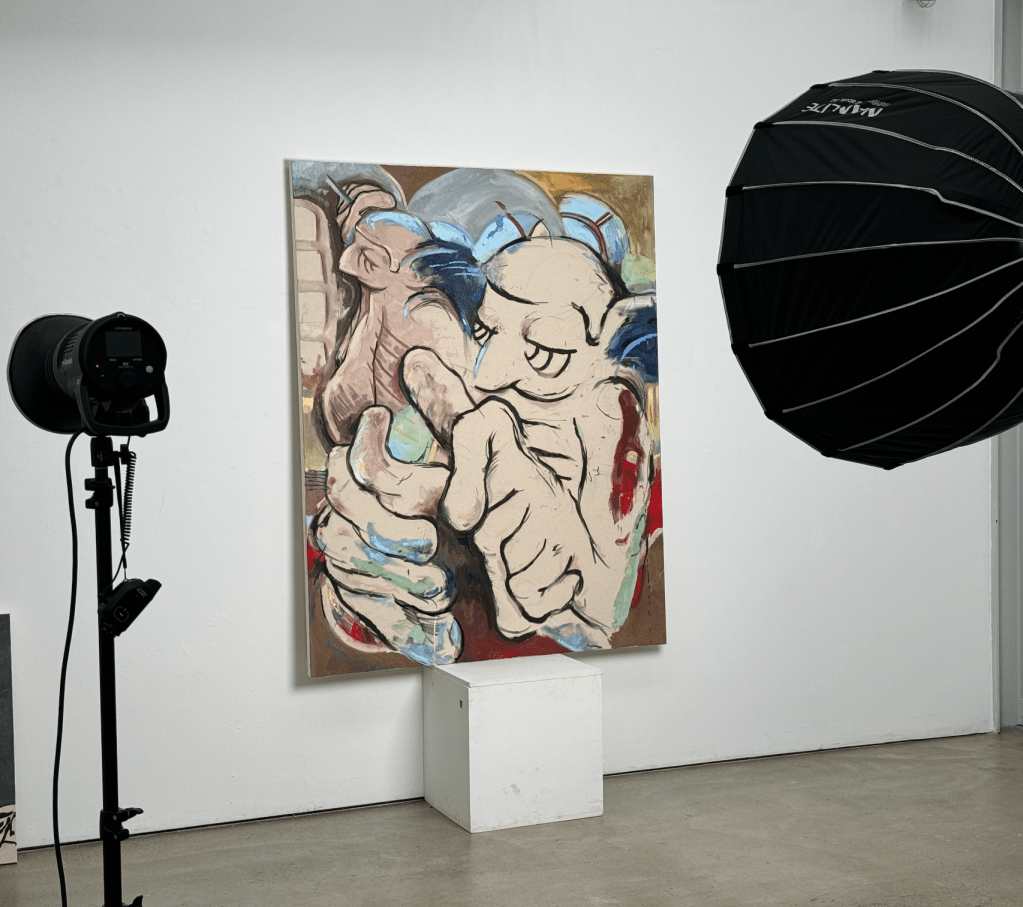
This figure, conceived from the remnants of a crushed beer can, embodies transformation—a metaphor for reclaiming beauty and meaning from destruction. What began as an alter ego has evolved into a profound exploration of duality: the seductive allure of indulgence juxtaposed against the weight of consequence. Its playful yet sinister presence bridges whimsy and unease, mirroring the complexity of the human condition. The figure isn’t just a character; it’s a vessel through which I interrogate identity, inner conflict, and the cyclical nature of existence. It invites viewers into an emotional dialogue that balances accessibility with depth—simultaneously intimate and universal.

3. Your paintings often juxtapose dreamlike landscapes with unsettling elements like broken windows and wilted flowers. What draws you to these contrasts, and how do they inform the emotional tone of your work?
The juxtaposition of the serene with the unsettling captures the fragility of human experience. Dreamlike landscapes, symbols of innocence and aspiration, are disrupted by elements like broken windows and wilted flowers—manifestations of decay, loss, and restraint. These contrasts are deliberate metaphors, layered to evoke an emotional tension that resonates with the viewer. They challenge the audience to find beauty within imperfection and to embrace the discomfort of transformation. My goal is to create compositions that linger in the mind, acting as catalysts for reflection on the precarious balance of hope and disillusionment.
4. You incorporate fragments from your daily life—conversations, slogans, literary works— into your art. How do these elements contribute to the narratives you create, and how do you decide what to include?
This is a question for my earlier work. My creative process was akin to a form of archaeology, unearthing fragments from the mundanity of daily life and transforming them into artifacts of narrative. Conversations, slogans, and literary excerpts become symbolic threads that weave together the fabric of my compositions. These elements are chosen intuitively—moments that strike a chord either personally or universally. They create a mosaic of lived experiences, a chaotic yet deliberate symphony where each symbol contributes to the overarching dialogue. The result is a narrative that reflects the randomness and complexity of life, yet is bound by the unifying force of human connection.
5. The tension between indulgence and consequence is central to your practice. How do you navigate this balance in your personal life, and how does that influence your creative process?
This tension is not just a subject of my art but an intrinsic part of my existence. Indulgence tempts us with liberation, yet it carries shadows that tether us to reality. Navigating this dynamic is an ongoing negotiation, both personally and artistically. My creative process mirrors this struggle: the interplay of whimsy and melancholy, of freedom and restraint, becomes a metaphor for life’s dualities. By embracing this tension, I strive to craft works that reflect the human condition’s raw, often contradictory nature.
6. The interplay of whimsy and melancholy is a powerful element in your art. How do you approach creating this balance, and what do you hope viewers take away from it?
Balancing whimsy and melancholy is akin to walking a tightrope, where each element amplifies the other’s impact. By juxtaposing lightheartedness with moments of quiet sadness, I aim to reflect the multidimensionality of human experience. My hope is that viewers are drawn into this balance, finding solace in its authenticity and resonance. This interplay invites them to embrace their own contradictions, fostering a deeper connection to the work and, ultimately, to themselves.


7. Looking ahead, are there any new materials, concepts, or collaborations you’re excited to explore in your practice? How do you see your work evolving in the coming years?
I’m eager to experiment with new composition and emotions related to my character. Conceptually, I plan to delve deeper into the dynamics of identity and the impact of external things on personal freedom. This will be result in a diverse medium such as hand made sculpture or other way to speak through the oil painting.

 ART HUB
Leave a comment