
“Alchemy” is a concept that perfectly describes the work of a curator and an artist who “found each other” at the right time and in the right place. At the exhibition “Blood of the Roots”, Katarzyna Oczkowska invites us to explore the underworld together with an artist Angelika Puff. The Jak zapomnieć gallery in Kraków has been transformed into a stage for descending into the afterlife, with elements of sacred numbers, a hidden bunny, and a beet juice.


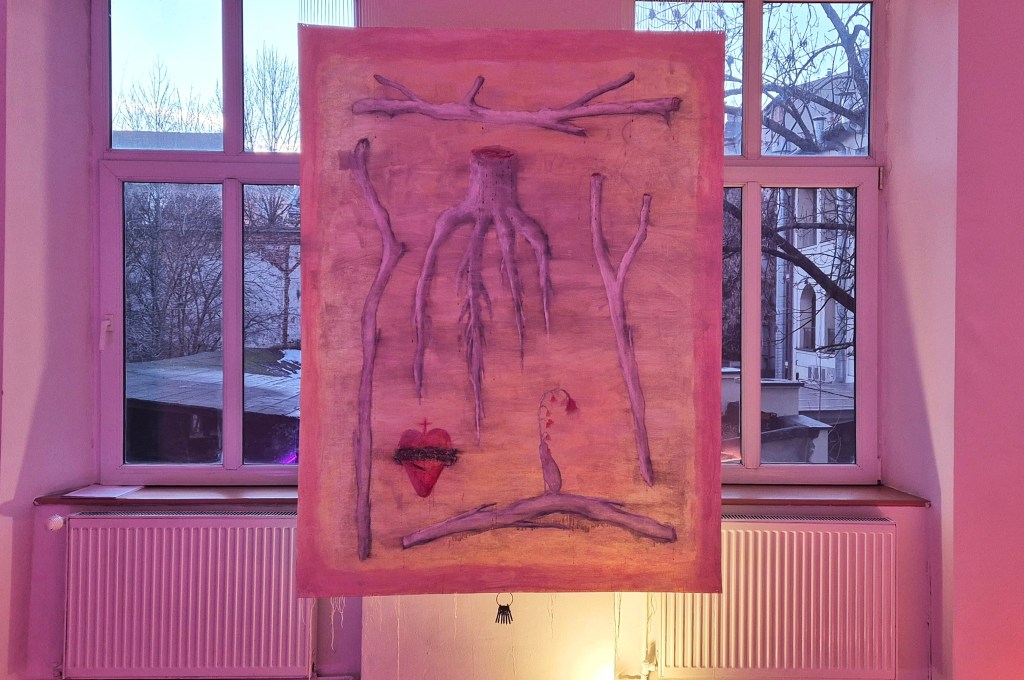
The first room looks like a cozy bedroom—or perhaps a soft velvet sarcophagus—with warm yellow lighting that sometimes flickers into purple. Seven paintings are arranged around the room. As expected, these are best experienced in person. The lighting emphasizes the soft pinks and delicate burgundy shades in Puff’s works. When you get close to the paintings, you feel a desire to touch the raised details—whether it’s the “lace” or the prints with symbols like wedding rings, vulvas, tears, or cups.

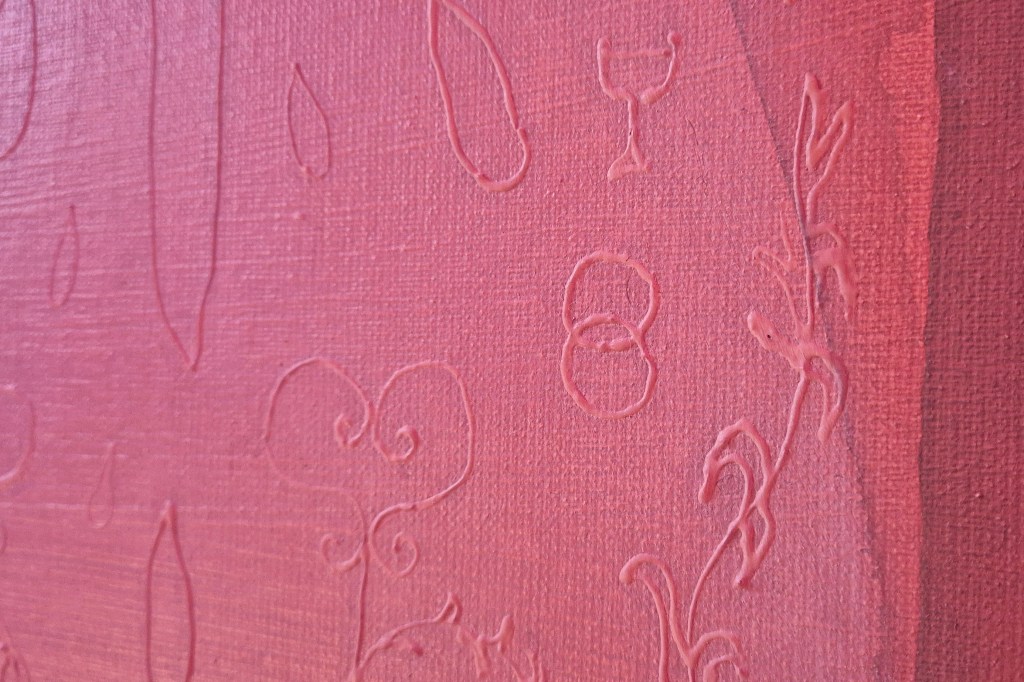

Out of the seven canvases, two feel central because they best represent the collaboration between the artist and the curator. These two show elements like a glass coffin, a beetroot, a cat, a white dress, and the underworld. Opposite to one of these paintings, there is a scene of a bunny sitting at a table with a “witch’s” cauldron. This cauldron comes alive in the second room, which, during the exhibition’s opening, hosted a performance where beets were peeled and their juice was extracted. This performance recalls Julita Wójcik’s 2001 action at the Zachęta Gallery, where she peeled 50 kilograms of potatoes to show how women’s domestic labor is undervalued and often invisible. However, in Angelika’s performance, the beet becomes a symbol of life, blood, and the recovery of feminine identity. It connects women to nature and the underground world. The beet represents lost female knowledge and the power of transformation, focusing on healing and returning to one’s roots. This process becomes a metaphor for women’s experiences and their resistance to oppression:
“From the collected ingredients, she wanted to create a potion to restore what was taken from her. Searching for her roots, searching for broken pieces of herself, she remembered an alchemical truth: no substance should be created from anything other than one’s own blood.”

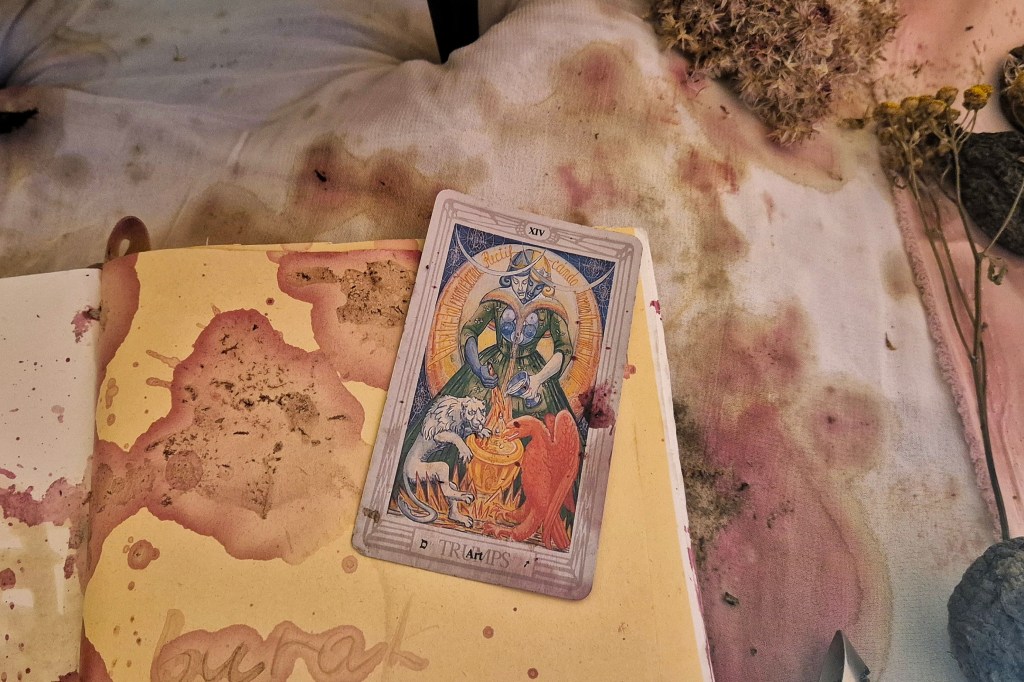
The second room also displays seven paintings, and a table holds seven candles (the original nine are now down to seven, as seen from the two that have already burned out). Katarzyna might be playing with numbers intentionally, as the first room also features seven keys under the largest painting. The number seven has many meanings depending on the context. In the exhibition, it might refer to Tarot cards, especially the card Temperance—Arcana XIV (7+7)—which lies on the table. Or it could be connected to Sumerian mythology. In my opinion, the Sumerian myth fits the exhibition’s theme better than the Greek one mentioned in the curator’s text. What made me think of The Descent of Inanna into the Underworld was the curator’s note that ‘she,’ the heroine, was naked:
„When she finally reached a place with no quick way out, she realized she was naked and walking among the glistening bones of the dead”.
When Inanna descended into the underworld, she had to give up her crown, her necklace, and her bracelets. The main difference between Sumerian and Greek myths lies in their portrayal of women: Inanna is an independent figure, while Persephone is presented as someone dependent on the actions of men. Perhaps the Greek myth was chosen simply because it’s more familiar to a wider audience. The number seven could also connect to the lunar cycle in Sumerian mythology, where every seventh day symbolized the end of a phase and was considered dangerous.

Returning to the XIV Arcana on the table, it’s worth noting that in most Tarot decks, Temperance is shown holding cups. Similar cups surround the cauldron on the table. These cups, made by the artist, are rough and uneven, as if poorly molded from clay, perfectly matching the subtle tribal style seen in the paintings. They still hold traces of beet juice from the performance.

We can also see the “artifacts” of the performance in the form of a white dress stained with beet juice, symbolizing blood. The white dress itself carries meaning, as white is often associated with death (in Slavic traditions, people were buried in white clothes, and in many cultures, white symbolizes the light of death).
The entire exhibition feels like an encyclopedia of symbols. Even the stones near the door to the second room seem to whisper: “You are entering to another world.” This is a world where a woman turns the underworld into her “workshop,” where potions are made, and a cat rubs against her leg— enhanced by the sound design. I’d also like to highlight the subtle reference to J.W. Waterhouse’s painting “The Magic Circle”. It feels as though a witch might step into the room at any moment, followed by a raven landing on a stick— that is a part of the composition in one of the artwotks displayed opposite.


The exhibition’s title, “Blood of the Roots,” ties everything together: the paintings depicting beets, the beet juice from the performance, the context of the goddess-artist’s descent into the underworld, and, of course, the connection to the feminine lineage and wisdom passed down through generations.
Photos by Valeryia Kaliaha & the photo of the performance is from Instagram:
Curator: https://www.instagram.com/artvstka/
Artist: https://www.instagram.com/angelpuff_/ Gallery: https://www.instagram.com/_jak_zapomniec_/

 ART HUB
Leave a comment