
An inspiring posthumous exhibition where substantial elements of Barlow’s work have been reconstructed and displayed in the picturesque Barn Gallery complex that is Hauser and Wirth in Somerset, an impressive venue with its beams, stone floors and a unique ‘found object’ bar, which is not only beautiful but strangely on theme for this exhibition. Barlow’s sculptures follow a theatrical path around the galleries and then out into the courtyard, farmyard and gardens, where the ‘PRANK’ sculptures are featured, a selection previously shown in Manhattan in 2023.


Photo credit: Deanna de Roche
Seeing, saving and giving, were the words which initially came to mind when looking at Phyllida’s legacy, and I felt this was applicable to her teaching, her family and also to the pre-loved discarded materials which were adopted by her and received a resurrection through her compassion and vision. These were utilised in the creation of unexpected offerings for her audience. Perhaps as a saviour of stuff, the angel of the skip, Barlow was good at spotting potential in the discarded and unwanted ‘ too good to waste’ items she collected, being able to translate the possibilities of reclaimed objects and elevating them, phoenix-like, into sculptural statements which transformed spaces. Phyillida Barlow had a big heart and a big vision, and an eye on fly-tipping.
It could be argued that restriction of self-development for the love of others is a form of self-sacrifice when our lives are so short. Many talented artists who are also mothers experience this, arriving in the morning at paid workplaces lacking rest, following the nocturnal impulse for personal artistic creativity when the family sleeps. Phyllida called the pieces that she produced in this way ‘Nightworks’. These works also indicated the direction of Barlow’s future sculptural path which she pursued when her teaching career ended and her five children were grown. These are hard trodden roads for still evolving and developing talents. Even with the support of the establishment and the love of her husband throughout her life, which, it has to be said, many Fine Artists do not have, Phyllida seemed to have so much more to give us before she ran out of road. Any time commitment from a gifted soul given in love to others should be treasured by them, for it may come at great personal cost. Barlow taught at the Slade for forty years to much acclaim, and left us many successful sculptors who were inspired by her tutorage, with deserved credit to both teacher and student.
Anyone who seeks the neat and tidy, and deplores the rough and ready might be wise to choose a different exhibition experience. This is the ‘rough male kiss of blankets’ as Rupert Brooke once wrote, of exhibitions. Phyllida liked her work to be rough around the edges, and for those edges to be undefined. If you cherish the unfinished and the spontaneous, you will find Barlow’s works exciting and reassuring. ‘It’s an argument with the world’, Phyllida wrote. Her disrespect for the spaces her works engulf is tangible, where her creativity fights to ignore, dominate and change the rooms that they inhabit. Unplanned solid considerations and contradictions irreverently own this space.
One room contains maquettes arranged on a table, samples constructed as experiments testing the balance and stability of unstable angled miniatures, an intro for the development of larger works. There is an excellent film screening of Barlow in her studio included in the exhibition. Phyllida spoke quietly, but was clearly creating her own wrecking balls to demolish preconceptions in Art. She was wearing an oversized plaster-covered jacket, was diverted, exploring the random, worlds away from recognisable female pampering, yet bold as Miley Cyrus of wrecking ball fame, still colliding with establishments and smashing through the concrete walls of conformity and convention. Wrecking balls here hang equally heavy, but are formed from random materials honed together roughly, as if finishing and polishing were something to be avoided or despised, each becoming larger and more extreme in their conception. Roosevelt once said, ‘speak softly and carry a big stick’, most apt in Barlow’s case with a dual meaning.
Her studio was full of reclamation. She used fibreglass, wire- netting, fabric, rope, wire, expanding foam, concrete, glue, plaster and wood, all linked together through the mediums of welding, plaster, glue, nails and paint. Whatever medium was applied, Phlllida challenged the status quo of mix, apply, finish, and re-wrote the rule book of application technique.
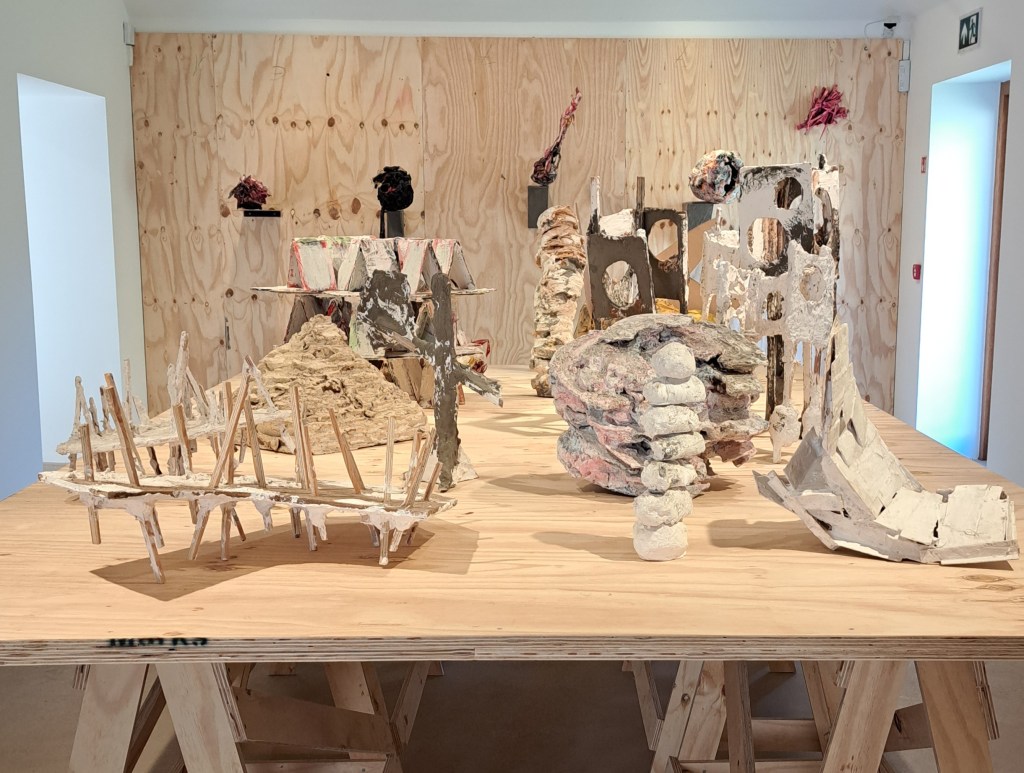
Photo credit: Deanna de Roche
Born in Newcastle in 1944, post-war influences of destruction she saw in the East End of London as a child, hung heavy on Phyllida. The atmospheres of WW2’s destruction echoed through time and fed into her later works, where ‘order from chaos’ comparisons can be drawn through observed human experiences and forms. Jagged unfinished edges of raw fabric, wood, metal, pipe and brick had awaited clearance in that post-war desolation, where the value of shattered objects and buildings was diminished, debris awaiting deliverance.
The 1960s and 70s birthed a new era of free expression, liberation and non-conformity. Against this backdrop Phyllida spent her Art College years at the Chelsea and Slade Schools of Art. King Crimson’s ‘20th Century Schizoid Man’ provided the soundtrack for a brave new world where rebellion was expected and accepted, and equality for women had arrived. This freedom to create for both new and established audiences posed its own new dilemmas and challenges in the creative Arts, but the gauntlet had hit the ground, plaster covered or not, and the challenges accepted. ‘I am the lizard king’, wrote Jim Morrison, ‘I can do anything’.

Photo credit: Deanna de Roche
‘How can it be a different experience’, Phyllida has said. ‘Shedmesh’, first held to acclaim in 1975, and subsequently dismantled and re-made, appeared at this time, along with Phyllida’s first baby. Barlow acknowledged influences from Tony Smith, Arte Povera’s Anti-form, and the grid structures of Polish weavers during this period. I, personally, still find the re-made ‘Shedmesh’ to be a thing of beauty and a stand out piece for me.
Wall space is devoted to a series of Barlow’s small paintings, hung uniformly where the colour sings out. They seem flat and three-dimensional all at once, and although fluid, lack the random unexplained developmental progression evident in her sculpture, almost preconceived planned statements, with a hint of Howard Hodgkin perhaps, although painted edges are surprisingly finished in these. I could not see the concept of recycle and up-cycle present in their execution at all, quite out of lockstep with Barlow’s sculptural innovations, where her confidence to embrace the random and change her work as it progressed, was important. I felt that experimental collages would have lent themselves more as a complimentary addition to her three dimensional practice instead, and what a joy they would have been!
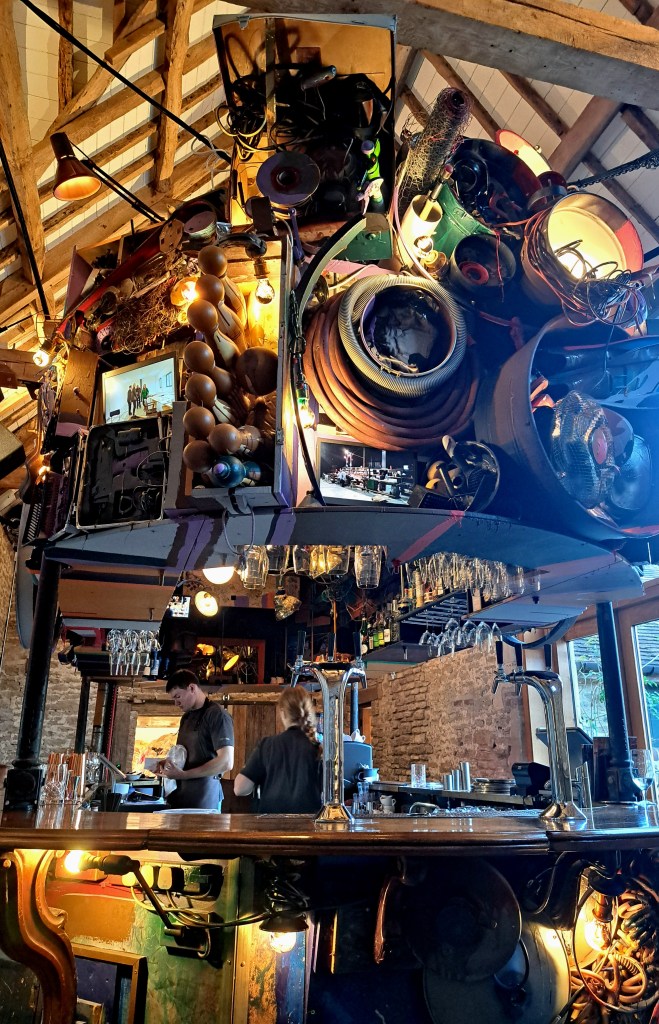
‘Not quite knowing where the reality is’, Phyllida wrote, and surely the very essence of that uneasy concept in her work, is an Art form in itself.
In addition to numerous exhibitions Barlow was invited to create theatre sets for Mozart’s Idomeneo opera in Munich. She thought of her large sculptures as theatrical experiences creating a connective space with an audience, and saw this opportunity as pertinent. Barlow also exhibited at the Venice Biennale in 2017 consuming the British Pavilion with her large sculptural experience named ‘Folly’.
A Review by Deanna de Roche 2024
This exhibition is highly recommended and runs until 5th January 2025
Curator Frances Morris
Hauser and Wirth.
Durslade Farm. Dropping Lane. Bruton. Somerset. BA10 0NL. U.K.

 ART HUB
Leave a comment