The exhibition, which deserves close attention, presents an alternative to mainstream themes in contemporary art. It offers a different perspective, not requiring viewers to conform to established ideals and norms, and frees them from the pressure of external systems. The exhibition opens a space for free dialogue and reflection, offering art without conformism.
The exhibition “56” opens the door to a unique temporary space where artists from different generations engage in a fascinating dialogue. Their names might not be familiar to the wider public or often seen in Polish galleries, under the curatorship of Dorota Roesler with the backing of DWF Poland and Generali Real Estate, this dialogue finds renewed strength and depth, connecting artists 56 years apart in age.
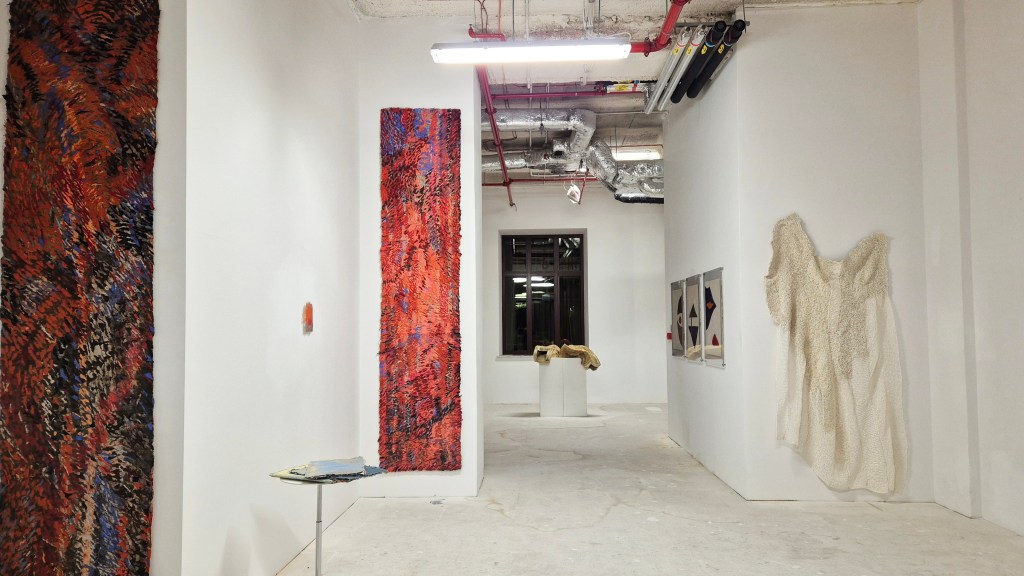
The exhibition is built around a “big idea” – a central concept that sets the direction for the entire exhibition. The main idea of the exhibition is to show visitors the important role that art plays in our everyday lives, and how it enriches our daily existence and promotes intergenerational communication. “The Big Idea” is designed to remind everyone that art is not just decoration, but a means of communication, mutual understanding, and the transmission of cultural traditions. The critical issues raised by the artists support this idea: social injustice, society’s relationship to memory and history, the human experience through the prism of death and resurrection, etc.
Mateusz Choróbski, Jonatan E. Jurkowski, Ewa Latkowska-Żychska, Jagoda Krajewska, and Hanna Zawa-Cywińska presented their works in the white space of the gallery, a space where every viewer can fully experience the special atmosphere, engage with the works, and listen to the curator’s words. Here, in this small area, everyone is given enough “air” to rethink what they have seen and heard. The selection of works, their arrangement in space, and the works themselves inspire admiration for their ability to convey, seemingly within the simple “white cube,” subtle feelings of empathy and emotions towards the creator and his characters. Special attention is drawn to the vertical red work by Ewa Latkowska-Żychska, created using Japanese techniques:
“The material used for the works is Fibre drawn using the Japanese washi technique from the bast of white mulberry trees. The Japanese technique is used here in an authorial way and the washi paper is created simultaneously with the painting”;
“Paper is created through continuous motion, and it succeeds in capturing the energy of this activity”, – the artist says. The fact that Ewa used spruce needles from a tree near her house, which had been cut down by a neighbor for firewood, to create the texture gives the work a special intimacy. Upon learning this, the viewer feels how the art takes on new, warm characteristics as if discovering not only its aesthetic value but also a personal connection to nature and history, evoking a desire to embrace and empathize.
One can talk about loss for a long time, but everyone expresses it in their way, often loudly. Although this is Jonathan E. Jurkowski’s diploma thesis, his cry sounds piercing, penetrating the depths of generations:
“Lazarus is the first work after the severe time of mourning, it is like a prayer, a mantra, or a request to “bring me back to life”.
As a curator working with the philosophy of death and as an ethnologist, I am genuinely moved and inspired by the simplicity of this work’s presentation, which requires only a little attention. It is a piece of cloth woven from the belongings of the artist’s relatives who died one after another during COVID-19. It is an example where form and content are in perfect balance requiring no additional visual context. Only the light which creates the illusion of an angel’s presence quietly but convincingly connects the viewer to this work.
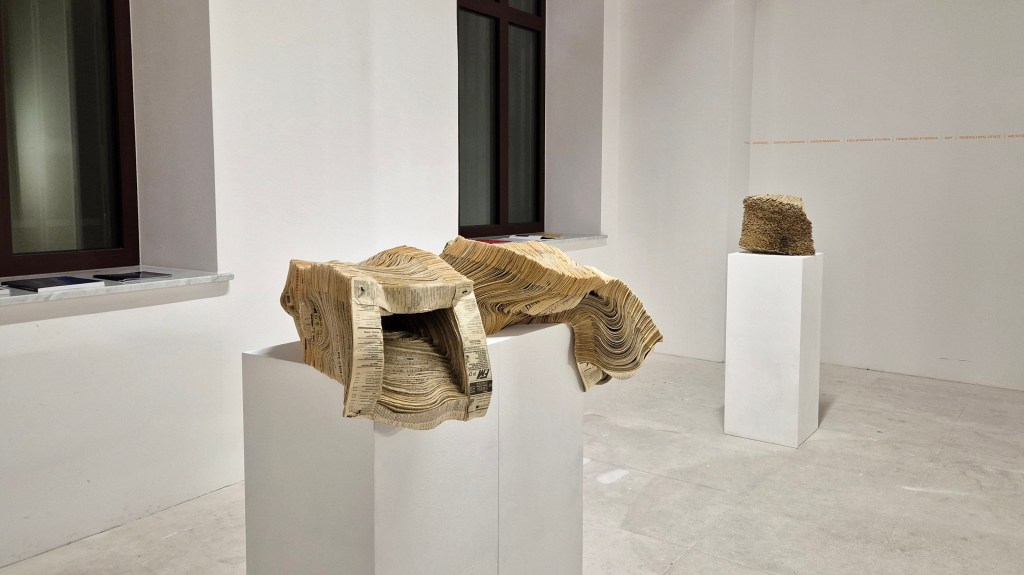
The previously mentioned dialogue of generations is complemented by Jagoda Krajewska’s internal dialogue with time and the development of new technologies. The work, executed in the simple yet delicate medium of paper, reveals its fluid and meditative facets to us. New York Yellow Pages are transformed into works of art, carriers of the history of people who once lived and companies that once existed. However, in today’s world, there is the notion of “personal data security,” and it is this idea that lies at the heart of the artist’s second piece, presented opposite the first. We cannot look at the data from the directories because the pages are rolled up into tubes. While the first work balances the concentration of information on the medium with a light, almost ephemeral form that can be neatly tucked away, the second work presents us with a heavy block of classified information — an emotional oversaturation, closed off from view.
Honestly, each work and each artist deserves individual attention because each one brings their own experiences and history into the material. We can appreciate the embodiment of microcosms that, while localized, possess a universal depth. One such piece is the work of an artist who is informally present in the “gallery” — Aliska Lahusen, with a post-mortem mask resembling lemon jelly.
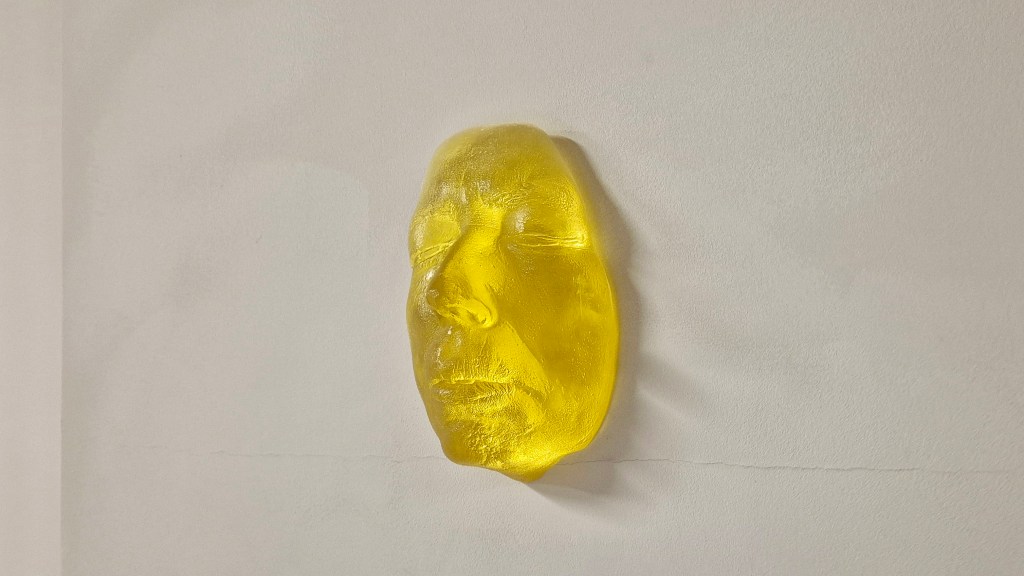
As the artist herself notes, her work awakens memories of the intangible cultural heritage associated with ancient funerary rites. Aliska Lahusen makes us reflect on traditions that disappeared in the 17th and 18th centuries: funerary portraits characteristic of the former Polish-Lithuanian Commonwealth (Rzeczpospolita) and liturgies associated with the French Ancien Régime. The image she has created serves as a reminder of that lost culture, which once formed an integral part of rituals and beliefs, creating in our minds a bridge between bygone centuries and the present.
As can be seen, the exhibition addresses a wide range of themes, with an emphasis on the theme of death. However, it is also worth highlighting the themes of poverty presented in the work of Mateusz Choróbski and the reflections on geometry, color, and texture expressed in the works of Hanna Zawa-Cywińska. The artists work with natural materials and elements we encounter in our daily lives, allowing us to “touch” nature, the past, and perhaps even our own lives.
The ’56’ exhibition underscores the unique role of art, not just as a visual experience, but as a powerful tool for deep philosophical reflection. Each piece here is not only an expression of the artist’s personal experiences but also a form of intelligence that allows the viewer to engage in a dialogue with past eras, as well as the present and future. The art in this exhibition expands the horizons of understanding, offering a new perspective on life, death, memory, and change. The works presented here become not just symbols of time, but active participants in it, capable of asking questions and provoking conversation about the most important aspects of human existence.
Sources:

 ART HUB
Leave a comment