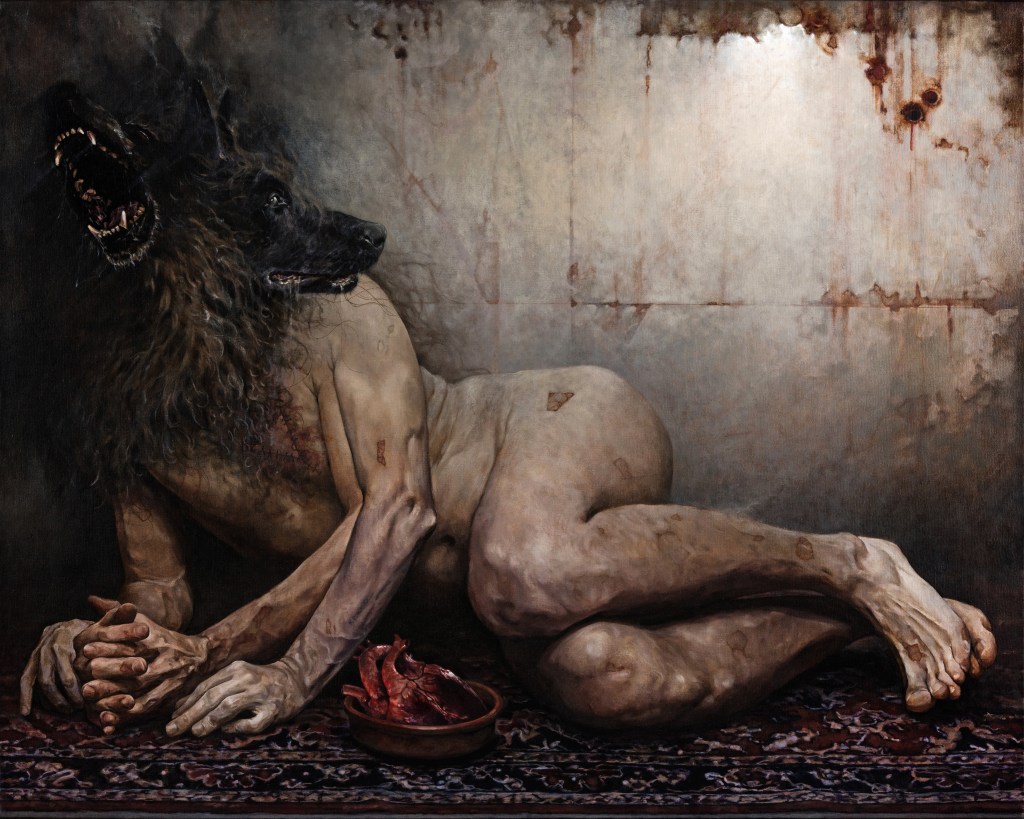
Krzysztof Powałka, born in 1985, is a Polish painter and visual artist with a specialization in artistic glasswork, particularly stained glass. His painting belongs to the movement of Psychorealism, of which he is the creator. He studied at the Academy of Fine Arts in Katowice from 2005 to 2010, earning his Master of Arts degree in painting. Under the guidance of Professor Zbigniew Blukacz, Powałka’s main diploma work, a painting series titled Muza opuszczona – Problemy Malarstwa (“Abandoned Muse – Issues in Painting”), explored complex themes within contemporary painting.
He also completed a drawing annex, Szczerość – Nagość (“Sincerity – Nudity”), in the studio of Professor Antoni Cygan, and wrote a thesis on the relationship between modern art academies and contemporary painting under Dr. Dorota Głazek. Before his studies at the Academy, Powałka graduated from the State Secondary School of Fine Arts in Dąbrowa Górnicza, specializing in artistic glass, where he honed his skills in creating stained glass. His work reflects a deep understanding of both traditional techniques and contemporary artistic discourse, distinguishing him in the Polish art scene.
1. Are there any particular artists or movements that inspire your work? How have they shaped your artistic vision?
To be honest, my interests go beyond any specific movement. I appreciate individual works by different artists, starting from prehistory, through the Middle Ages, Renaissance, and Baroque, all the way to the present day. I love painting, but I also enjoy illustration, architecture, design, crafts, ceramics, comics, film, music, theater, and more. Wherever I look and sense beauty, that’s where my heart goes, regardless of the creator’s name. I particularly appreciate when, in addition to the formal beauty perceived through sight and hearing, there is also the beauty of an idea, a message, or some wise content that offers something more to our lives. This ‘wisdom’ can perhaps exist in everyday life.
2. You favor oil painting but also work with ink and drawing techniques. How do you choose which medium to use for a particular piece, and what do you feel each medium allows you to express differently?
For many years, I worked with different techniques. At school and university, I did stained glass, sculpture, and then explored ink, pencil, and various experiments. Now, for many years, I have concentrated on oil painting, which is such a demanding technique that requires a great deal of time. You still have to learn it, and it constantly surprises you.
Of course, the basic principles are simple and generally known, but to go further and experiment within the painting itself—such as brush strokes, brush marks, and color combinations—is often ‘terra incognita’ for me. Sometimes I resort to sketches; although some are quite elaborate, they serve as ‘preparations’ for the final pictorial work. These sketches form the initial ideas for paintings, which are usually created on the fly or, for example, in the middle of the night, and I often use a pen for this.
I do have series, such as the ‘MAD WORLD’ series, which was created over a year in Barcelona. During that time, I only worked with ink, and I remember specifically choosing this medium. The illustrations were monochromatic and often very ‘poster-like,’ where the idea and message are intentionally ‘narrowed down,’ clear, and without ambiguity. The titles, sometimes very long, are meant to complement and further direct the viewer. The result is a kind of decalogue (though there are more than ten works) about contemporary, often young people. The ink and monochromatic colors were intended to emphasize this message.
3. What specific experiences or events in your life have influenced the themes and subjects you explore in your paintings?
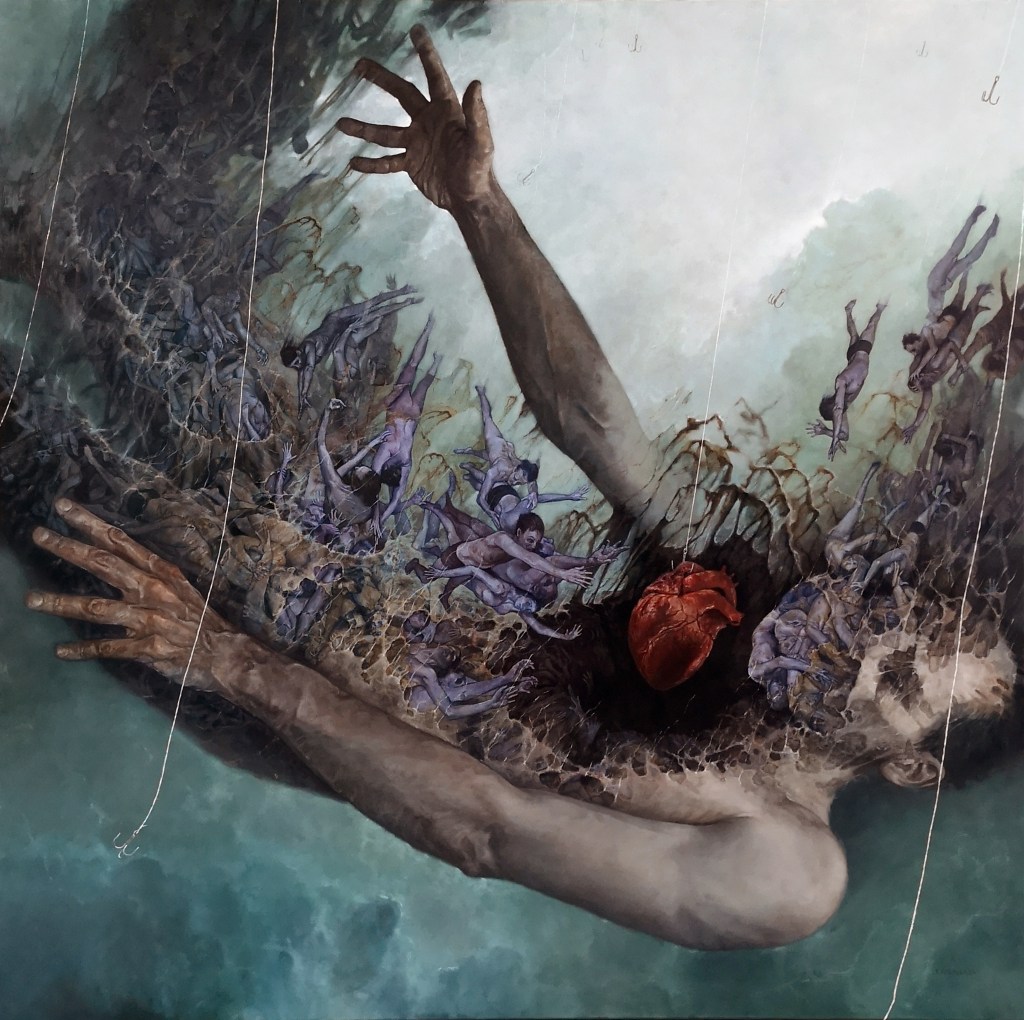
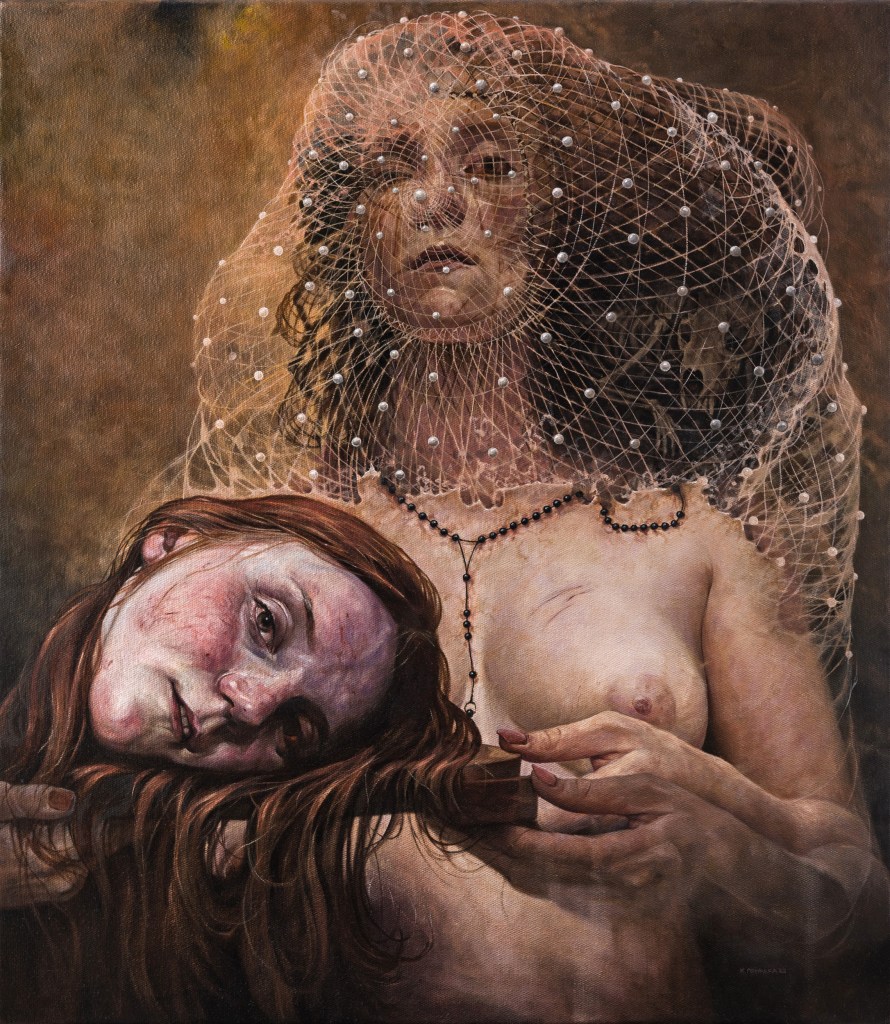
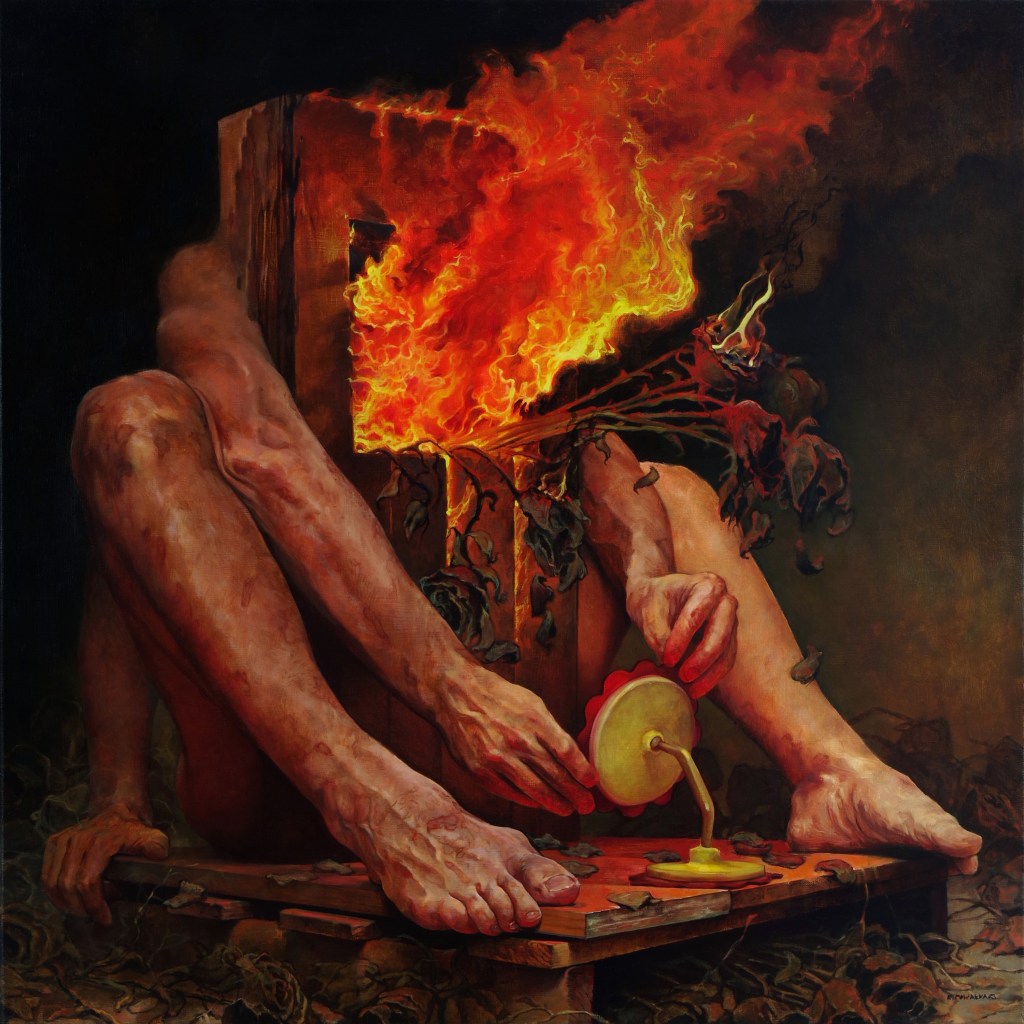
Each of my paintings flows from private experiences. Everything that evokes emotions influences my work—from the sense of isolation and the struggles of the individual to the downs and ups, betrayals, loss, death, joy, happiness, and fulfillment, as well as politics, the devastation of nature, wars, ideologies, and religion. I am a Psychorealist painter. (Psychorealism is my artistic manifesto, significantly different from the concept of Surrealist Psychorealism contained in the book A Tale of Mother’s Bones.) Psychorealism, or psychological realism, draws its origins from a literary genre from the turn of the 20th century. My painting narrative employs a language based on realistic objects, figurativeness, and shapes that are generally familiar to the contemporary viewer. When juxtaposed in a non-obvious and disturbing way within a painting composition, they create an allegorical statement.
I believe that psychological realism in painting is most expressive when the issues depicted derive from the experiences of the psycho-realist painter, subjecting them to internal analysis and reflection. These conclusions are then rendered on canvas. It is impossible to convincingly and truthfully paint the feeling of hunger if one has not experienced it; it will only be an incomplete representation of that state, leading to a certain artificiality.
I remember that one of the factors that led me to take up art—and consequently painting—was the feeling of incomprehension and discord from the people around me, my peers at the time. It often felt like a bad and unjust world. I thought about law, charity work, philosophy, and teaching in school—areas where one can help and attempt to address existential and real problems. This is also where I see a role for the contemporary artist. The idea of ‘art for art’s sake’ does not really convince me. I chose painting.
4. How do you engage with current social or political issues through your art? Can you provide an example of a work that reflects this engagement?
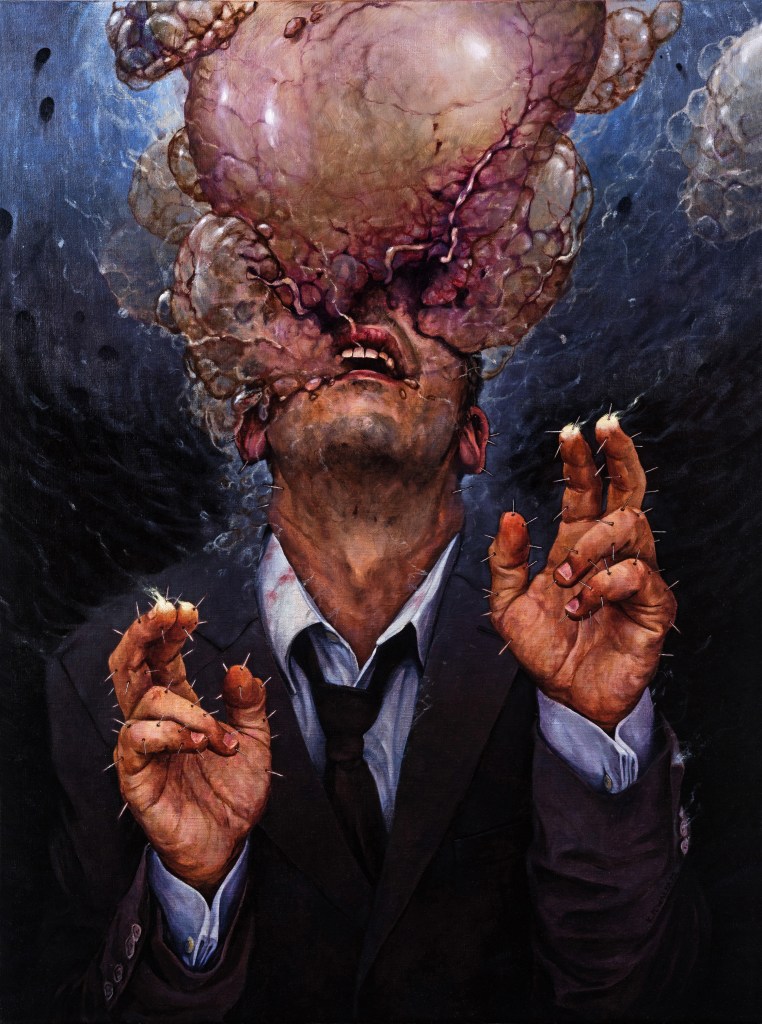
Today, the modern world—and thus its people—are grappling with pressing, unresolved issues. These range from global concerns like the war in Ukraine and the genocide in Gaza, to the specter of another ‘cold war’ and the consequent fear of nuclear conflict. We face the hunger and misery of the world’s poorest and most disadvantaged regions, contrasted with the wealth and capital of the few. There is the devastation of the environment, global warming, ubiquitous plastic, the extinction of more animal and plant species, the poisoning and lack of drinking water, and the deforestation and desertification of forest areas. Social issues still involve the ongoing struggle for equality for women and LGBTQ+ individuals, as well as inefficient education, health, and social care systems.
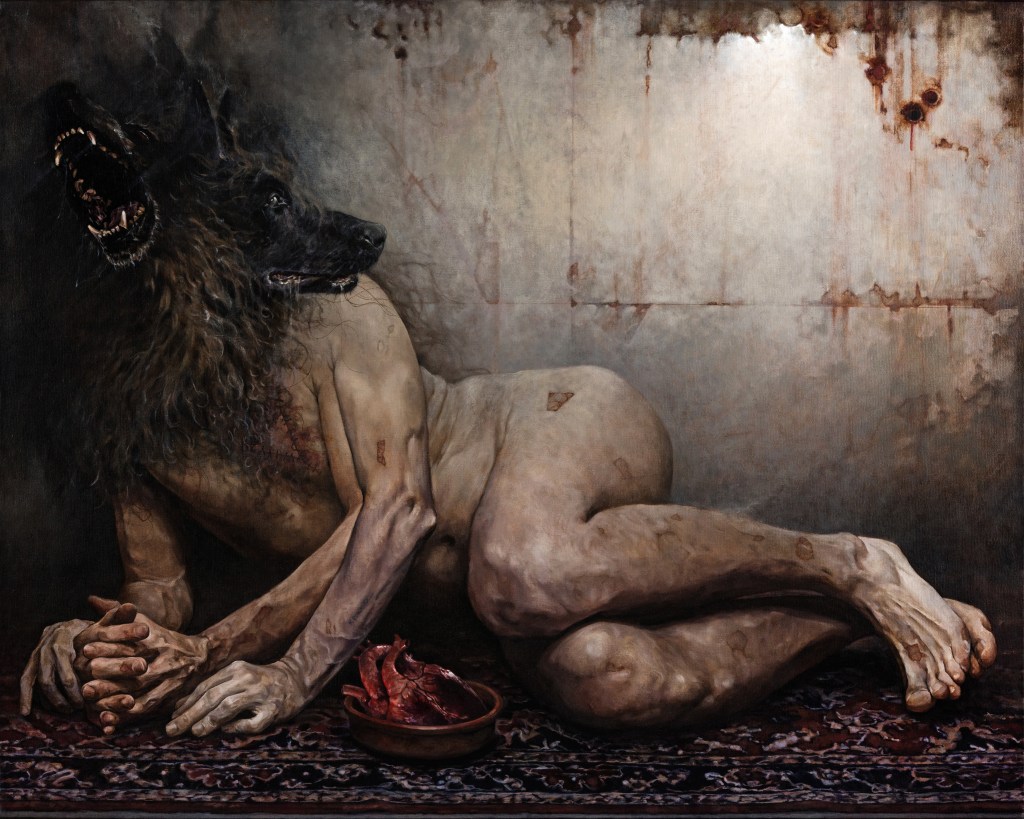
We also confront problems of population migration, assimilation, and the misunderstanding of different cultures, which breed fear and hatred of the ‘stranger.’ The moral and actual collapse of various religions, which for many hundreds of years have ‘guided’ humanity as ‘infallible,’ adds to these challenges. Furthermore, the darker side of digitalization, gadgets, technology, and AI has already shown what it is capable of doing to ‘homo sapiens,’ and this is just the beginning of a revolution that may well ‘eliminate’ humans.
It seems to me that any creative, empathetic, emotionally aware person cannot remain indifferent to these (few mentioned here) issues. They influence my painting; I might be tempted to say they are present in practically every piece I create. In my opinion, a painting—especially a psychorealistic one—should be ambiguous.
One of the aims of psycho-realist painting is to search for ways to improve the human condition or to communicate and present a given problem, touching on fundamental existential questions. In psycho-images, the painter expresses opinions on social or political issues through an appropriate combination of symbolism. However, nothing in psycho-realist painting is laid out literally. The message must be constructed artistically in such a way as to stir the sensibility and shatter the calm. Its aim is to stimulate extreme emotions and provoke reflection.
5. Your paintings invite viewers to confront uncomfortable realities. What reactions do you hope to elicit from your audience when they engage with your work?
Psychorealist painting seeks to establish a dialogue with the viewer through the means of expression used in the artwork. For the artist, figurativism and symbolism serve as an alphabet with which the painting ‘speaks.’ He does not want to create a monologue that is incomprehensible, placing the viewer in the role of a silent ‘listener.’ The psychorealist cannot completely eliminate himself as an artist from this contact; however, he always leaves it up to the viewer to interpret. The artist creates the pretext and motive for such an encounter, gently suggesting and directing the viewer. This is why the titles of the works are so important in psychological realism. As a psychorealist, I want to emphasize through them that the ‘encounter-dialogue’ with my painting addresses this, rather than that, problem.
We understand that each viewer, through their own experiences, mood, and emotions at a given moment, will likely see something different from what the psychorealist painter sees while creating. This is obvious and understandable; we are different people. But this does not prevent us from discussing the same issue, viewing it from many angles and enriching ourselves with knowledge drawn from different experiences. It is a known fact that only through dialogue and confrontation with another human being (in this case, the person hidden behind the canvases) can we define our own selves and perhaps arrive at conclusions different from those we have reached before. This process allows us to enrich ourselves, change, and evolve.

6. You mention the determination akin to Sisyphus in your approach to integrating reality into art. Can you elaborate on this metaphor and how it reflects your artistic journey?
I place the human being at the center of my ideological and artistic considerations—a being full of contradictions, possessing both advantages and various flaws. The friction at this junction has always represented the struggle between the eternal dilemmas of humanity: good and evil, instinct and primal urges. This is a being who puts himself on a pedestal, above all other species, yet remains profoundly imperfect, wandering every day along life’s trails.
Their actions, choices, decisions, feelings, dilemmas, thoughts, and anxieties serve as eternal inspiration for me as a painter. With the idea of Psychorealism, I strive to lift the veil on what occurs in the human psyche, that intuitively tangible yet invisible inner world, which significantly impacts the outer world around us.
Through my paintings, I want to draw attention to the problems of human existence and its psychological underpinnings. This is where, in my opinion, creativity—in its broadest sense—finds its raison d’être and an inexhaustible source of inspiration. This is not an easy task, as today’s world allows less and less time for analysis and reflection. However, despite the passing years, I still believe it is worth attempting.
The stakes are high: the innermost self of humanity, with its psyche and emotions, is a constant battlefield, the source of all the good and evil in the world—an area that remains largely unexplored and misunderstood, even with the advancement of modern technology. People focus on conquering space, developing new technologies, and even transferring human consciousness to robotics, but it seems they often forget the most important thing. If they do not emerge victorious from this eternal battleground of good versus evil, new worlds—no matter how distant—will be lost.
7. Your art reveals the darker aspects of reality while also hinting at beauty and color. How do you balance these contrasting themes in your work?
Yes, it’s true that I often touch on quite dark, controversial, and so-called ‘problematic’ subjects, although they are not always perceived as such by me. Where one person sees darkness, another may already see light. I believe that problems, ‘fears,’ and controversies should be addressed (and painted) more often. After all, by articulating (in this case, painting) and acknowledging the existence of a problem, we take one step closer to solving it.
In grasping the complexity of human nature, I recognize its dichotomous nature. I can clearly see the distinction between the light side and the dark side, between corporeality and spirituality, as well as emotionality and intellect. On one hand, each of these spheres is mutually exclusive; on the other, they complement each other, creating wholeness and harmony. This is the harmony I strive to convey in my painting.

8. You work alongside your brother and father. How is it to collaborate with family members in your artistic practice?
The beginnings of my art education were not easy. On one side was my dad, who, in the difficult eighties, gave up his painting practice in favor of a more profitable occupation—teaching at school. On the other side was my older brother, who had no interest in painting and chose to attend a humanistic high school.
It was only after years of solitary struggle, and perhaps a little under my influence, that a situation arose where all three of us could function as professional painters. Dad returned to his painting practice, and we all have our own separate studios (Dad has maintained his since the 1990s, where he created advertisements and prints, while I painted my first works). Each of us approaches painting a little differently, although the subject matter we cover is similar.
We often exchange our experiences as painters, hold joint exhibitions, and, most importantly, are able to talk freely to each other about art, creativity, and painting techniques. Sometimes we collaborate on projects, and then we go off to paint together. Painting with another person on one canvas is indeed not a typical experience, and I recommend it to every painter.
One must confront their skills and, above all, their inner emotions and doubts (which are the driving forces behind any free, individual, and creative art) with the other person (in this case, one’s brother). Finding a compromise that satisfies both parties while creating a relatively coherent composition—so that one cannot distinguish where one painter’s work begins and the other’s ends—is a truly difficult challenge.
9. Can you describe your creative process? What does a typical day in your studio look like for you?
At the very beginning, there has to be an idea, a concept. Later, I need to answer the question, ‘Why would I want to paint this?’ ‘Why should I devote several months of work to this particular painting? Is it worth it? And if so, why?’ If I find the answers affirmative and convincing, I can ‘move on.’
Next, I think about composition, form, color, and so forth—what to choose in order to best render the entire issue on canvas. Then come the first sketches, compositions, light placement (if important), etc. These are mostly small drawings that sometimes take a more finished form and sometimes do not. Once I have this stage more or less set, I look for and collect material I call ‘painting aids.’ These usually include photographs, model sessions, color inspirations, notes, old sketches, and so on—anything I can use to support my creative process.
Of course, I continue analyzing and processing the idea and concept that will appear on the canvas. In my case, the former is never final, as changes often occur during the painting process. I believe more in the ‘process’ and painting intuition than in cold calculation and transferring a finished idea or photo onto the canvas.
Only now do I enter the painting studio. I prepare the canvas (nailing the loom, stretching the canvas, gluing, and applying the primer). This takes a few days. Once everything is ready and the white canvas is on the easel, I sit down in front of it in an armchair and stare at the white…
First, I have to engage in some ‘magical’ activities without which I would not be able to paint or create. I need to set up the right music, make tea, sweep the floor, and prepare a mixture of nuts and sultanas. It sounds like a lot of fun, but I know that if I don’t do these trivial things, my ‘creative process’ will not begin. I usually take my first break (after painting in the morning) around lunchtime, only to return to the studio immediately afterward and paint until late. I often find myself returning to the studio on weekends in addition to my normal working days.
10. What projects or exhibitions do you have coming up, and how do you see your work evolving in the future?
At the moment, I am in the process of planning several exhibitions in interesting venues; however, until the final decisions are made, I don’t want to talk about them. My biggest challenge is collecting enough paintings for an exhibition, as practically all of them are in private collections, and the process of lending them is not always easy. There is a permanent exhibition of my brother’s and my work at the Elektrownia gallery in Czeladź, near Katowice.
I don’t dwell on the future and the evolution of my creative work. You can’t invent it; you have to paint it and enjoy the creative process itself. I feel some changes taking place in my painting (it’s encouraging to see that my work has been evolving over the years), but I’m not sure where it will take me. It remains a great unknown, and the horizon keeps shifting.
One thing is certain: to quote Alfred Tennyson from his work Ulysses, ‘Made weak by time and fate, but strong in will / To strive, to seek, to find, and not to yield.’

 ART HUB
Leave a comment