
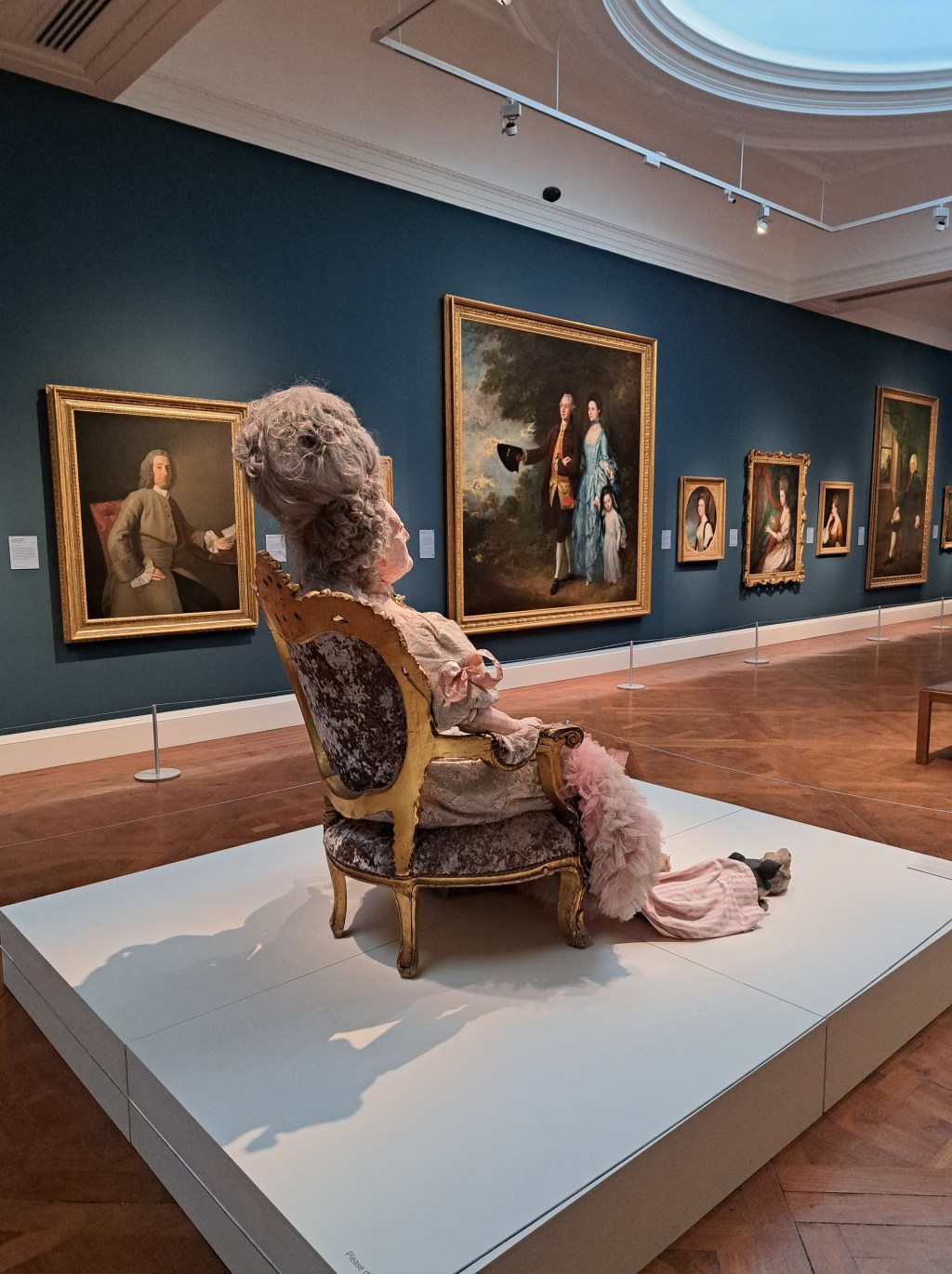
The Holburne is an eighteenth century Mansion House in Bath, home to Art Galleries and a Museum, also featured in ‘Bridgerton’ as Lady Danby’s house. Currently showing in the first floor gallery is an exceptional offering which is the result of an inspired idea to host a joint exhibition displaying the etchings and dry point works of two Art giants, born two hundred years apart, but together in this space. A comparison to the finite and undisputed genius of Francisco Goya’s etchings would be hard to find, and yet here Rego’s works hang next to those of her personal inspiration, side by side, as if in homage.

Papier-mache & textile. Copyright Paula Rego
Photo: Deanna de Roche
Given my admiration for all Goya’s works and a love of Rego’s pastels, I attended the exhibition with an open mind and generosity of spirit. To view Goya’s innovative genius and exquisite aquatint techniques up close was a deeply felt and appreciated experience. His subtle use of chiaroscuro provided an intriguing subterfuge for glimpses of observed horror and questionable realities, leaving much to the observer’s imagination, as a vampire disappearing into fog or watching a phantasmagoria horror theatre where disturbing images of the unspeakable drift in and out of obscure unexplained darkness. Goya did not search for subject -matter, his own lived experience was of the atrocities called the Napoleonic wars, the Inquisition and indeed his own debilitating illness, were clearly dark material enough to create these masterpieces.
Nursery Rhymes and Folk Tales from her childhood in Portugal gave Rego the vehicle she needed to reinterpret their original concepts and meanings and morph them into her own sinister tales and fables, many cruel and perverse reflections of societal ills, where familiar existing characters take on a darker face. Goya and Rego understood the depths of human vulnerability, repulsion, victimhood, passion and despair; it is here on these walls for all to see. The pain of humankind was etched into their hearts and transferred onto their etching plates.

Through her own personal admiration for Goya, Rego travelled to Spain to study the master’s works, which makes this dual display all the more poignant. This collection of etchings from Rego’s estate is impressive, demonstrating her competence as an etcher but also highlighting the differences in style between these two. Rego’s bold robust technique, a hallmark of her work, forms a contrast to the subtlety of Goya’s unsurpassed refined skill in aquatint and his ethereal undertones. Nonetheless, the Rego etchings make strong statements, are equally valid in their own right, and much admired independently for their re-imagined content and effective striking contrast techniques, but for me the etching prints lacked the sensitivity of her drawings in the use of this medium.
The Goya prints are as clear and sharp today as when he pulled them off the press 220 years ago, a tribute to the quality of the materials and inks he used. Rego’s are sharp and black and powerful. All prints in this exhibition are pristine high quality prints and a commendable tribute to both.
Life Journeys
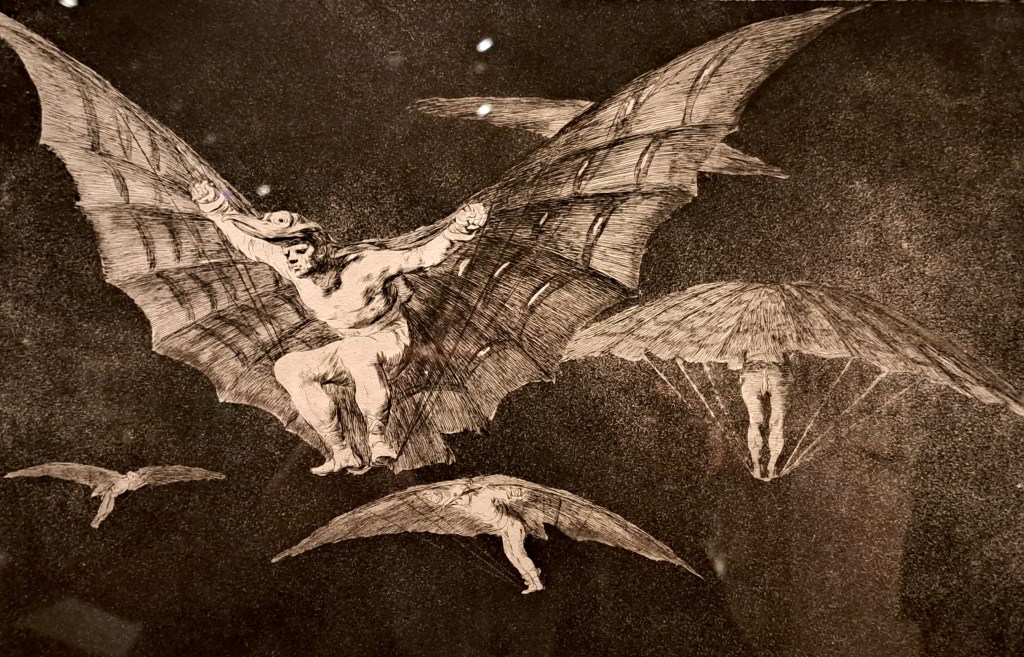
Francisco Goya y Lucientes was born in 1746 in Saragossa, Paula Rego in 1935 in Lisbon
Both came to etching in later life and had a strong sense of social justice, a strong character and a passion for life. Each bore witness to arrogance, ignorance, the futility of war and poor governance and both bravely fought injustice through the medium of Art.
Goya, age thirteen was apprenticed to a painter producing large provincial canvases for churches. He failed to get into the Royal Academy twice. He was stabbed in the back by a rival husband, hunted by the Inquisition, and fought in the bull-ring. He designed fashionable Rococo style tapestries in the studios of Francisco Bayeu y Subias in Madrid to escape the Inquisition’s investigations. Goya married Bayeu’s sister Josepha in 1773. Despite Goya’s numerous affairs she remained faithful to him until her death in 1812. She also introduced him to the Court, and commissions followed. Goya drew Spanish peasants and gypsies, bull fighters and courtesans, Majos and Majas, and he mixed well with Court life. His mistresses were the most powerful women in Spain.
Rego remained in Portugal with her Grandmother during her childhood until 1939 whilst her parents moved to England due to work placements. It was during this time spent with her Grandmother and the family maid that Rego is said to have enjoyed hearing their stories about old Folk Tales, Fairy Tales and traditional stories, and had been influenced by the subject-matter. She attended English language school in Lisbon and St. Julian’s School in Carcavelos from 1945-1951, when she moved to the U.K and attended the The Grove at Sevenoaks, before attending the Slade to study Art from 1952-1956.
Goya, amongst other artists, was invited in 1778 by the King to produce engravings of the Royal Tapestries. Among the other candidates Valesquez most impressed Goya, and this admiration was life-long. At this time in Spain the church was an obsessive dominant power discouraging creativity and free spirit thinking. Goya’s portraits were much admired and commissions flowed.
Rego made rapid progress at the Slade and joined the London Group exhibiting with David Hockney, amongst others, possibly a group of six. Her style was more abstract at that time. From 1962 she participated in numerous shows at the ICA, Institute of Cotemporary Arts, including a solo show there, and at the SNBA, Sociedale National de Belas Artes, Lisbon.

Photo: Deanna de Roche
Goya suffered an unknown illness in 1792, which was devastating. He was delirious for months, became partially paralysed for a while and there was a possibility that he would go blind. When he finally recovered it left him deaf. The experience changed him and his Art, but his artistic drive remained undiminished. The superstitious and grotesque behaviour of soldiers and peasants repulsed him.
Rego met Victor Willing at the Slade, and they had an affair which resulted in Paula having an abortion, as Willing was already married to another artist. The rights of women and the right to have an abortion feature strongly in Paula’s later work. These experiences were influential to her commitment to freedom of choice for women and to prompt societal change. Pregnant again with Victor’s child, Rego opted to keep the baby this time, and in 1957 moved to Portugal. Following divorce from his first wife Willing followed Paula there and they were married. They were parents to three children, Caroline, Victoria and Nick. In 1967 Rego’s father bought a house in Camden, London, and Rego’s time was then split between London and Portugal
Goya painted the Duchess of Alba in 1795 at the time of their much publicised affair. He was made Court painter to Charles 4th in 1799. Riots erupted against the French ruling regime. The Napoleonic wars began, lasting from 1803 until 1815. From 1810-1813 Goya worked feverishly, and created ‘The Disasters of War’ set of prints, a reaction and a recording of the horrors inflicted by the French army. On May 2nd 1808 the French cavalry cut down rioters with sabres, killing hundreds. Further executions followed the next day, and hence Goya’s painting ‘the Defenders of Madrid’ which perfectly demonstrates disgust through the powerful use of chiaroscuro in this painting. In 1819 Goya returned to Quinto de Sordo and worked obsessively, painting the walls with visions reflecting his nightmares.
Rego had a flourishing career exhibiting widely, including being the Portuguese representative at the 1969 Art Biennal, plus solo shows in Lisbon and Porto. Between, 1971-1978 Rego held a series of solo exhibitions in the U.K, including at the Air Gallery, the Serpentine and the Arnolfini in Bristol. In 1990 she was the first associate artist at the National Gallery, and began printmaking in 1991. The Nursery Rhymes series continued until 1996. In 1995 Rego revisited themes using pastel including Snow White and other feminism themes. Large scale works were inspired by Carlo Crivelli in the National Gallery, known as Crivelli’s Garden. Other exhibitions followed in Madrid, France and Mexico.
Goya had a second serious illness in 1820 which he again recovered from, and after which he painted 14 murals known as the ‘Black paintings’ which now reside in the Museo del Prado, having been transferred onto canvas by Salvador Martinez-Cubells in 1874 and donated to the Spanish State in 1881 by their owner Baron d’Erlanger.
Rego was commissioned to design a set of stamps for Royal Mail on the theme of Jane Eyre in 2004. Rego was represented by the Victoria Miro Gallery and Cristea Roberts Gallery. 43 of her works are in the British Council Collection, 10 in the Arts Council of England and 48 at the Tate Gallery, London. Rego had a most successful career and left us a vast body of exceptional work. Rego died at home on 8th June 2022 and is buried in Hampstead, London.
Goya again fell under suspicion from the Inquisition in 1824 for ‘liberal’ activities. Goya was quoted as saying ‘I have only three masters, Velasquez, Rembrandt and Nature’. He was exiled to France. Here he was employed as a portrait painter to the Bourbon French Royal family. Here, Goya, painter, satirist, printmaker, wit and tour de force sadly died in 1828.
The Benton Museum of Art now owns four sets of Goya first edition prints, a total 211, Los Caprichos, 1799, Los Desastres of War, 1799, Los Desastres of de la Guerra, 1810-20 and Los Disparates, 1815-24, were given to Promo College . In 1998 the museum purchased ‘La Tauromaquia’, 1815-16
Uncanny Visions: Paula Rego and Francisco de Goya. 27th September 2024 – 5th January 2025 at The Holburne Museum Bath BA2 4BD U.K
A Review by Deanna de Roche

 ART HUB
Leave a comment