From September 26 to 29, 2024, Warsaw Gallery Weekend will be one of the key events for contemporary art in Central and Eastern Europe. This year, special attention will be given to Belarusian artists who, in their work, raise the issue of corporeality, transforming it into a tool of resistance and protest. In their art, corporeality becomes not just an artistic expression, but a political act, reflecting resistance and opposition to socio-political realities. This profound connection between the body and politics gives the works of Belarusian artists a particular sharpness and relevance, making them a significant voice in the contemporary art of Eastern Europe.
Belarusian art, imbued with a distinct cultural code, flourishes both within Belarus and across various nations, including Poland. Warsaw, as a vital hub for Belarusian creatives, plays a pivotal role in amplifying their voices, particularly during Gallery Weekend. The event will feature several Belarusian artists whose works not only reflect their rich heritage but also engage deeply with contemporary issues. Their art—rich in cultural symbolism—ranges from starkly evident to subtly nuanced, challenging viewers to uncover layers of meaning that may resonate differently depending on one’s perspective.

One of the most anticipated showcases at the event is ART PROJECT REVOLUTION – a multidisciplinary initiative that merges political art, film, and visual expression to address human rights, with a focus on collaborations with artists who have experienced repression. The project’s centerpiece, the exhibition “Paradise Lost” (Chmielna 10A/20) in collaboration with Krupa Gallery, curated by Kasia Piskorz, explores the intersections of art, trauma, and identity. The exhibition’s thematic core is the body, both as a physical entity and as a symbolic vessel where trauma is inscribed, reflecting broader societal crises.
ART PROJECT REVOLUTION aims to uncover the deep impacts of political repression, social conflict, and the ongoing struggle for identity and autonomy. The works presented in this project engage in a powerful discourse on how the body becomes a site of resistance, resilience, and transformation. A series of film screenings at Jasna Street, 10, in collaboration with Krytyka Polityczna, will further explore these themes through cinema, accompanied by educational events designed to deepen public understanding of how art can serve as both a mirror of trauma and a tool for healing.

Another prominent participant in “Paradise Lost” is NADYA SAYAPINA, an interdisciplinary Belarusian artist who positions herself as a mediator, giving voice to those who are excluded, vulnerable, and traumatized. Sayapina’s work is rooted in socially engaged, community-based art, often beginning with interviews, surveys, and the collection of personal archives like photographs. She employs a range of media—including video, performance, drawing, and multimedia installations—to reveal and manifest these deeply personal stories.
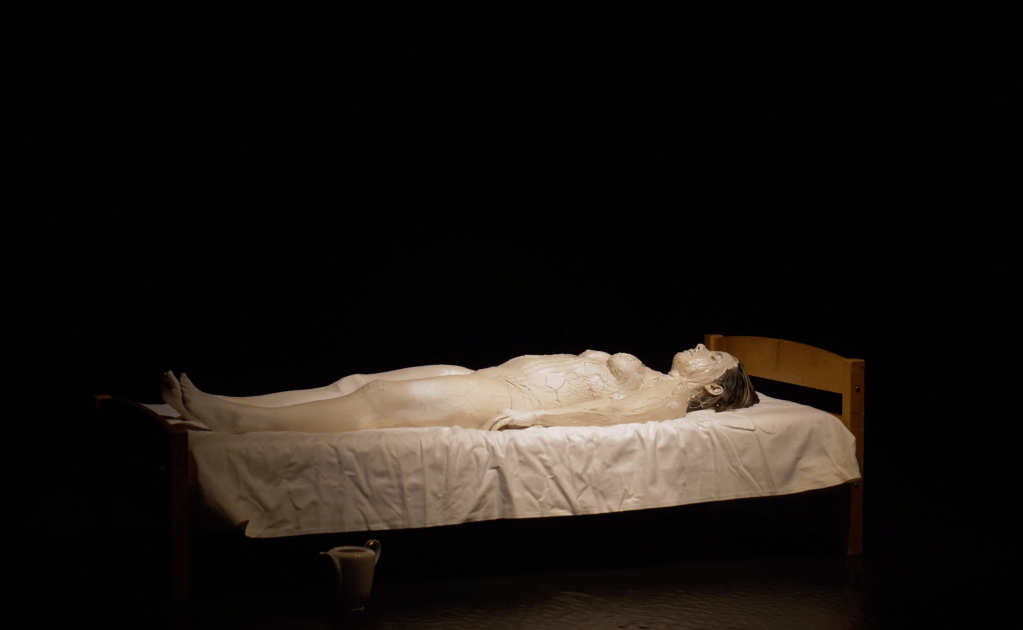
Sayapina frequently uses her own body as a medium, channeling the experiences of others while also reflecting her own. She emphasizes the importance of maintaining a horizontal relationship with the subjects of her work, engaging only with experiences that she herself understands and shares. This approach underscores her commitment to authenticity and empathy in her art.
At Warsaw Gallery Weekend 2024, Nadya Sayapina will present her work “Coming Alive…”, part of the “X Letters” project—a video diary created in collaboration with musician and composer Eugene Buldyk and vocalists from Neue Vocalsolisten Stuttgart. This project interweaves diverse contexts and human stories related to exile, loss of home, and existential crises in Ukraine and Belarus. “Coming Alive…” continues her long-term research project “Letter-to-Mom”, which delves into the experiences of forced migration.
“Coming Alive…” is a deeply personal and politically charged piece that explores the intertwined experiences of displacement among Belarusians and Ukrainians. The video, based on a poem by Ukrainian poet Olena Stepanenko and translated into Belarusian by Julia Cimafiejeva, captures the profound emotional resonance of social and political tragedies through the body. Having migrated to Ukraine following the 2020 events in Belarus, Sayapina reads the poem in both languages, reflecting the shared realities of forced migration.
Marked by its raw and performative nature, “Coming Alive…” was recorded in a single take—a method that enhances both the emotional and physical intensity of the work, while also emphasizing the authenticity of the experience. Sayapina describes the piece as a “video-performance,” highlighting that while video is the primary medium, the actions captured are a form of performance art, executed without edits or retakes, embodying a pure and unfiltered expression.

Her collaboration with Eugene Buldyk, who contributed to the project’s aural tension and visual staging, is essential to the work’s impact. The carefully constructed scenography, lighting, and body art amplify the video’s focus on the body’s role in experiencing and communicating trauma. Among the works in the “X Letters” cycle, “Coming Alive…” stands out for its brevity and concentrated power, making it one of Sayapina’s most corporeal and evocative pieces.
Warsaw Gallery Weekend 2024 promises to be a groundbreaking event, not just for the artistic community, but for the broader discourse on identity, memory, and the power of art as a medium for social change.
Links:
KRUPA | Warsaw Gallery Weekend
LETTER TO MOM – Nadya Sayapina (cargocollective.com)

 ART HUB
Leave a comment