
Lee Ellis is a British multi-media artist based in Bristol, known for his bold and expressive style that blends bright colors with dark, intense subjects. His work spans various mediums, including printmaking, drawing, and painting. Ellis’s paintings often depict deep-seated angst, conveyed through raw, visceral brushstrokes. His recent work, however, balances this emotional depth with wit and originality. His ‘Imposter’ collection garnered significant attention, and he continues to explore creative new themes, drawing inspiration from royalty, superheroes, iconic design, and more, all presented in his distinct contemporary voice.
Can you tell us about your journey as an artist and how you came to embrace multiple artistic mediums?
Where to begin? I’ve always been fascinated with portraits and figures, but more so the process of creation. Experimenting with any medium and tool I can dine to create something new. The process is possibly the most important thing for me as an artist. The constant experimentation and never knowing what will happen intrigues me and drives me to try new things within my art. The use of different mediums started when I first began painting regularly. I had limited money and had to be resourceful by using whatever I could find. I started with cheap paints, decorating materials and whatever was free. This has evolved over time, but the sentiment remains the same.
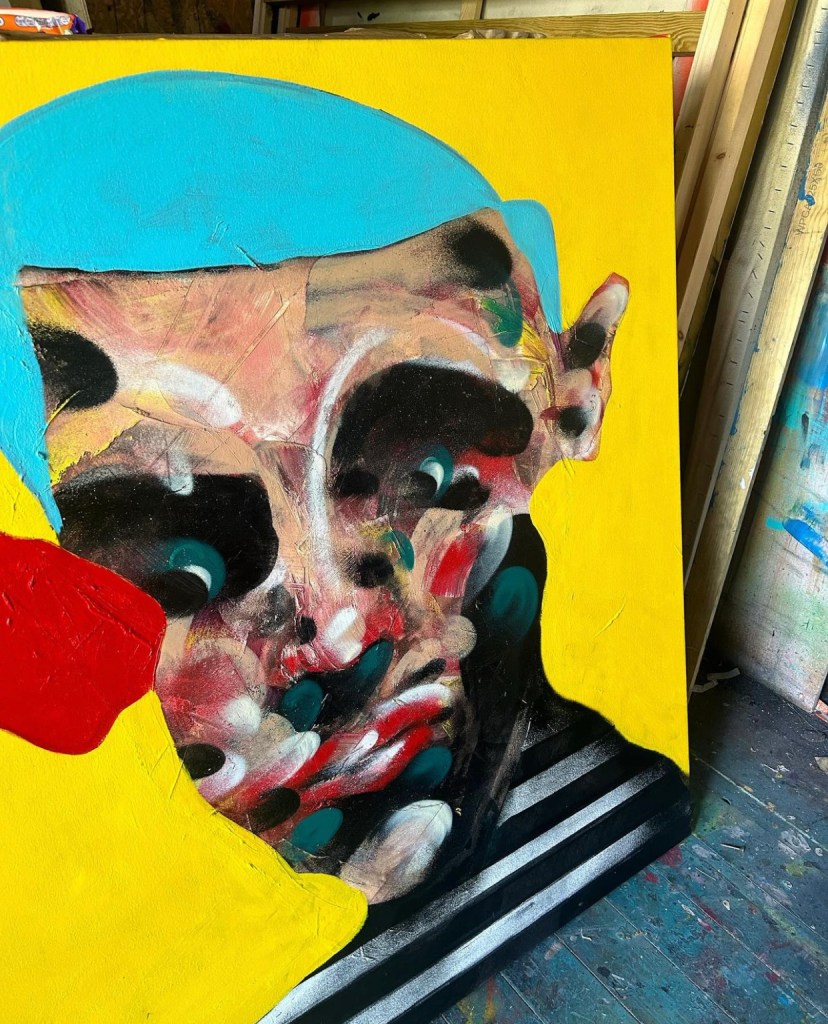
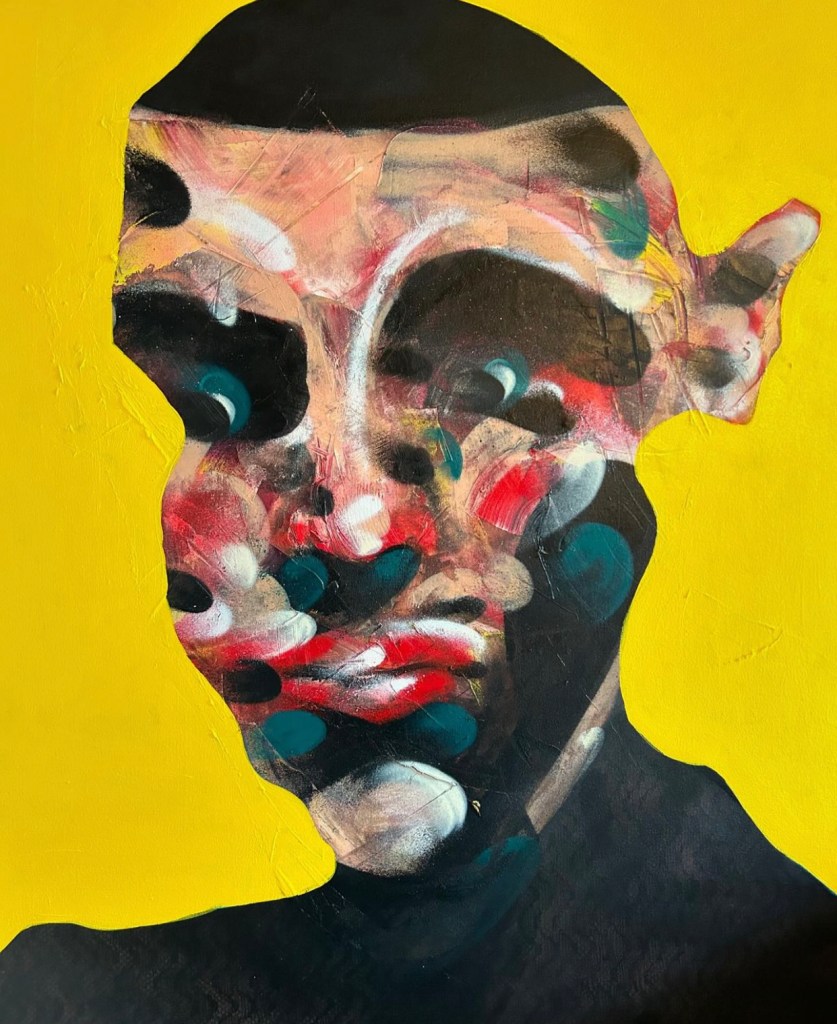
Your work often juxtaposes bright colors with dark subjects. What draws you to this contrast?
I love the contrast. The playful, kitsch colours and patterns alongside the macabre, textural portraits. I think the two work so well together, complimenting each other. The bright softens the macabre, while the macabre tones down the over the top theatrical elements of the bright colours.
How did your ‘Imposter’ collection come about, and what impact has it had on your artistic evolution?
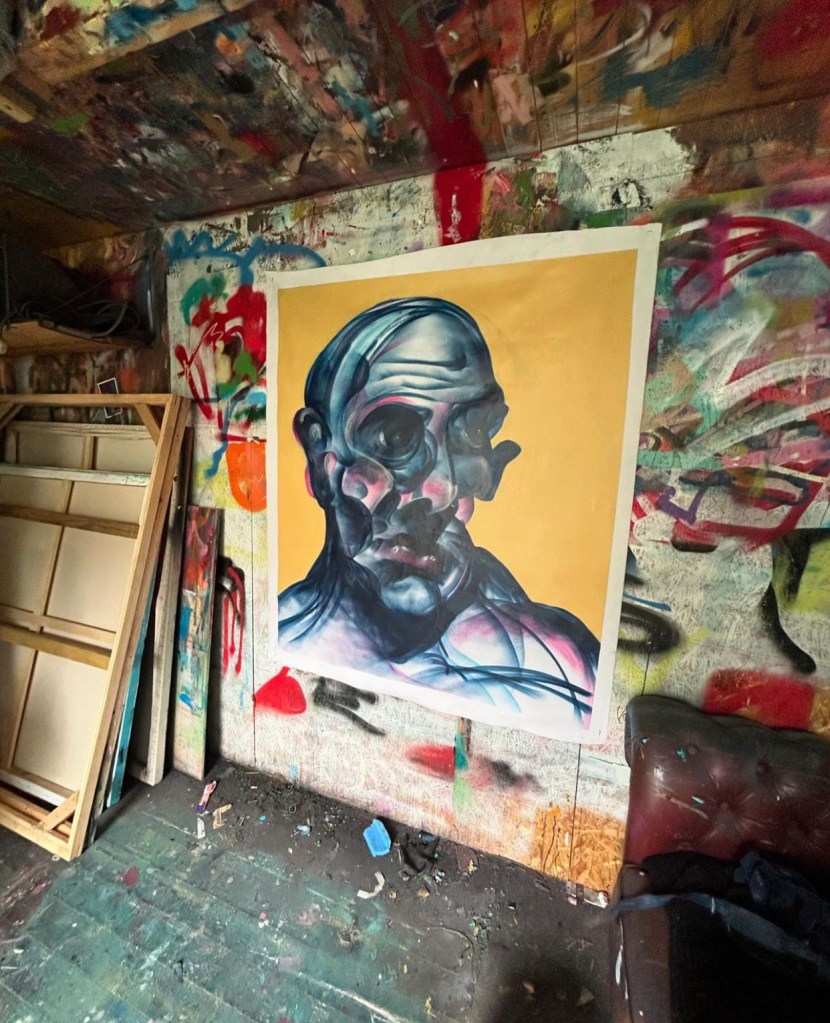
I wanted to paint artists. Everyone paints icons / famous people at some point, but I didn’t like any of them, so I wanted to explore artists that ordinarily wouldn’t be painted. These are the creative people that have inspired by over time. The reason they are ‘imposters’ is that their faces evolved throughout the process and mutated, making them look like impersonators. This influenced the title.
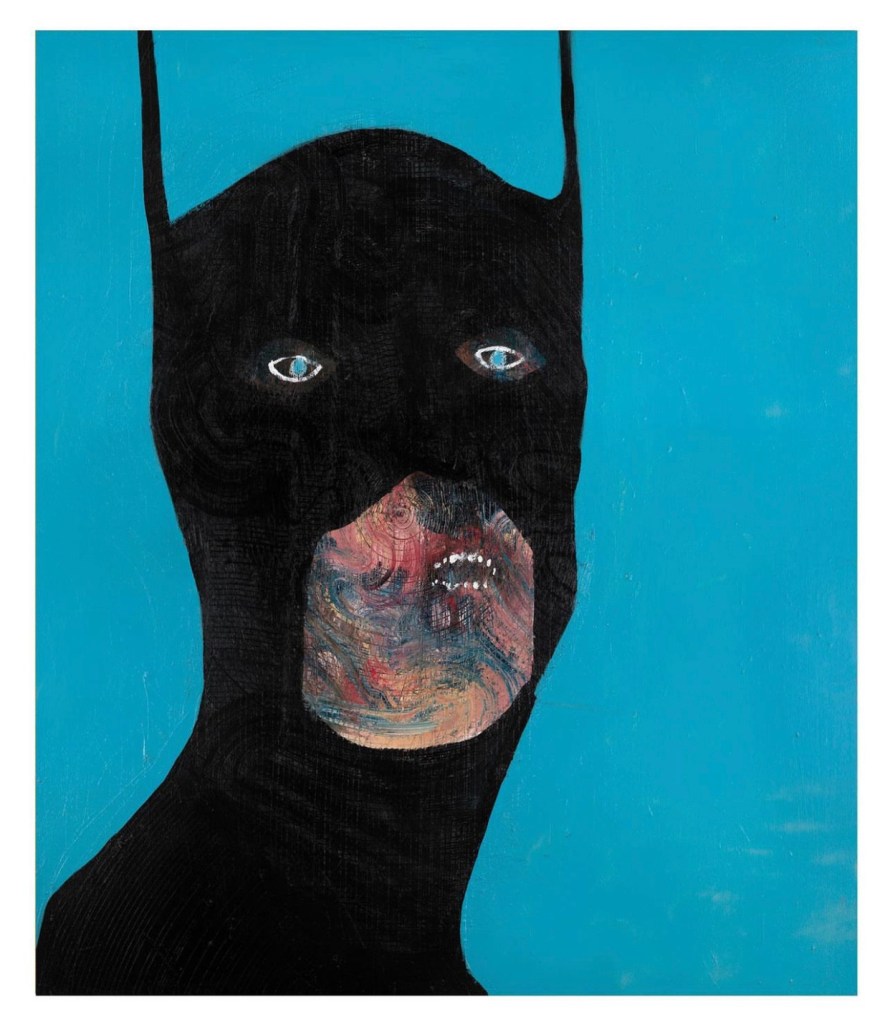
Could you elaborate on your statement that the human face acts as a “vessel for experimentation” in your work?
The face being a vessel means I can do whatever I like within it. Without the face form it would become an abstract painting, but I don’t want to create purely abstract pieces. I want to capture people, emotions and tell stories. The human face allows me to do this.
How do you balance the use of oils, spray paints, and charcoals in your paintings? What does each medium bring to your art?
Great question! I often mix two of those together be lit charcoal & spray paint or charcoal & oils. Sometimes I use all three , layering up in a specific order – charcoal, then spray paint & finished with oils. This is down to the fact oils take longer to ‘dry’ and even then they don’t fully dry. I don’t want scary paint cracking over the top of the oils if something moves them for example.
They all offer me different freedoms creatively. Spray paint is fast drying and allows for more aggressive creation, charcoal I can manipulate to a point through the use of an eraser. The charcoal has a more graphical feel to it, while still be emotive and expressive. The oils are lovely to paint with and the slow drying time allows for me to work into pieces over a long period of time. When I mix the mediums they create a completely different look and feel. Often having some of the elements coming through. They allow for great expression and experimentation.

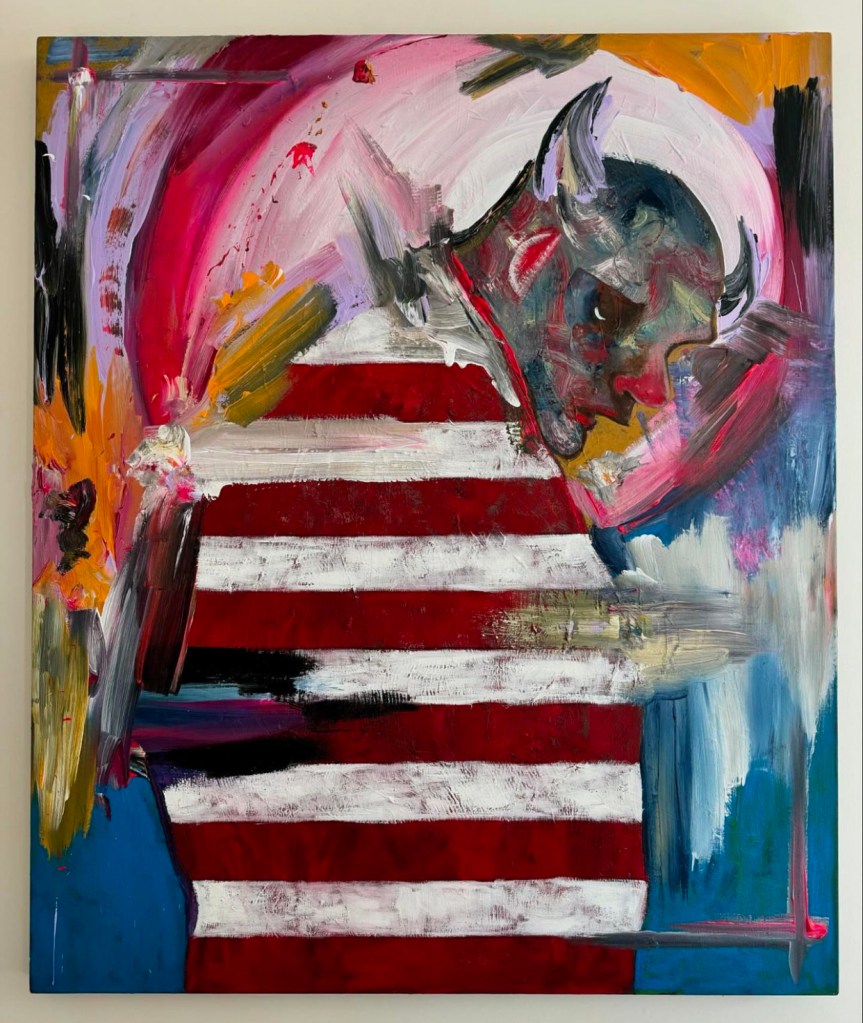
The work of Arnulf Rainer, Francis Bacon, and Lucian Freud has had a significant influence on you. Can you share more about how these artists have shaped your style and approach?
The Arnulf Rainer painting “red wine crucifix” was hanging in the Tate modern many years ago. I saw it on a school trip and it was the first time a painting really struck me. It was seeing that piece that made me think, I want to do that. I bought a little postcard of it, stuck it in a sketchbook and let the inspiration flow.
My love for Bacon and Freud are years later at University, their mark making, texture and the way they captured their subjects appealed to me. Bacon’s colour palette and his macabre style juxtaposed with the bright stark backgrounds is wonderful and something I’ve always wanted to achieve in my own work.
What was the turning point in your career that led you from studying Graphic Design to becoming a fine artist?
Once I graduated from university with my design degree I quickly came to the realisation I would be working to someone else’s brief for an awfully long time. I wanted to hold onto some creative freedom without briefs, so I piked up painting around 2006 – weeks after graduating. I began painting every day, experimenting with every style and technique I could. I spent all my spare time painting and trying to exhibit the work on any wall that was available. After 12 years in the design world and using up all my spare time to paint, I went freelance and this allowed me more time to paint in between jobs. Over the course of the last 6 years I’ve managed to tip the balance between design and fine art, spending 95% of my time painting. I still do the odd bit of freelance, but I pick and choose what I do.
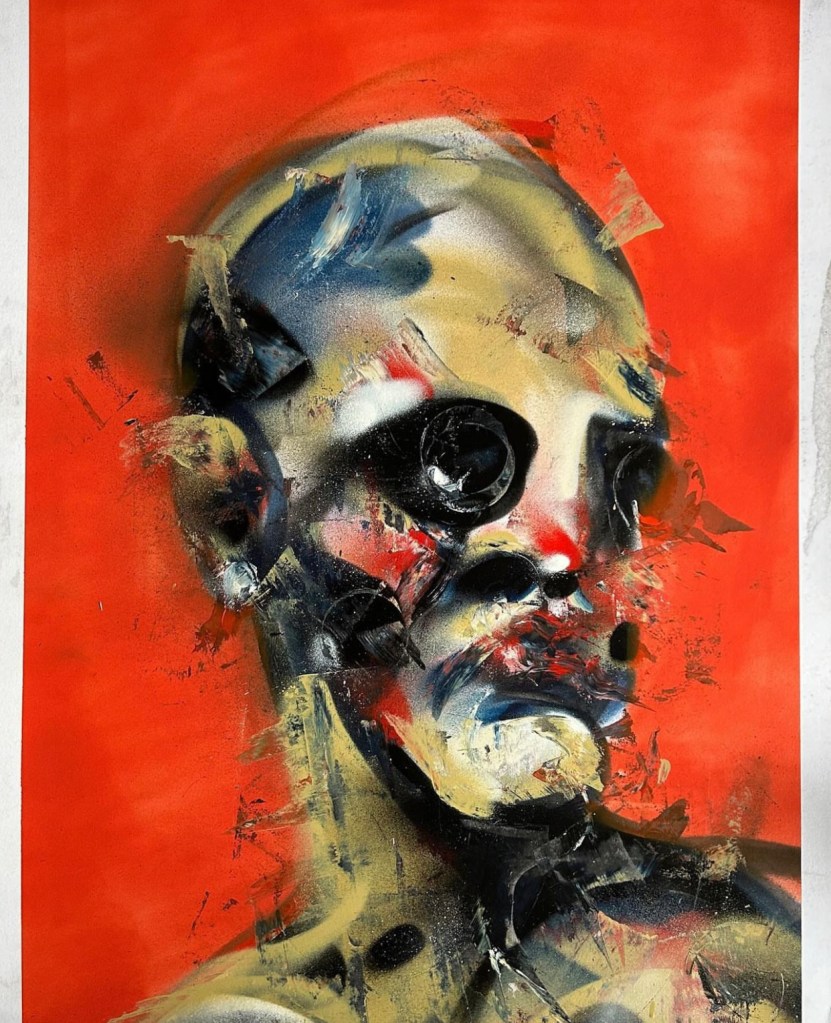
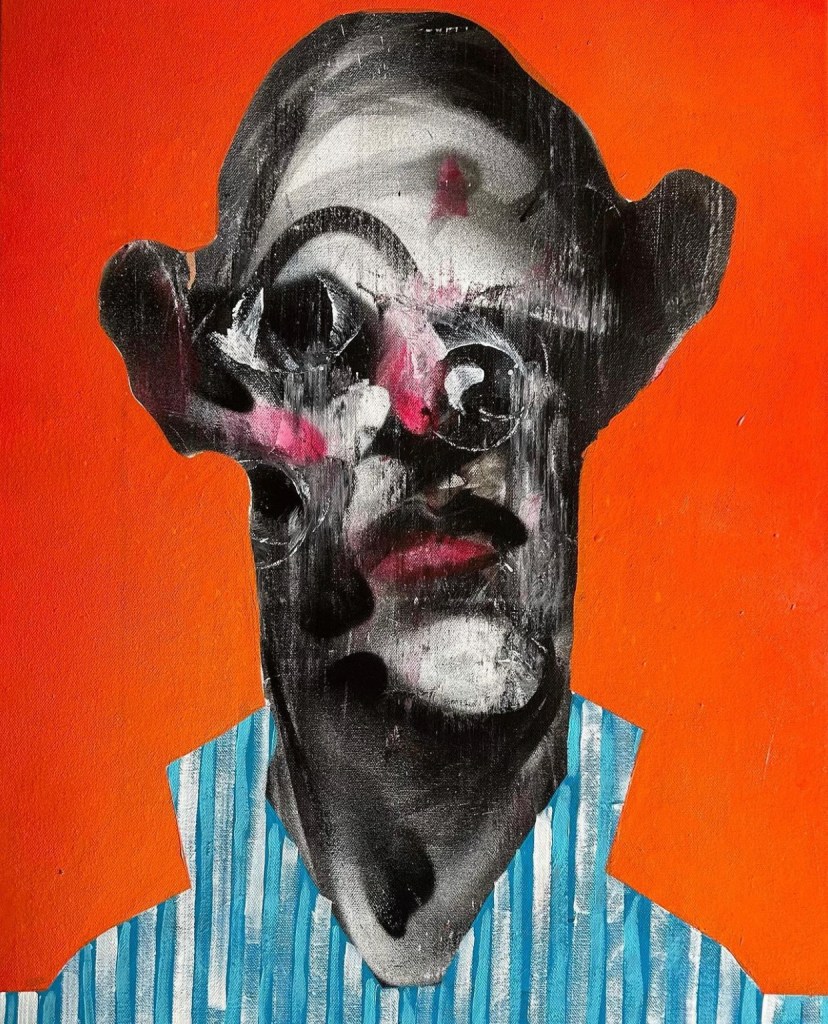

Could you describe your process of experimenting with non-traditional painting tools and how this impacts the final piece?
I will use anything I have lying around the studio. Things painters wouldn’t be expected to use from wire brushes to hand saws or scrap pieces of wood. I use these to move paint in unique ways that is unpredictable and out of my control. The results don’t always work as there is a lot of experimenting with this. However, when they do work they look great and new and it’s all down to those serendipitous moments.
What does a typical day in your studio look like? How do you maintain creativity and energy in your work?
Brave the 30 second commute from my house to the studio at the end of the garden, usually armed with a black coffee a little after 9am.
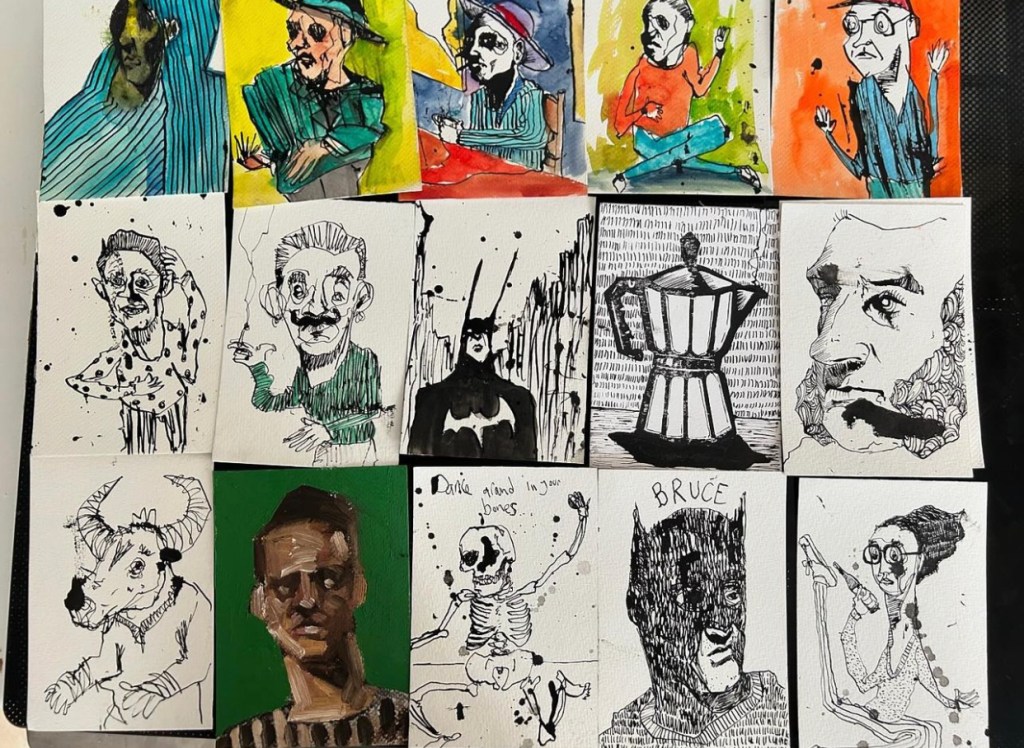
It differs depending on what projects I have on or exhibitions I’m working towards, but the main thing that is consistent is I will do a quick 30 minute charcoal drawing or spray painted portrait on paper to loosen up and start the bigger works. I work on multiple pieces at a time, having to rotate them around the limited wall space I have. Turning them away once I’ve added some paint to each piece. I’ll stop for lunch and another coffee around 12ish before heading back to work for a couple of hours more. I then stop around 15:00 to pick the kids up from school. It’s a short day, but it works for me.
I maintain the energy and creativity by doing something eery day, be it a drawing, painting, printmaking, collage, etc… Keeping up with the practice helps create more ideas and keeps me excited about my work.
What are some upcoming projects or themes you are excited to explore in your art?
I’m excited about a new theme for a series of paintings based on the black dog. There re two routes to explore with this theme, the more traditional English folk lore whereby the black dog is more supernatural /or a demonic hellhound that is usually large with glowing red eyes, often connected with the Devil and is sometimes an omen of death. Or the more contemporary route where the black dog represents depression. This stems from the WHO video that explains depression through the use of the black dog metaphor. I’m leaning more towards this with hints of traditional folklore for a new series. It’s something I find interesting and relatable to so many people, myself included. I’m excited to work on this across several canvas to create a strong series.

 ART HUB
Leave a comment