
As Paul Meusburger eloquently states in his book Milieus of Creativity, “Innovation is applied creativity that generates value; requires imagination which requires diverse stimuli, flexible environments, and networks that can withstand it.” This article aims to explore the concept of parallel innovation in the arts and its future potential, drawing from both academic literature and a recent interview I conducted with Colombian artist Andrés Ribón. Our conversation, sparked by a contact through social media, delves into the theme of connection, an idea central to Ribón’s work. This collaboration has allowed us to explore the independent invention of ideas and to compare our perspectives on culture, art, and life, influenced by our backgrounds in the Colombian, Polish, and broader international diasporas.

The concept of parallel innovation – exploration of artistic interconnectedness
In exploring the concept of parallel innovation, it is vital to understand how artistic influence and identity converge in the creative process. The article Catalysts for Creativity and Innovation by FAST45, a collective initiative focused on equipping arts institutions with the tools to shape an uncertain future, notes that “the parallel feature by which few activities are carried out simultaneously accelerates the innovation process.”
The interconnectedness of creative minds has always been a driving force in art history. Artists who were unaware of each other’s existence, living in different parts of the world, often found themselves creating in a similar spirit, for example my interviewee Colombian sculptor Andrés Ribón and Spanish sculptor Jaume Plensa. Their surroundings and experiences led them to the same realisations, producing similar effects through different thought processes. Today, this phenomenon raises questions about creativity itself. Is there still originality in art, or is everything a reflection of what has already been seen?
Visiting art shows and exhibitions often triggers a sense of déjà vu, a feeling that has been a catalyst for my journey into the arts. During my Art History lectures with my mentor, Lucyna Urbańska Kidoń, she encouraged a thinking process rooted in associations, intuition, and the visual memory of art. The more I learned, the more I felt I had seen it all before. Initially, I viewed this as a negative, but over time, I realised that similarities in art are essential. They are the foundation of art movements and collectives. Understanding that inspiration is a key part of creativity, without directly copying another’s aesthetics, is crucial. Ideas are meant to be developed and reinterpreted.
This idea resonates with the insights shared by Andrés Ribón in a recent interview, where he reflected on his experience working with collectors over the eight years. Ribón explored the fine line between inspiration and imitation, drawing parallels between the art world and industries like automotive design. Just as brands like BMW, Audi, and Mercedes may share similar forms but distinguish themselves through subtle design variations, Ribón believes that true creativity emerges when an artist makes something uniquely their own. This perspective is supported by Pine and Gilmore in The Experience Economy: Work Is Theatre & Every Business a Stage, where they note that “societies operate in economic, social and technological interrelated contexts which are undergoing a continuous evolution that has been subject to a progressive acceleration.” As economies have evolved from a focus on production to services and now to knowledge, the arts, culture, and creativity have become pivotal in this transformation, driving what is now known as the creative economy.
Ribón also emphasised the importance of finding one’s unique voice in art, while acknowledging the inevitable influence of others. He recounted an experience early in his career when his work was compared to that of Jaume Plensa, an artist he was unaware of at the time. After completing his first prototype, he shared some photos with friends, one of whom pointed out the similarity to Plensa’s sculptures.
“At that point, I didn’t know who Jaume Plensa was, but when I finally saw his work, I was blown away. It was amazing to see that my idea aligned with such an established artist,” Ribón recalled. This realisation made him feel validated, as if he was on the right path, not just creating something unique, but also contributing to a larger artistic conversation. Ribón’s reaction was refreshingly different, especially considering that many artists might fear being labelled as copyists in such situations. Instead of feeling defensive, he embraced the comparison as a sign that he was on the right path, creating work that resonated within a larger artistic dialogue. Ribón, while listening to the song “Telefonía” (2017) by Jorge Drexler, which includes the lyrics “Aunque todos creen que han inventado algo. Y siguen siendo las mismas las canciones” (meaning “even though everyone thinks they’ve invented something, the songs are still the same”), underscores the current reality of creativity in today’s world.
However, Ribón also experienced a moment of doubt. “I found out that someone had already been working with similar ideas and techniques for about 15 or 18 years before I started. It was like realising I was not the first to discover America, except, America existed long before it was ‘discovered.’ That’s how I felt at first. I was disappointed, thinking, ‘I’m not as good as I thought. I’m not a genius, and I’m not discovering anything new.’”
This journey highlights the complex emotions artists navigate when they realise that their ideas are part of a broader continuum, reinforcing the importance of both individuality and connection in the creative process.
Historical context in Parallel Innovation
Parallel innovation in art history refers to the phenomenon where similar artistic movements or styles emerge independently in different regions, often influenced by shared cultural, social, or technological contexts. One of the most prominent examples is the development of Cubism by Pablo Picasso and Georges Braque in the early 20th century. Despite their close collaboration, both artists independently explored new approaches to form and perspective, leading to the creation of the Cubist style, which fundamentally reshaped modern art as stated by John Richardson in the book A Life of Picasso. Ribón acknowledges this, drawing on Picasso’s insight that true originality is often elusive and frequently involves mastering and reinterpreting existing ideas. “Growing as an artist and a person means understanding that you’re not creating something entirely new, Picasso himself said. He was known to be a great forger, someone who could imitate others’ works so well that sometimes his versions were better than the originals,” Ribón reflects.
This view challenges the traditional notion of the artist as a solitary genius, emphasising instead the importance of influence and adaptation. Another compelling example is the simultaneous rise of Impressionism in France and a comparable aesthetic movement in Japan during the Meiji period. While French Impressionists like Claude Monet and Pierre-Auguste Renoir focused on capturing the effects of light, colour, and brushstroke in their depictions of transient moments, Japanese artists were independently exploring similar themes through ukiyo-e woodblock prints. These instances of parallel innovation highlight how artists, despite being separated by geography and culture, can arrive at similar creative breakthroughs, underscoring the universal nature of artistic expression as stated by Ives Colta Feller in The Great Wave: The Influence of Japanese Woodcuts on French Prints.
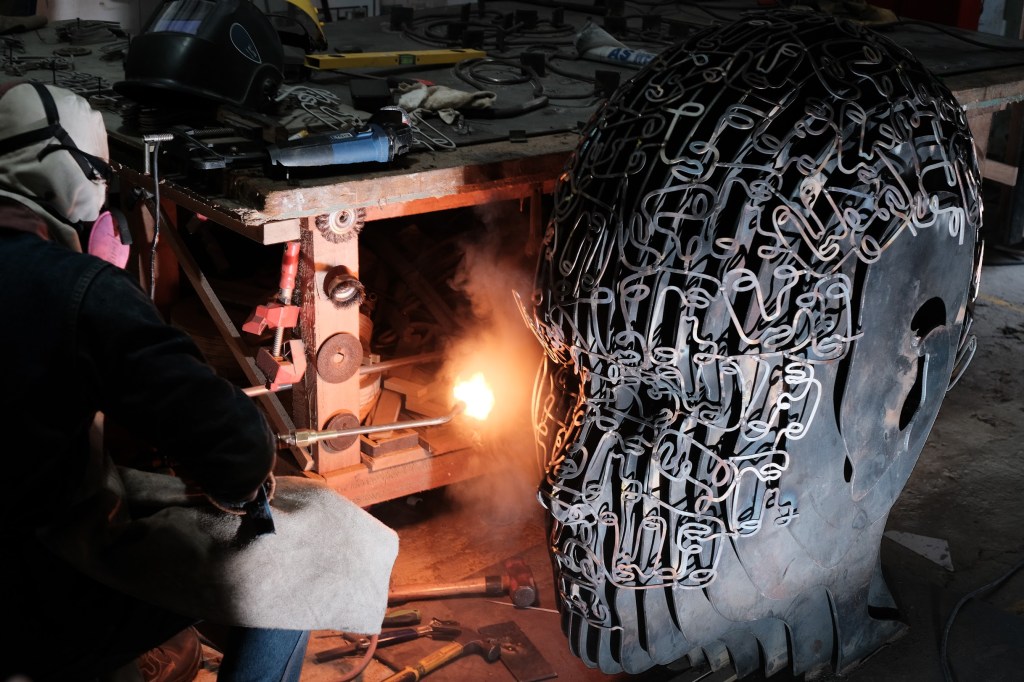
As Andrés Ribón continued to evolve his artistic practice, he recognized the critical importance of collaboration, especially when executing large-scale projects. Drawing parallels to artists like Jaume Plensa or who often works with teams of artisans to realise his conceptual visions, Ribón shared his experience of partnering with a bridge-building friend to create his largest sculpture. This trend reflects a broader shift in contemporary art, where the role of the artist increasingly includes managing teams and overseeing the complex processes involved in creating large-scale works.

What is more, Roberto Gómez de la Iglesia in the article “Artes y Cultura Para La Innovación Abierta: Hibridar Para Innovar (Generando Conexiones Improbables)” notes that creative industries significantly contribute to the global economy, playing a vital role in driving innovation and shaping new models of work and business. He argues that the prevailing discourse around creativity has, in many ways, become a conceptual and practical barrier to rethinking culture and the intricacies of cultural work in the digital age, a perspective that aligns with Ribón’s views.

The Impact of Cultural Exchange
Cultural exchange is a vital force in both personal and artistic growth, acting as a catalyst for creativity and the fusion of ideas. People often stay within the boundaries of their familiar environments, shaped by their culture, language, education, and social circles. However, stepping beyond this comfort zone and embracing new experiences can expand one’s mind and foster learning from the differences that exist among us. Andrés Ribón reflected on the transformative impact of his first trip to Europe, particularly his time in Germany, where exposure to cultural differences sparked new ideas and perspectives. Engaging in deep discussions about politics, society, and art with people from diverse backgrounds deepened Ribón’s understanding of the duality in being both unique and similar to others. This exploration of identity and community became central to his work, leading him to develop ideas that reflect the complexity of being distinct because of our differences, yet connected through shared experiences.

Upon returning to Colombia, Ribón was inspired by his European travels and filled with new ideas, particularly the concept of creating an installation or sculpture that people could physically enter, symbolising the idea that we are all part of something larger. Influenced by Julian Voss-Andreae’s use of stainless steel patterns, Ribón began experimenting with moulds, integrating them as a critical component of his creative process. While Voss-Andreae’s patterns were final sculptures, for Ribón, they marked the starting point for a more extensive exploration.
Globalisation in the art world
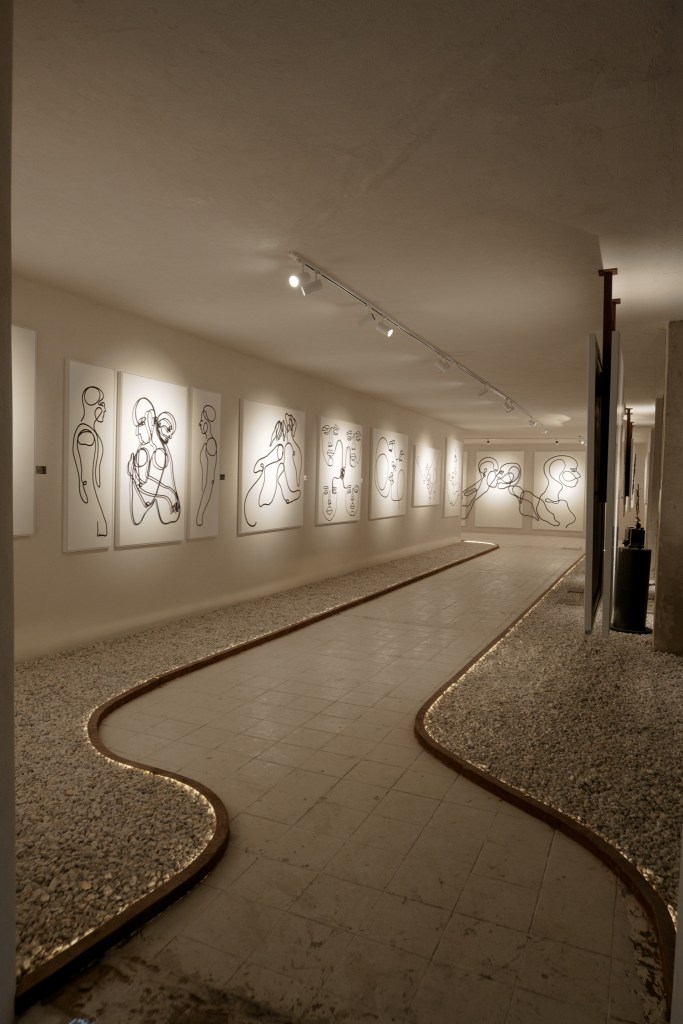
In today’s art world, the tension between originality and reinterpretation is a significant challenge for many artists, including Andrés Ribón. While originality has long been celebrated, the reality is that no art is created in isolation; every artist builds upon the work of those who came before. Ribón’s transparency about his influences highlights the idea that innovation often stems from reimagining existing concepts rather than inventing something entirely new. However, this approach also forces artists to confront the commercial realities of the art market, where the demand for originality can sometimes overshadow the creative process. Ribón speaks openly about the struggle to balance artistic integrity with market pressures, noting that while his large, intricate sculptures are driven by passion, he must also contend with the demands of capitalism to sustain his practice. This ongoing tension between art and commerce underscores the complex environment in which contemporary artists operate, where staying true to one’s vision often requires careful negotiation between originality and reinterpretation.
As Jaime de Los Ríos, an artist and specialist in new media and technologies, noted in a 2021 interview for FAST45 Knowledge Alliance, “art must be constructivist in the sense that it allows to create people, and that those people build society. Then the most important thing about art is no longer there, which is the ability to reflect and to destroy itself in order to rebuild once more.” This perspective aligns with Ribón’s understanding of the evolving nature of creativity in a globalised world.
Ribón acknowledges the profound impact of technology on his work, noting how it has enabled him to continually reinvent his artistic approach.
“I have seen incredible progress over the last 20 years. What excites me most is how my art has evolved. I am creating work now that’s completely different from what I was doing just a year ago, or even seven years back. I am exploring how technology and social media shape our lives, and I am incorporating those insights into my sculptures and installations.”
~ Ribón explained.
Conclusion
As we move further into the 21st century, the concept of parallel innovation in art is likely to evolve in unprecedented ways, shaped by rapid advancements in technology and communication. The ease with which ideas can now be shared and disseminated globally means that artists from different corners of the world can influence each other more quickly and directly than ever before. Andrés Ribón, a contemporary sculptor deeply engaged with these changes, offers a thought-provoking perspective on the future of art. He suggests that artists, galleries, and curators must now consider how to define their roles in this new century. “In the way I create and present my artwork, I think artists, galleries, and curators now need to focus on how we can be artists for this new century. The last century had Picasso, Dalí, and even contemporary artists from the 80s and 90s. But now, what’s happening with artists who are starting in this new century? How are they developing their art?” Ribón’s question highlights the uncertainty and excitement that comes with this new era in art.

References:
- FAST45. “Artists as Catalysts for Reativity and Innovation”, n.d.
- https://www.fast45.eu/art-school-futures/artists-as-catalysts-for-creativity-and-innovation.
- Gómez de la Iglesia, Roberto. 2019. “Artes y Cultura Para La Innovación Abierta: Hibridar Para Innovar (Generando Conexiones Improbables).”
- Ives, Colta Feller. “The Great Wave: The Influence of Japanese Woodcuts on French Prints.” The Metropolitan Museum of Art, 1974.
- John, Richardson. “A Life of Picasso.” Alfred A. Knopf, 1991.
- Peter, Meusburger. “Milieus of Creativity: The Role of Places, Environments, and Spatial Contexts.” 2009 In , 2:97–153. Springer Dordrecht.
- Pine, Joseph, and James Gilmore. “The Experience Economy: Work Is Theatre & Every Business a Stage”. Boston: Harvard Business School Press. 1999.

 ART HUB
Leave a comment