
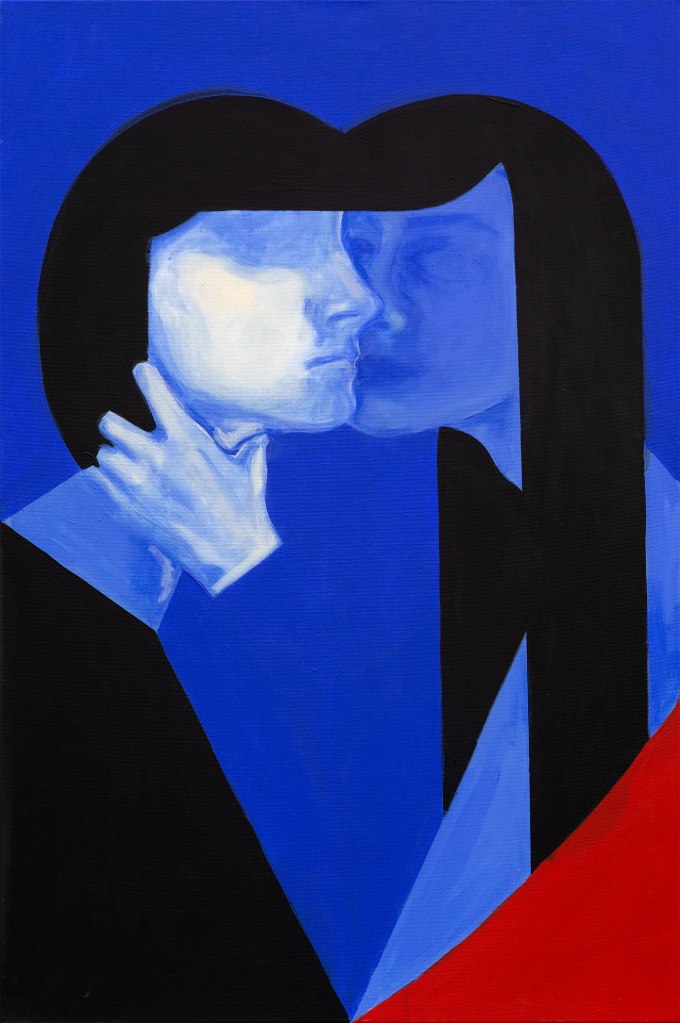
Joanna Ambroz is a multidisciplinary artist engaged in painting, poster design, and the creation of “total books.” Her work delves into current events, societal concerns, and human passions, often using her own image as a prop to comment on the universal nature of human existence and contemporary issues. Through her art, she explores the interplay between two dominant colors—red, symbolizing consciousness, tension, and conflict, and blue, representing the subconscious, reflection, and mourning. Ambroz holds a PhD from the Academy of Fine Arts in Katowice, where her practical work, Come, I Will Show You My Knives, was added to the collection of the National Museum in Poznań. She has received numerous accolades, including the Rector’s Award for her master’s and bachelor’s degrees, and her works have been featured in prominent publications such as Vogue Polska and Gazeta Wyborcza. Ambroz currently resides in Warsaw.
Can you share a bit about your background and how you started your journey in art?
I come from Częstochowa, a place closely associated with religious cult. The city lived in the shadow of the sanctuary while I was growing up, fighting a constant dispute between faith and the free-thinking views of its inhabitants. There was a sense of deep worship and conservatism in Częstochowa that I was unaware of as a child. I think this has had a significant impact on my actions: I want to function in opposition to the reality around me, although at the same time I am filled with the need for order and rules. Being free within what is imposed is my constant conflict.
When I was a child, I observed my mother painting a large painting. She had never received formal art education, but she loved to create. At the age of nine, I asked my parents to enrol me in a drawing class for art school applicants. I then went to a six-year art school in Częstochowa and later to the Academy of Fine Arts in Katowice. Despite the maturity of independence, I was very much affected by the separation from my family. I cried so much! After my bachelor’s and master’s degrees, which I completed with honours, I started my doctoral studies and I graduated last year. Ever since I was a child, there was a great desire in me to create. So great that I didn’t realise what a huge impact it was having on my life.
What are the main influences and inspirations behind your work?
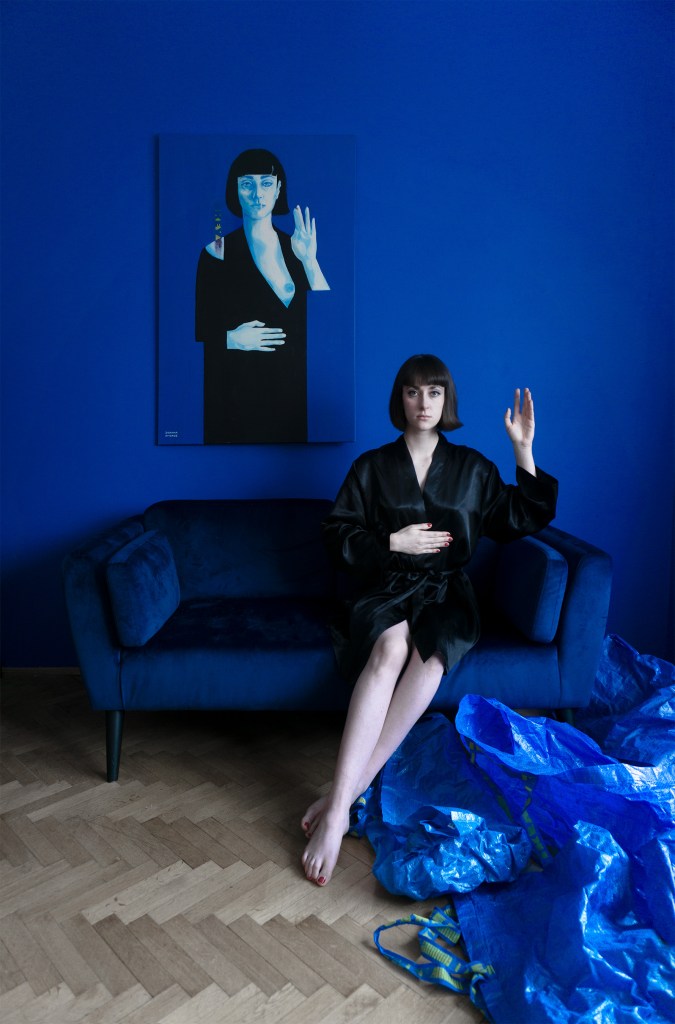
Mostly I do a story about what makes me passionate, curious or deeply sad. I like to reflect on who I am, how I am changing, how I am affected by what I surround myself with. I analyse what is going on inside me. Often understanding comes after time, when I look at a painting or read a book that has already been written. For me, creating is an act of trying to close down events so that I can process them and not think about them. I don’t feel comfortable when I have to tell my friends about my problems, I feel ashamed. But I also don’t want them to stay in me; creating is the only way to get clear of sensations. What I make is a transcript of my life, of what made me happy, fascinated or worried.
How would you describe your artistic style and the evolution it has undergone over the years?
From classical drawing and painting, to a complete synthesis in an author’s book and poster, to a combination of these fields. It’s symbolic for me to combine what I learned in secondary art school to what I understood at Academy with how much I can do as an adult. At my Master’s degree defence I was asked the question ‘Are you an artist or a graphic designer?’ I replied that I didn’t need to put myself into a framework, I was consciously planning my artistic path and wanted to explore all that art has to offer me. Art and science is for me to learn from. When I got to know a lot, I could choose what gives me the most pleasure and what I am fulfilled in.

Can you tell us about your creative process? How do you start a new piece and what materials do you typically use?
I always start with /this/ emotion. Sometimes I read something, discover something, see something, the dots from the past connect in my mind. I have to put it onto canvas or paper. I like to read classic books and sometimes reach out to the thoughts of philosophers or psychologists. Right now I am most inspired by Jung and Lacan. The moment of enlightenment is important for me, I get up and start making, without a plan. Then comes the working time during which I reflect a lot. It’s like a process of meditation for me, of intense concentration. Something like writing a diary, but without the fear that someone might one day quote my inappropriate words exactly.
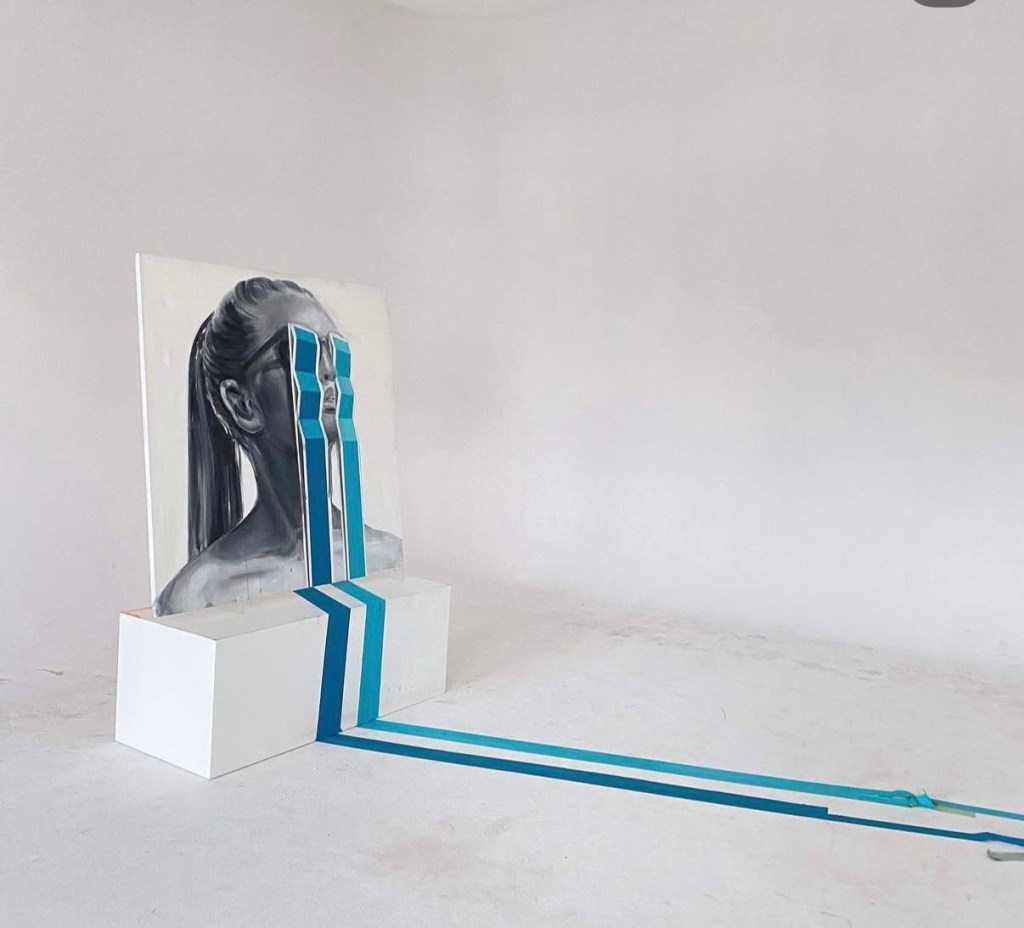
I often lean towards negative space: that is, not on what is depicted in the painting in the foreground, but on what shape is between the frame and the first contact with the figuration on the canvas. In preparation for my studies at the Academy, I read one of Kandinsky’s texts on the construction of compositions, which strongly influenced me as a young person.
Now I use paints and canvases the most. In my life, I have gone through various stages of fascination with materials, at the very beginning there was drawing, then sewing, then design, posters, and in the middle of all this, always painting and extremely important to me: the image supported by the word, i.e. the creation of books in a total sense. After a long break from painting, for example after exhibitions, I find it hard to sit down to a canvas. I feel fear. Then I give myself 15 minutes to do anything. The next day it’s 30 minutes to get back into a rhythm. Now I do a lot of things intuitively, it’s like with language: this is a language I have been learning since I was a child.
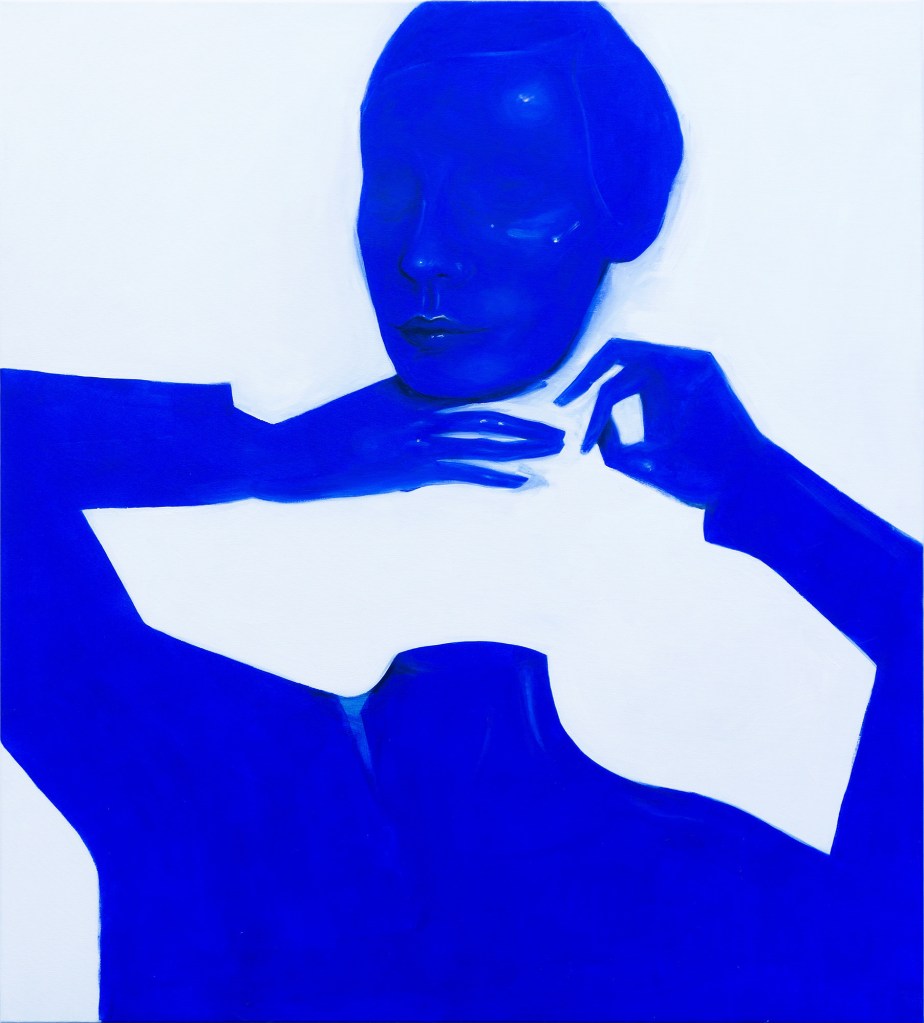
Your work often involves a dynamic interplay of red and blue. Can you elaborate on the significance of these colors and how they interact in your pieces?
I am concerned with the interaction of these colours and the contrast which for me is a metaphor for the exchange between the intensity of sensation and the need to block it out. Red represents consciousness, tension, temperament and conflict. Blue is a symbol of the subconscious, agreement, reflection and mourning. Through these colours it often encodes what feelings are in the painting.
How do current events and contemporary issues influence your artwork?
Current events make me reflect on the fragility of our existence.
When I was learning to draw, I thought that artists’ works were a game of fiction. It wasn’t until I grew up that I realised that artists processed what was around them, the works are a testament to the times. This was a great discovery for me, and my actions became dynamic.
Coming into contact with death in particular was a discovery of a truth for me: I see how short life is and how little time I have to live the life I want. At one point I had the feeling that I had lost everything, that my world had almost come to an end. That’s when I moved to Warsaw, with the feeling that now I would do what I wanted to do, without inhibitions, without being too reserved. Freeing myself, had a huge impact on what I do now and how I do it.

Can you describe a typical day in your studio?
At Academy it was non-stop work, from Academy in the morning, after Academy doing projects for Academy, my own projects and my first collaborations. Now I live for myself more often, not for the work cult, I have learned my rhythm. I don’t have typical days. I try to make plans about what area I am going to be in that day: whether it’s painting, sketching, reading or maybe meetings. I have two patterns: when I start painting, I just paint with my favourite playlist. I think about what is happening on the canvas in front of me. Sometimes I reflect on one sentence I have read. Recently I had that with the definition of desire.
When I have to write something, a scientific text or something serious: I go out to my favourite café, order a French breakfast and write. Often, when I am very unable to get going on something, I go out and just having a coffee outside is my motivation for working
I am gentle with myself because I know my body is fragile. I have learned that when a situation doesn’t suit me, I start to feel bad. That’s why I take a pampering attitude to myself
One thing is typical: I get annoyed when someone makes an appointment with me and cancels on the same day, at worst an hour before the meeting. Such an event doesn’t allow me to focus on what I’m supposed to do and such a day is most often wasted. If this happens the first time I meet someone who wants to work with me, there is little chance of me ever wanting to make a second meeting with that person.
How does your use of self-image as a prop serve to comment on universal human experiences?
Often experiences are universal, but not everyone has the confidence to talk about them. For me, writing down my experiences in images is an everyday thing. Then someone else can find themselves in it. Later, at exhibitions, we talk to visitors about these things that are so obvious that we only realise them when someone else says them.
Are there any particular projects or pieces that you are currently working on or excited about?
Now I am still in the process of thinking about Jung’s shadow and desire according to Lacan. It gives me a lot of pleasure and I am still exploring it. I am just now preparing for my first art fair in New York and a big exhibition that will take place in November in Warsaw.
I recently realised that I have been taking pictures of myself since I was very young. I am thinking of collecting this documentation to see how my perceptions and needs have changed against the backdrop of events, growing up and pop culture.
How has your academic journey at Fine Arts Academy in Katowice shaped your artistic practice?
Training at the Academy of Fine Arts Katowice was key for me. It was there that I learned a completely different way of looking at art: through synthesis. It was there that I was able to realise my direct way of expression: I was interested in the symbol, colour, in compact solids, in poetics. This is an academy about thinking, about how to solve a problem. And I loved solving problems, they were the most important driving factor for me. At first the problem, then the form. It was a very good course for me, after this school I can put everything together: thanks to this, I know how to deconstruct.
Could you share some insights on your doctoral thesis and the practical work “Chodź, pokażę ci moje noże” that was included in the collection of the National Museum in Poznań?
‘Come, I will show you my knives’ is a triple work: a book, a series of 14 paintings and a theoretical work on the my method of making reflective books.
A book has been added to the museum’s collection in which I share the experiences and anxiety surrounding the loss of my beloved Mum. It is a testimony to the struggle with feelings of fear and loneliness.
In an attempt to understand the events, I compare it to a cellar – a symbolic place where not only unnecessary material objects are collected, but also difficult experiences that accompany us despite the need to repress unwanted memories. It is a space where painful moments are concentrated, representing the process of confronting fear, loneliness, suffering and passing.

What do you hope viewers take away from your artwork?
I would like them to find space to think about what they have not been allowed not to talk about. I hear feedback that viewers find themselves and their experiences in my work. My first serious work, after which I received many very intimate messages, was ‘A short book about passing’, which I made in 2013 after the death of my friend. At that time, I emailed my viewers and talked about our experiences. After a while, the messages started to be a lot, they became a huge emotional weight for me. Now I prefer to work in silence and I don’t talk about these things anymore.
How do you see your work evolving in the future? Are there any new mediums or techniques you are interested in exploring?
Art offers many possibilities, a constant exploration of self and space. I am more and more attracted to installations, absorbing the whole space so that the viewer can enter into the story. I am beginning to be interested in the full impact: from the image, the story, to what they can touch, hear and smell.
Could you share some advice for emerging artists who are just starting their journey?
To be constantly hungry. Making. Making, watching a lot, travelling, reading. In between intellectual activities, have a lot of fun, meet people. Work and play – life is meant to be satisfying, not a sad duty to do. To expand your horizons, even when overwhelmed by fear. Not to think too much about the opinion of others. Surrounding ourselves with people who believe in us. To do what you feel good at, to perfect your technique, your idea of yourself and to cultivate your sensitivity and intelligence.

 ART HUB
Leave a comment