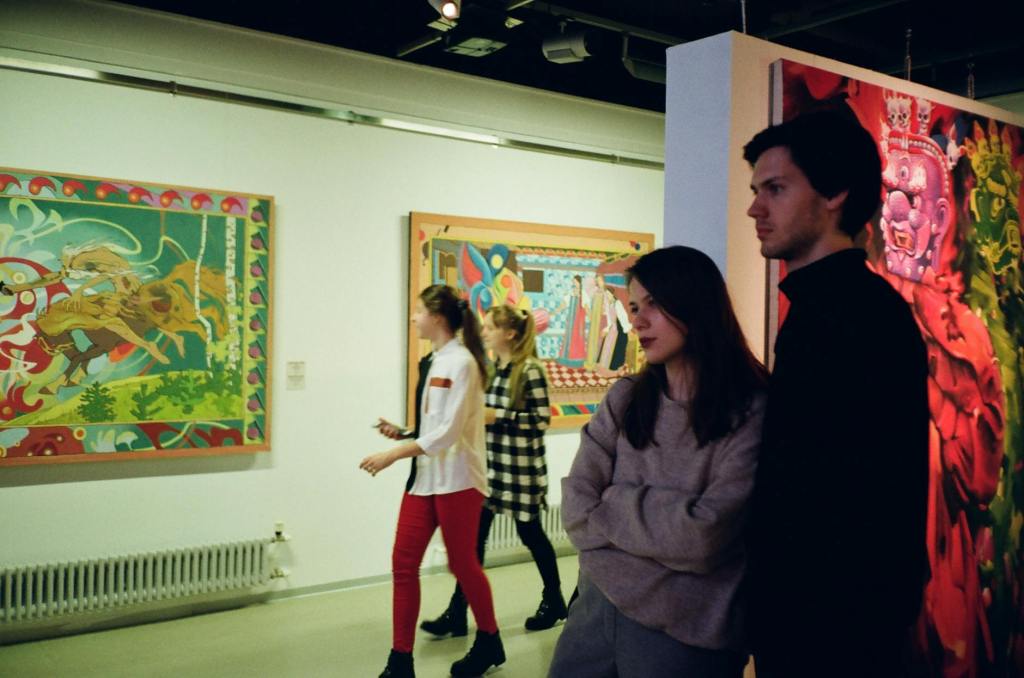
In recent years, Poland has captured the attention of Europe like never before, emerging as a significant hub for contemporary art. This newfound recognition has not been a sudden development but rather the result of a series of impactful events that have put the country—and its artists—under the European spotlight.
One of the first sparks that ignited this broader interest was the Women’s Strike against the proposed abortion law amendment in Poland. The powerful imagery and messages born out of these protests reverberated across Europe, drawing attention not only to the social and political challenges in Poland but also to the country’s vibrant art scene. The strike highlighted how deeply intertwined art and activism are in Poland, with artists playing a crucial role in documenting and shaping the narrative of resistance.
The war in neighboring Ukraine further intensified Europe’s focus on Poland. As waves of Ukrainian migrants sought refuge in Poland, a cultural exchange blossomed, enriching the Polish art scene with new perspectives and themes. This migration not only underscored Poland’s role as a frontline state in a time of crisis but also brought to the forefront the country’s capacity to integrate and reflect diverse experiences through its contemporary art. European audiences began to see Poland as a place where the complexities of modern life—conflict, migration, identity—are vividly and creatively explored.
Political shifts within Poland also played a part in this rising interest. The replacement of the eight-year-long rule of the Law and Justice Party (PiS) with a new government signaled potential changes in the country’s direction, prompting a closer examination of its cultural output. European critics and curators started to pay more attention to how these political dynamics were being mirrored in Polish art. The transition became a focal point for understanding the broader cultural shifts occurring within the country.
The controversy surrounding the Polish Pavilion at the Venice Biennale served as a pivotal moment in solidifying Europe’s interest in Polish art. The scandal, which involved debates over national identity, artistic freedom, and censorship, placed Poland in the center of a broader European conversation about the role of art in political discourse. The event not only showcased the boldness and relevance of Polish contemporary art but also signaled to Europe that Poland was a critical voice in the global cultural landscape.
As a result of these developments, Europe has begun to view Poland not just as a country with a rich historical heritage, but as a vibrant and dynamic player in the contemporary art world. Polish artists, long active within their own borders, are now finding wider audiences and greater appreciation across Europe. Their works, deeply connected to the social and political fabric of their country, offer unique insights and perspectives that resonate far beyond Poland’s borders.
There are five Polish contemporary artists you need to know—each bringing their unique vision and voice to this ever-evolving artistic landscape.
1. Patryk Różycki is a versatile artist known for his work as a visual artist, painter, performer, and creator of written and audio content. Born in 1992, he resides in Warsaw but originally comes from Koło. After studying at the Academy of Fine Arts in Gdańsk, where he graduated in 2017, Różycki initially focused on performance art before transitioning to painting as his main form of expression. His artwork is intensely personal and introspective, often exploring emotionally complex and sometimes traumatic experiences.
Różycki’s painting style merges simplified realism with expressive elements, characterized by dramatic shifts in perspective and distortions similar to the fisheye lens effect. His use of bright colors and strong contrasts, combined with bold, quick brushstrokes, gives his work a distinctive intensity. He often draws on both recent events and distant memories, dissecting these experiences to uncover repressed or forgotten moments. By doing so, Różycki positions himself as an observer of his own past, bringing to life even childhood memories with the same vividness as more recent experiences. Beyond his personal art practice, he has also curated multiple editions of the Kick Off Perfo performance festival and the Baza experimental short film festival, highlighting his significant role in the contemporary art world.
2. Agata Słowak, born in 1994 in Busko-Zdrój, is a prominent figure in the Polish contemporary art scene. She began her artistic training at the Fine Arts High School in Kielce before advancing to the Academy of Fine Arts in Warsaw, where she graduated in 2019. Her graduation project not only capped her academic achievements but also earned her the top prize in the university’s renowned Coming Out competition, which showcases the best final projects from the Academy.
Słowak has participated in numerous group exhibitions, such as the 2019 show “Farba znaczy krew. Kobieta, afekt i pragnienie we współczesnym malarstwie” at the Museum of Modern Art in Warsaw, the 2020 exhibition “Płaca za pracę domową” at Foksal Gallery, and the 2022 exhibition “Niepokój przychodzi o zmierzchu” at Zachęta – National Gallery of Art. In 2022, she also held a solo exhibition at Foksal Gallery, titled “Tylko nasze stany,” which further cemented her reputation in the art world. That same year, she received the prestigious Paszport Polityki award in the Visual Arts category during its 30th edition.
Słowak’s work often explores important social themes, with a particular emphasis on human relationships, gender issues, and women’s rights, while also delving into her own fears and desires. Through her art, she provides a compelling examination of these topics, establishing herself as a significant voice in contemporary Polish art.
3. Karolina Jabłońska, born in 1991 in Niedomice, is a notable painter and co-founder of the Potencja collective and gallery. Currently based in Krakow, she completed her studies at the Academy of Fine Arts in the city in 2015, where she worked under the guidance of Leszek Misiak. From the early stages of her career, Jabłońska has made herself—or rather a figure resembling her—central to her artwork. As she noted in an interview with Wojciech Szymański for “Szum,” while she often uses her own likeness, her paintings are not strictly self-portraits.
Jabłońska is recognized for her unique approach to self-representation, opting for a deliberately exaggerated and somewhat grotesque portrayal of her features rather than striving for realistic or idealized depictions. Her paintings frequently feature large, expressive brown eyes, slicked-back hair, and a wide, often ambiguous expression that straddles the line between happiness and discomfort. This stylized figure is often set against backgrounds that resemble theatrical sets, with flattened, cartoon-like characters and vivid, saturated colors. The simplified forms and imaginative, sometimes fantastical settings in her work have drawn comparisons to the “naive” style of Henri Rousseau, reflecting a similar blend of whimsy and bold, graphic elements.
4. Emilia Kina, born in 1990, graduated from the Academy of Fine Arts in Krakow in 2015. Since then, she has consistently exhibited her work, including collaborative projects with Filip Rybkowski. Her art is represented in the collection of the National Museum in Gdańsk.
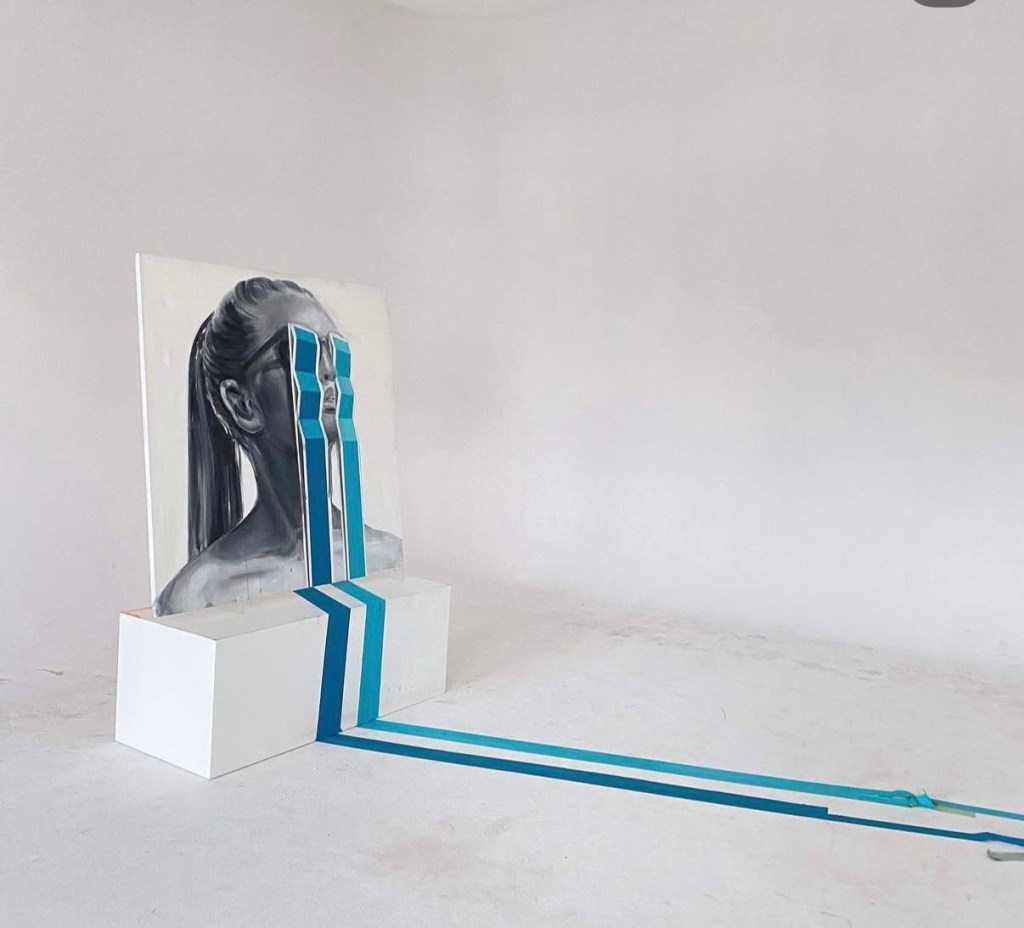
Kina’s practice explores the relationship between the image and the object, focusing on the contrast between a painting’s flat surface and the spatial presence of objects. Drapery, with its shifting folds and rhythms, is a recurring motif in her work. This approach reflects the concept of the painting as a window (with a curtain) or as a curtain itself, emphasizing painting’s ability to simulate and represent. Through her work, Kina interrogates the medium’s potential and limitations.
Additionally, Kina’s use of wooden structures in some of her pieces adds a sense of lightness and fragility, making her compositions appear suspended in space. Her contemporary practice also incorporates elements of photography, using photographic backgrounds to both obscure and reveal different elements. In this context, the curtain serves as a tool for staging and narrative, acting as both a prop and a veil that hides or reveals. Similar to a mask that conceals what is beneath, the curtain in her art suggests a deeper, more elusive truth. This theatrical element—where the curtain remains closed—invites viewers to engage more deeply and stimulates their imagination, encouraging them to consider what might be concealed.
5. Monika Falkus, born in 1993, is an artist with degrees in painting from the Academy of Fine Arts in Katowice and art history from the University of Silesia. Her artistic practice includes oil painting, installations, and video art, with a focus on themes of love, intimacy, and sexuality, alongside an exploration of female nature and strength. Falkus also addresses issues of objectification and related abuses, drawing inspiration from both historical and modern cultural references, literary myths, fairy tales, and her own personal experiences.
Her work examines the connections between humans, animals, and plants, with visual motifs and symbols unfolding like stories on her canvases. This approach encourages viewers to engage in their own interpretive explorations and decode the underlying themes. In her paintings, Falkus places a strong emphasis on color to express moods and sensory values. She often contrasts nearly monochromatic, pastel backgrounds with vibrant, contour-driven compositions. Her semi-abstract figures are sometimes distorted, with blurred boundaries between body parts, enhancing the sense of fluidity and transformation in her work.

 ART HUB
Leave a comment