
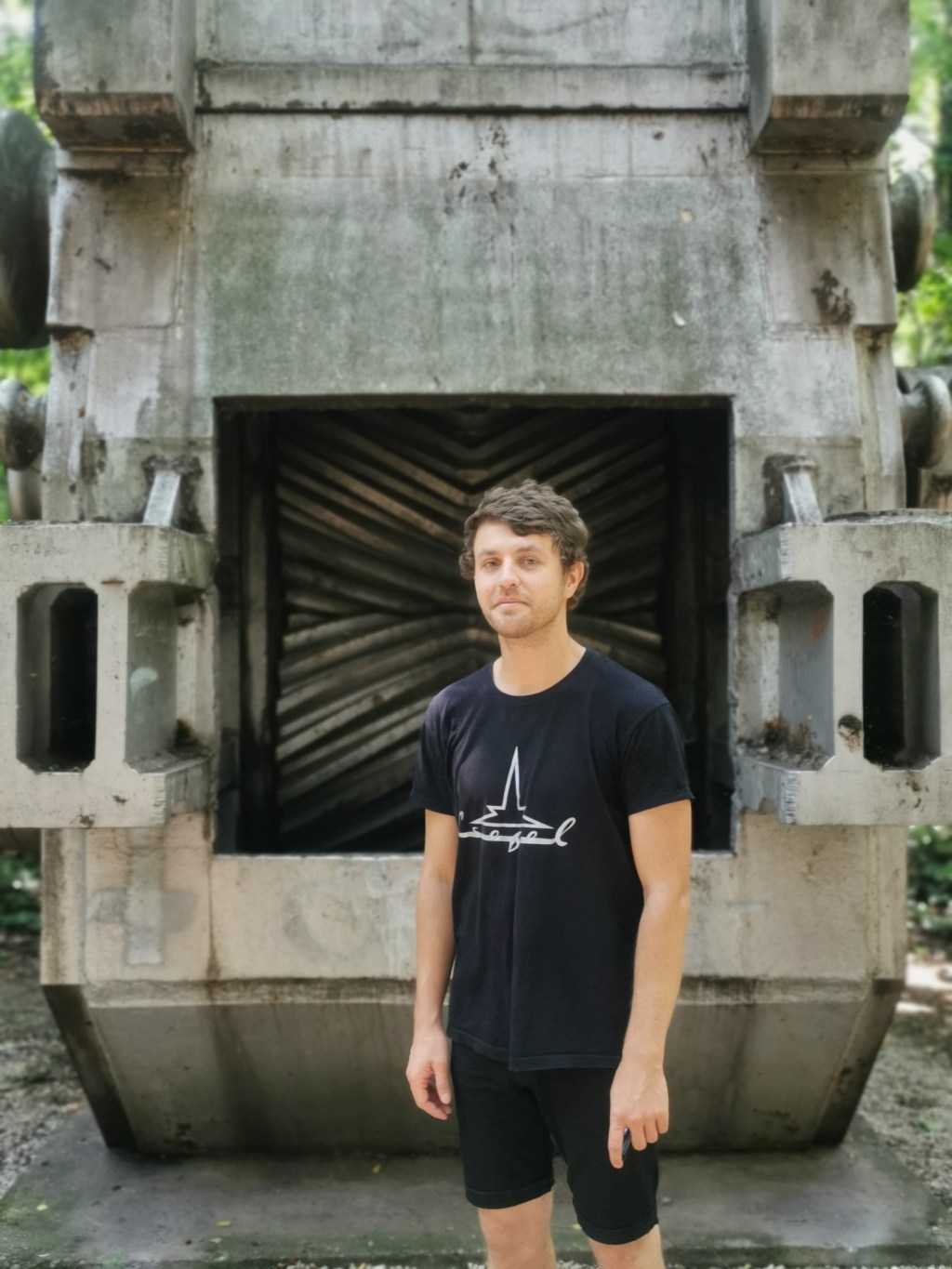
Nina Dziwoki is a Polish artist. She specializes in paintings, collages and murals. She attended the Academy of Fine Arts and currently creates in her art studio located in Cracow.
She also maintains an active profile on instagram.
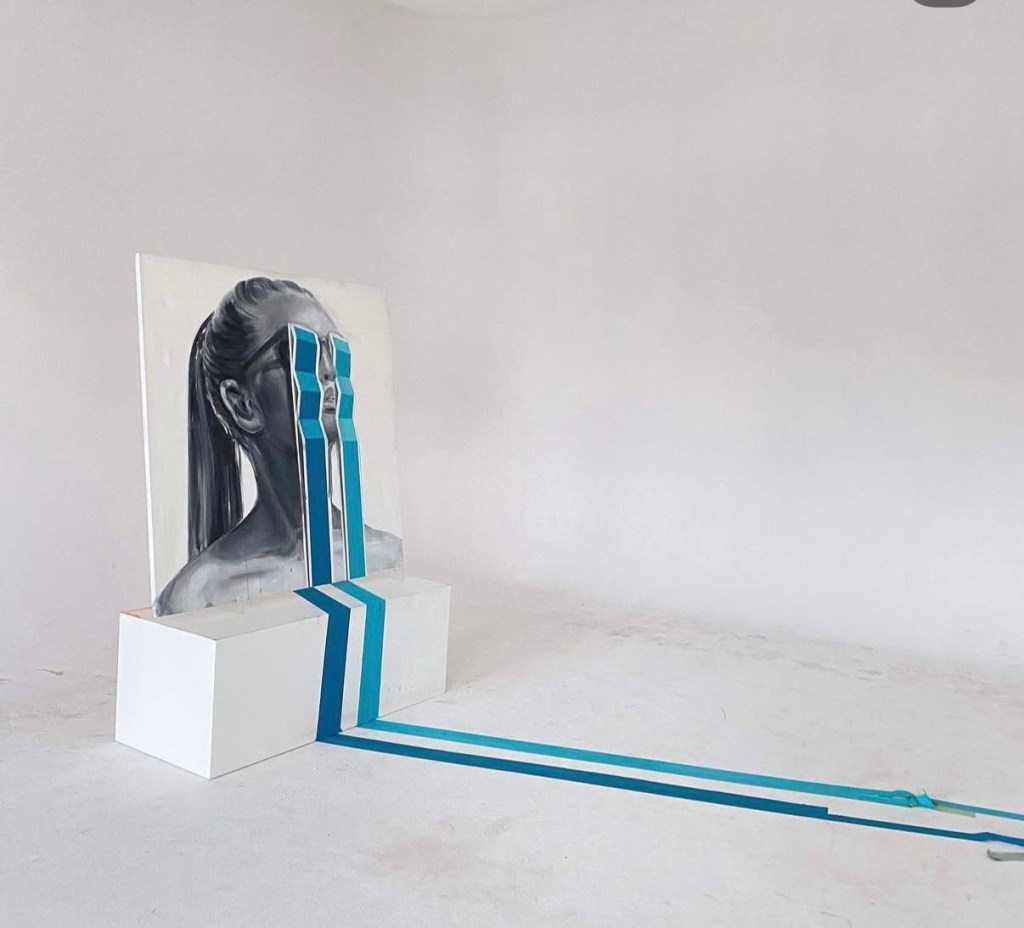
Her style can be described as fully abstract, full of distinctive original blocks and expressive colors. But I think it’s best to let her tell you herself about her artwork
What made you start creating?
I have always been drawn to it. I know it sounds cliché but I’ve always been that kid who painted and drew in my corner. It gave me the most pleasure.
This continued to evolve and by pure chance I ended up at the art club in Rybnik with Ms. Katarzyna Kiszka. This activity was to fill the time between classes so I wouldn’t have to wait in the day care center. I quickly liked the classes and stayed until high school.
In high school, the instructor asked if I wanted to go into it professionally. My answer was “yes.” I knew from the beginning that it had to be specifically painting. She then told me directly “ok, I won’t teach you anything else” for which I am still grateful to this day. She guided me further because of which I am now where I am. She recommended me to take an intensive art course before the ASP (pol: Academy of Fine Arts) exam. The rest of the story is the road in college up to the diploma.
And at the end of the day, are you satisfied that you went into this field of education?
Yes, I did not have a crisis moment that I would regret it or that in the process I would ask myself “what am I going to do after this study?”. This thought didn’t scare me. I wanted to do what I liked.
I was just about to ask about possible doubts and crisis. But from this I understand that you had no such moments?
It is known, there were moments at the ASP that I had enough, but somehow I never doubted that it was a bad decision
So you didn’t give in to your fears and you knew that it externalized you
Exactly right, I tried to do my own thing
And what is art to you, how would you describe it?
I think it is simply beauty (laughs).
For me, art is finding beauty in different things. Not only painting but also in design, everyday objects. It can be found in every aspect of our life.
Going back to the topic of doubt. When there is a moment where an artist is overwhelmed by insecurities but continues to feel that art expresses them. Do you think they should let go or keep going and fight?
It depends on individual situations, of course, but in my opinion you should always fight. But I also know a mass of people who let go after graduation. They had enough, or simply burned out.
Perhaps they will come back to it. This is also great, to give yourself space to do something else to come back to it later looking with fresh eyes.
But I’m of the opinion that when you feel it inside you should do it. Of course, there will be hurdles thrown your way. There will be moments where it will feel bad, there will be weeping and gnashing of teeth, and you will have to keep your guard up. At the end of the day, however, it will pay off.
I think this is a very good answer that will reach many people. Moving on to your paintings and works. How would you describe your style?
It is certainly abstract. I don’t represent anything directly. I try to rely on shapes, forms. Two words that accompany my creation are firmness and delicacy.
This is also what many curatorial texts or my professor called my art. I think there is something in it.
Firmness manifests itself by the fact that when I create a sketch I try to stick to it, repainting it faithfully. I also really like firm shapes: clear solids, triangles, thin and sharp lines.
At the same time, there is a lot of such delicacy in it. Permeation and using layers give it all an expression that makes the end result not heavy and sharp.
It is also delicate and created by a woman. This too is quite distinct. Always the painting of women is, willy-nilly, more delicate than that of men. Even when women create very “flashy” paintings they are in their own way more delicate.
As for the art of women. Do you notice in the art landscape in recent years that you see women making art? They are making their mark by showing things from a different perspective?
Of course they do. Men look at the world very differently from women. All of education and history also shows these differences or paths to artistic careers. All of this still manifests itself today.
And would you be able to identify, in your creative history, the moment when this style formed.
I have such a moment, it was during the pandemic. My professor in an online class said that since we were sitting at home we needed a “model,” something to inspire us. He had us create a small physical object. They were all sorts of creations.
I created an artistic cocoon out of it, I don’t have it to this day because unfortunately it didn’t survive (laughs). That’s when I started sketching it. It was a very abstract form based on the shape of an setsquare. Then I started focusing more on geometric shapes and on abstraction.
This can be seen in my diploma – a triptych. I started from figuration. It began with working with a model but in the further creative process these forms became more simple. The right, final side of the triptych was already completely simplified. This was also the moment where this abstraction began to pulse inside me and it stayed that way. After graduation, I stopped creating completely realistic paintings. I focused on the abstract side of art.
What will happen next? I don’t know. Perhaps I will stay with it forever. Perhaps I will return to figuration and space. Or maybe I will do something completely different.
I think it is visible. You take the blocks out of the environment and show them in their purest form.
Exactly. I’m more interested in the form itself and not necessarily the meaning.
I have never been interested in “moralistic content”. It’s great that others do it and preach important messages through their works, but with me it’s not important at all. I am interested in how the forms behave, what colors are created and how they interact with each other, how the composition in the painting is constructed. This is important to me. I try to appreciate beauty with my art.
Did you have a moment, during your education, when you were asked what you wanted to convey through your art?
Every time (laughs). Especially at the Academy of Fine Arts. It’s not popular at the academy to do abstraction. Rather, everyone does figuration, etc. Once you make an abstraction you are flooded with questions “and what does it mean, what does it symbolize, and what is it”. It is searching for that message. I have faced this many times.
Once having a copperplate learning class I tried to create abstract shapes, to capture this beauty. Then the professor at the review asked ” what is it about”. I answered ” about nothing”. Automatically it was a grade lower, because how can art be about nothing.
And to this day, people still ask about it.
So you had a moment that you felt from the side of teachers, professors that they educate but do not fully understand the idea behind the art itself.
A little bit yes. I also felt that there was such an injustice between being able to just create and do something that doesn’t quite represent something specific to people who are just painting a character, for example. It was promoting what was fashionable, what people liked to see.
But I didn’t care about that. I also stood out in my own way at the time, that I was creating abstraction. A few people also created abstraction but it was a definite minority.
You had a moment that you felt that this art education, If it hits the wrong person, student, It can do harm, discourage or limit?
Totally yes. There is a very big problem at the ASP to get a good professor.
I was fortunate that I finally succeeded. After years of wandering between teachers who didn’t contribute anything and looking for the right professor I finally ended up with a superb one. I am happy with it.
But there are some people where you can clearly see that they were with a particular professor. They paint completely like him or have the same worldview. So if you get it wrong it can be absolutely lousy. Not only in terms of artistic development but also mentally.
So would you be able to answer directly to someone who is facing this choice? Whether to go into being self-taught or choose an art college?
This is a very difficult question. It all depends, of course. If someone has an inner doggedness and meticulousness then he can do it himself. If he knows what he wants to do, what to paint, then go with it.
If someone is completely clueless, however, I would recommend this academy. You can learn a lot from there and you can do no progess for those 5 years. Either way you will learn various techniques, workshops. You will always get something out of there.
Could it be worse? Sometimes yes. I think it is the worst for one that are going there after high school of fine arts. Because they already have their habits, beliefs, ideas. They already have an established style. All this suddenly collides at the Academy of Fine Arts with the opinions and egos of professors, who tell them to look for something new. These individuals are actually lost in this academy. Here lies the question of whether these people should go to this academy. I don’t know, it’s heavy on this subject. Art education is very specific and unfair.
You mentioned solid blocks. Are there any other things you are inspired by? Both in the environment and in other artists or within other fields of art?
A mass of things inspire me. These are, of course, other artists, but it is also everything that surrounds me.
They are also the travels, of course. Colors and hues that I notice somewhere or artists from other countries that I have the opportunity to see in museums locally.
I also very often analyze the compositions in different works. Starting from the creations of masters from the Middle Ages to the ones from the present day. Those that have gone their way somewhere looking for the perfect composition and balance. I try to figure it out and transfer it to my canvas.
But the greatest inspiration is simply spontaneity. Every sketching at which, with the help of intuition, I manage to discover something new.
Regarding artists of the past/today. What is your take on contemporary art and the direction it has gone?
Very often I just don’t understand her (laughs). I try to read curatorial texts. I have a background of experience and education. But sometimes they just don’t help. I sometimes have the impression that “everything has already been done” and these are attempts to make something weird by force. But it also has its audience, its niche, of course.
Contemporary art is certainly interesting. I’m also curious about which way it will go. Will we go backwards, to the basics or even more towards digital art or even AI.
Don’t you sometimes have the impression that “high” art, compared to popular art, lacks a culture of reviews and opinions? As a result, there is a lack of opportunity for discourse in order not to be considered ignorant.
Yes, it’s true. Seemingly there are reviews, critics, magazines. There are a few prominent critics in Poland. But they criticize something that is already known and does not need criticism. Everyone already knows that it is good or is just known. It’s rare for young art to be criticized. It’s also interesting how this will work and whether it should or maybe not.
And when it comes to AI. Over the past year, we’ve seen a remarkable development in technology. What is your take on the art created by AI?
This is very scary to me. Although I myself once tried to generate an image. It’s not so easy to make it come out what you want. In order for it to represent anything or have a realistic tone you have to spend some time.
But it’s certainly intimidating and can replace many professions, such as illustrators. It seems pretty simple: someone has a description and wants to generate it.
Recently I was at such an exhibition where an artist programmed a robot that created abstract watercolors. She would choose paints and create compositions that she would have this robot make. He later transferred it with perfect precision. There was not a single accidental paint or going out of line. And watercolor is not a simple technique. It was quite scary and thought-provoking. It was a very significant gallery in London. So this is already being implemented in the art market.
Yet I have a comparison with the Biennale of 2 years ago, which was supposed to be technologically advanced. I was expecting a mass of installations, projectors and robots and, against all odds, there was a lot of classical painting and drawing. This is the biggest event as far as art is concerned and there was not so much of this artificial intelligence there at all. I have a feeling that everyone is getting over it, too.
What will be in the biennial this year? I don’t know yet, but it seems to me that also, despite the vast possibilities of digital technology, people appreciate more and more what is done by hand. So here, there will definitely be a twist, that we will let go of this artificial intelligence and maybe return to what is handmade.
This is something that a robot can’t do or put its heart into.
We can use this tool, sure, but at the end of the day it won’t replace humans. We are the ones who end up using it, and it will never replace real art.
We often see different attitudes towards artists. What kind of reception do you get when you say you are an artist, and what do you think about that reception? What do you think about how people relate to artists and art today?
I think the reception is always positive. The first reaction is always “Wow, you paint?”. Immediately after that, however, come the questions “do you work in your profession?” “do you make a living out of it?”. Unfortunately this is very often the case, and when I say that I make a living from painting then there is a shock.
I also think that people are becoming more and more interested in art. Young people are also investing in art increasingly. They are trying to buy something unique, even if small, just to have it. We stop buying generic artwork in ready-made frames. We want something more original. Also, often when I go to a birthday party and create a hand-created gift, people are delighted with it, they can appreciate it. This is really great.
Is it related to the growth of social media? Instagram?
Yes, people see these things on Instagram and find that they want to have it. It could be a painting, handmade jewelry or cool designed clothes. By having it coolly presented and photographed it drives consumerism. We want to have it.
So in your opinion, the development and possibilities of social media are good?
Yes, by all means. It is also a more casual form than websites and strict competitions. Instagram is a form where I can show my mess in the studio. I can also show everyday life, what I saw cool, what inspires me. On other channels I wouldn’t have this opportunity.
Well. Do you have anything at the end to share, to say to people who would like to go into this?
To just keep trying, don’t be afraid and be determined in what you do!
All authors of the photos have been appropriately captioned in the linked posts on instagram

 ART HUB
Leave a comment