
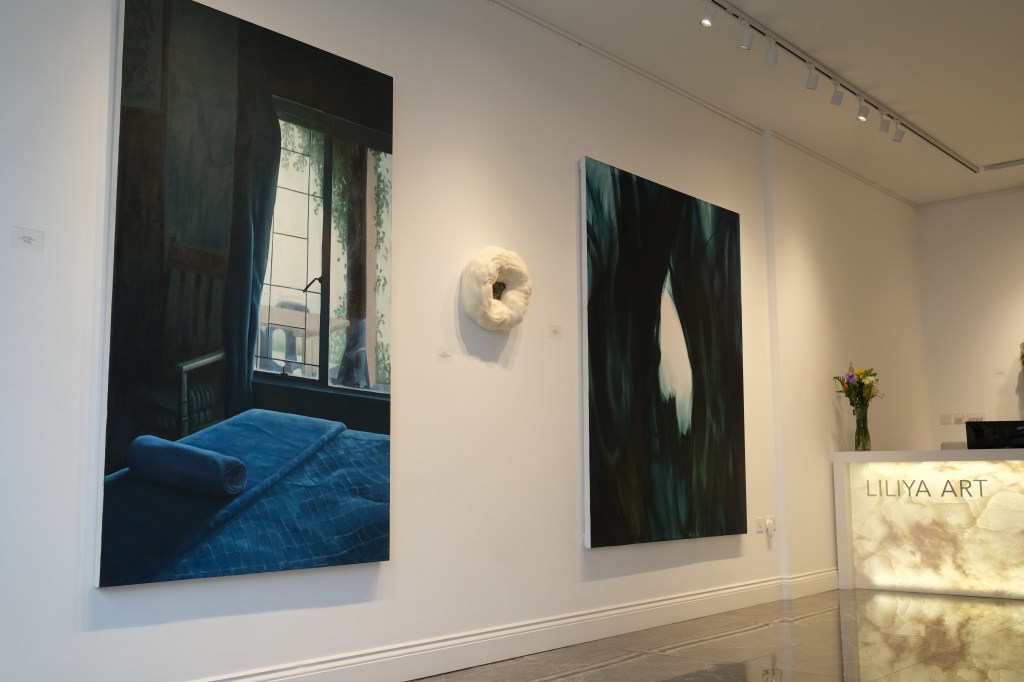
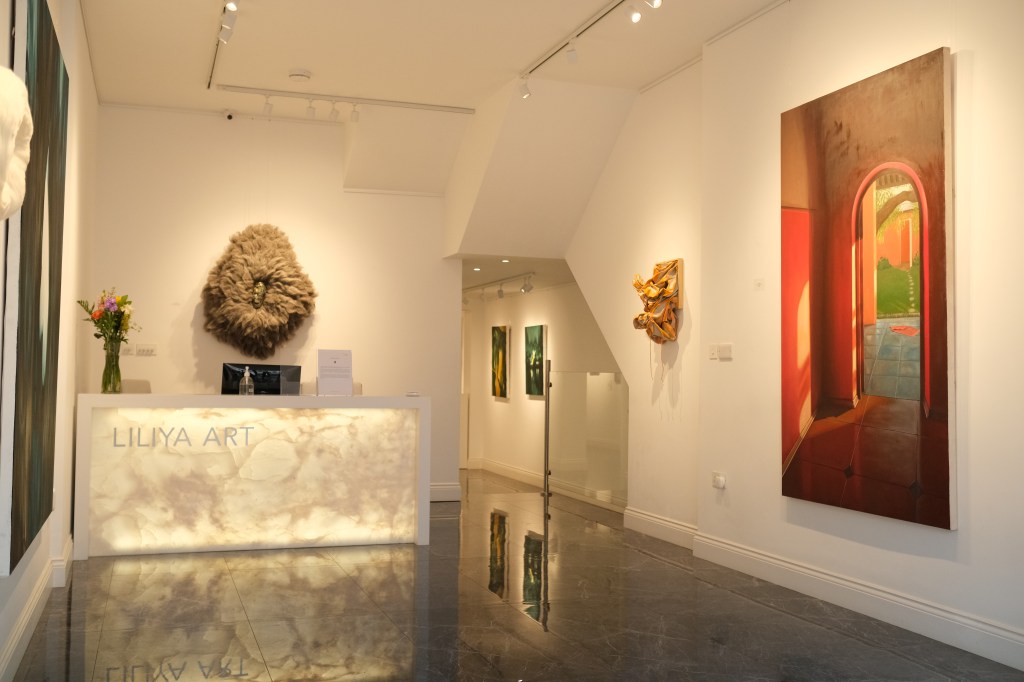
Today, we have the pleasure of exploring the exhibition Within and Without at Liliya Art Gallery in South-West London, curated by the talented Anna Moss. The exhibition showcases works by numerous graduates from London’s art schools and beyond, offering an exciting glimpse into the graduate season and its commercial evolution. This article will feature insights from short interviews with the curator, visitors, and artists, offering a comprehensive view through what I like to call the 3 P’s: three perspectives of perception. I invite you to join me on this journey. The show concludes on August the 2nd, so if you find yourself in Putney, South-West London, and have some time for an art adventure, do not miss the chance to check it out.
Within and Without explores the philosophical dichotomy between lightness and weight, delving into existential themes. Through the fusion of abstract landscapes, domestic interiors, and figures, the works function as visual or symbolic portals, inviting moments of quiet reflection. Having attended Anna’s previous exhibitions, I have noticed her deep inspiration from literature. One of my favourite exhibitions, In Search of Lost Time, drew from Marcel Proust’s 1913 novel, a personal favourite of mine. Anna has done it again with this exhibition, drawing subtle inspiration from another beloved novel of mine, The Unbearable Lightness of Being (1984) by the Czech-French writer Milan Kundera. In the novel, Kundera reflects, “The heavier the burden, the closer our lives come to the earth, the more real and truthful they become. Conversely, the absence of burden makes us lighter than air, causing us to soar into heights, away from our earthly being, becoming only half real, our movements as free as they are insignificant.” This metaphor of ‘weight’ and ‘lightness’ underscores the idea that without burdens, our lives may lack meaning. We cannot truly experience life without the euphoria of happiness and the depths of sadness. Life is about finding balance between these emotions.
3 P’s of a show experience
When I visit an exhibition, I strive to understand every aspect, focusing on details and elements that resonate with me. Although I could not attend the Within and Without show, I opted for an interview-style article to gather insights from others and form my own opinion, imagining my experience there. I realised that I always view exhibitions through what I call the 3 P’s: perception of the curator, the artist, and the visitor.
Reflecting on my background in business, I see this as a nod to the 4P’s analysis I studied during my BA in Business Management. Now, in the art sector, I am returning to my roots with a twist. Who would have thought…
The first P is the perception of the curator, encompassing their vision, execution, and the final result of the show. The second P is the artist’s perception, focusing on their feelings about their work in the space and how it aligns with the curator’s vision and other works in the exhibition. Finally, the third P is the visitor’s perception, highlighting their emotions, feelings, and associations sparked by the curator and artist’s work. This holistic approach is facilitated by space, in this case, by Liliya Art Gallery, which “provides a platform for engaging and innovative artists working across disciplines of painting, drawing, sculpture, and ceramics.”
First P – perception of the curator
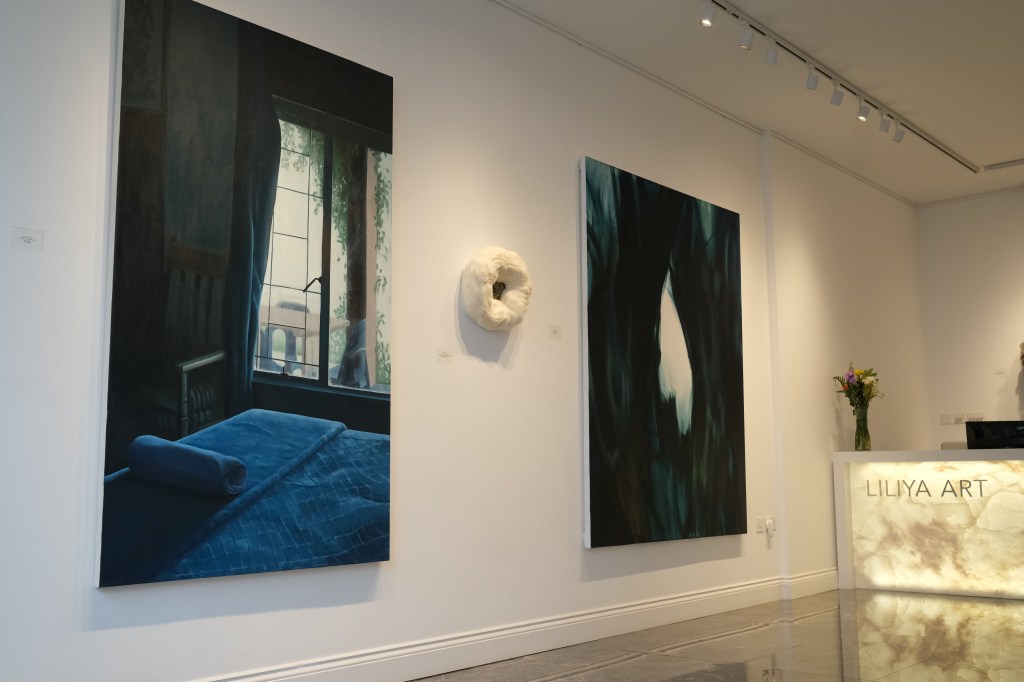
In my conversation with Anna Moss, the curator at Liliya Art Gallery, her pride in the young artists’ unique talents was clear. She described the exhibition as “wide-ranging,” featuring a diverse array of genres and mediums, including landscapes, interiors, figuration, painting, and sculpture. Yet, despite this variety, the show succeeded in “evoking a more intangible mood or feeling,” focusing on opening unexpected dialogues between the works and mediums rather than forcing them into a singular narrative. I appreciated how she carefully curated the placement of the pieces, creating a compelling dialogue among them. Moss noted that even though the works were outwardly different, they collectively “evoked a similar sense of deep contemplation and consideration of what is external to us as individuals.” This thoughtful curation is evident in the juxtaposition of Lea Rose Kara’s otherworldly wool sculptures with Selena Corsellis’ interior scenes and Keisuke Azuma’s mysterious abstracts, which together create a fascinating mix of textures, weights and lightness.
Second P – perception of the artist
After selecting my personal favourites from the show, I had the opportunity to interview the artist to gain insight into their perception of the exhibition. We discussed the connections and conversations their works created with other artworks, exploring the dynamics of these interactions. Additionally, we delved into the artist’s experience of the show and examined the relationship between the curator, the artists, and the gallery. Let us explore these elements together, uncovering the layers of interaction and collaboration that brought the exhibition to life.
Lea Rose Kara
At her first commercial show, Within and Without at Liliya Art Gallery, Lea Rose Kara reflected on the experience of transitioning from unconventional exhibition spaces to a commercial setting. Having exhibited in nearly 40 shows, Rose Kara humorously noted, “the gallery even has black marble floors,” contrasting it with the varied and often challenging environments like chapels, crypts, and abandoned houses where she had previously showcased her work. Rose Kara explained that these unconventional settings forced her to “edit and adjust” her artworks, making them site-specific and ultimately pushing the development of her art practice.
Despite her success in more community-led projects, Lea Rose Kara felt it was time to “diversify her exhibition portfolio” and reach a different audience by exhibiting in a commercial gallery. Rose Kara described the experience as one of readiness, having grown in professional and exhibition experience, and felt “lucky” to work with a curator like Anna Moss. Rose Kara’s research-based approach, aligned with Mosse’s experience, made the artist feel “guided and understood” during the exhibition’s run. In this new environment, Rose Kara was encouraged to “highlight her work to its full authenticity” without compromising its research-driven essence.
A significant memory from Rose Kara’s childhood in Ukraine also deeply influences her work, involving a ritual of visiting two oak trees that symbolise a connection with her late grandfather. This memory, filled with “happiness and nostalgia,” later shaped Rose Kara’s beliefs about the energetic connections between all living things, influencing her multisensory installations and artistic practice centred on nature and ancient rituals. When I mentioned to Lea that her work reminded me of Kupala Night, the Slavic tradition celebrating the summer solstice, particularly her forest-like sculptures and creatures, she laughed and revealed that she was actually born on that special day. The celebration of the sun and the longest day of light ties in perfectly with the themes of Within and Without.


Zhenlin Zhang
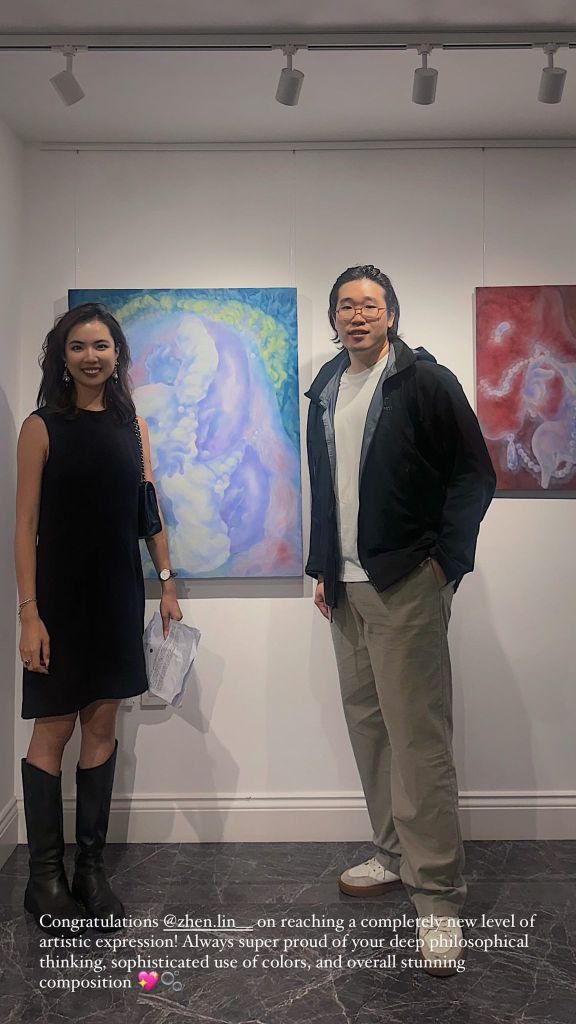
At the recent Within and Without exhibition, Zhenlin Zhang explored the connection between their artistic expression and the themes in Milan Kundera’s The Unbearable Lightness of Being. Kundera’s discussion of “the weight and lightness of life” resonated with Zhang, who intentionally blurred facial features in their work to emphasise atmosphere and body language, reflecting these existential themes. Zhenlin Zhang’s use of transparency and blurring aimed to capture the sacred essence of ice and snow in Tibetan culture, symbolising redemption and hope. This approach added both mystery and “a deep reverence for life, nature, and the everyday.”
Working with the curator was a highlight for Zhenlin Zhang, who described the collaboration as “exceptionally smooth.” The curator’s clear vision and attention to detail helped frame Zhang’s works to enhance their visibility and impact, creating a cohesive and engaging experience for visitors. Zhenlin Zhang found the audience’s reactions particularly gratifying, being “surprised and delighted by the range of emotions and interpretations” their pieces evoked. Observing viewers engage deeply with the themes and express their thoughts was both unexpected and enriching for Zhang. Moreover, Zhenlin Zhang appreciated the interactive element of the exhibition, where visitors left written feedback. This provided Zhang with invaluable insights into how their work is perceived and experienced, inspiring them with the diverse interpretations that emerged.
For Zhenlin Zhang, Within and Without was not just about displaying art but about growth, learning, and connection, deepening their understanding of their work’s impact.


Dien Berziga
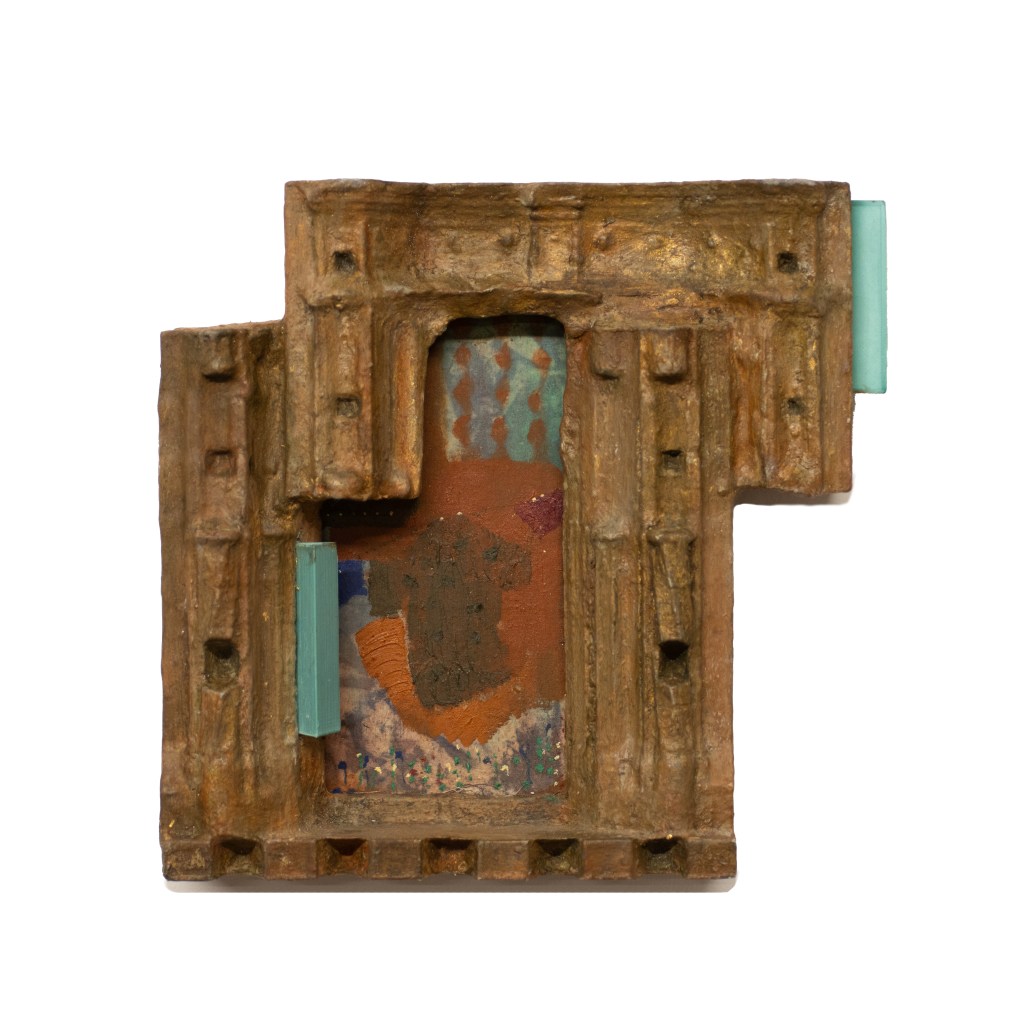
Dien Berziga, Chinese-Italian artist based in London, expressed deep honour in being part of Within and Without, a show that resonated profoundly with his exploration of materiality and urban landscapes. Reflecting on the experience, Berziga noted the inspiration he felt in seeing his work displayed alongside other talented artists who also navigate “these existential tensions.” The exhibition’s emphasis on slow, contemplative looking was particularly meaningful for him, as it “perfectly aligns with my intent to invite viewers into a space of quiet reflection,” where they can reconsider the transient beauty and complex value of the urban environment.
This experience, Berziga explained, reaffirmed his commitment to creating art that bridges “the ephemeral and the enduring, the light and the heavy.” He expressed heartfelt gratitude to the show’s curator, Anna, and the incredible team at Liliya Gallery for their support and vision in bringing this exhibition to life.

Third P – perception of the visitor
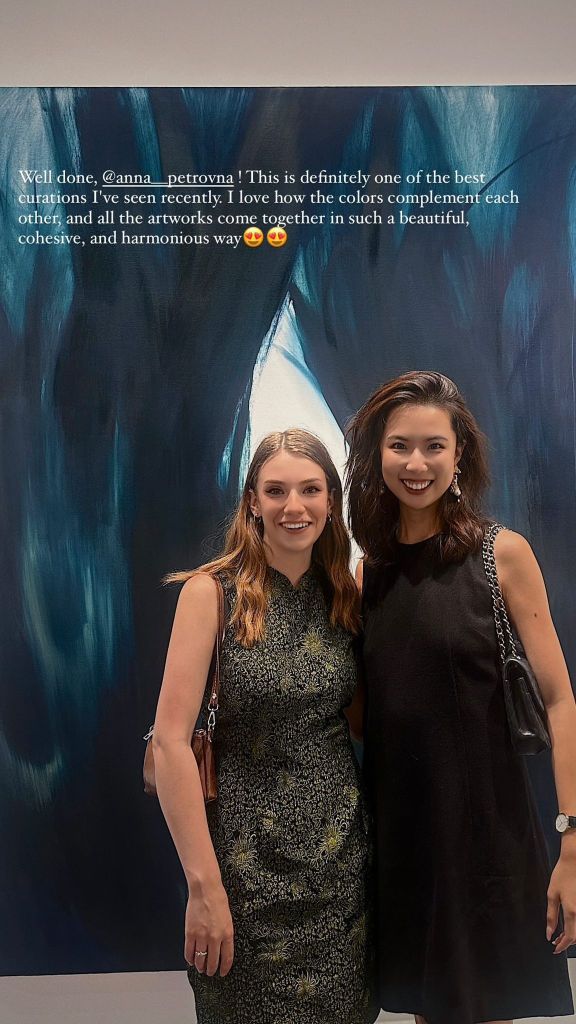
The third P, the perception of the visitor, reflects the profound impact the exhibition has on its audience. Jiayu Song, an art enthusiast studying Art Business at Sotheby’s Institute of Art, shared her experience of the show, noting how the colours complement each other, creating a cohesive and harmonious display. She said that the blend of colours and mediums resonated deeply with her.
The works of Zhenlin Zhang, a recent MA graduate from the Royal College of Art, made her appreciate deep philosophical themes, his sophisticated use of colour, and stunning compositions. Similarly, with works by Selena Corsellis, a recent BA graduate, she was mesmerised by the texture and light effects on a quilt. Personally, the works of Selena made me mind travel to Venice, since the mysterious beds, windows and corridors remind me of the colourful, velvet-like interiors of Palazzo Fortuny, which I visited this year. Jiayu, on the other hand, was particularly charmed by Dien Berziga’s works, describing the experience as “like enjoying chocolates,” with the artist’s intricate details evoking sweet, bubbly memories of her childhood. Conversely, I was particularly drawn to the framework of his pieces, which evoked a mediaeval castle setting where such works would be perfectly at home. This highlights how diverse our associations and perceptions of the same art can be, shaped by our cultural backgrounds, tastes, and personal memories.Another standout piece for Jiayu was Lea Rose Kara’s eye-catching sculpture, which blended extraterrestrial elements with the natural world, using organic wool sourced from the Lake District. The sculpture, inspired by the tektite stone believed to awaken Kundalini energy, beautifully showcased Lea’s ability to merge the cosmic and the earthly. This variety of perspectives highlights the emotional and sensory journey the exhibition offered its visitors, engaging them on multiple levels.
In conclusion, Within and Without at Liliya Art Gallery successfully brings together a diverse array of artistic expressions, thoughtfully curated to explore existential themes of lightness and weight. Through the 3 P’s, perceptions of the curator, artists, and visitors, the exhibition offers a rich, multidimensional experience, engaging audiences in profound reflection and conversation.
Reference
- Berziga, Dien. “Within & Without – Review”. Interview by Interviewer Michalina Franasik. Art Hub Magazine
- Liliya Art Gallery, “About the gallery”, https://liliya.uk/about/.
- Rose Kara, Lea. “Within & Without – Review”. Interview by Interviewer Michalina Fraansik. Art Hub Magazine
- Song, Jiayu. “Within & Without – Review”. Interview by Interviewer Michalina Fraansik. Art Hub Magazin
- Zhang, Zhenlin. “Within & Without – Review”. Interview by Interviewer Michalina Franasik. Art Hub Magazine

 ART HUB
Leave a comment