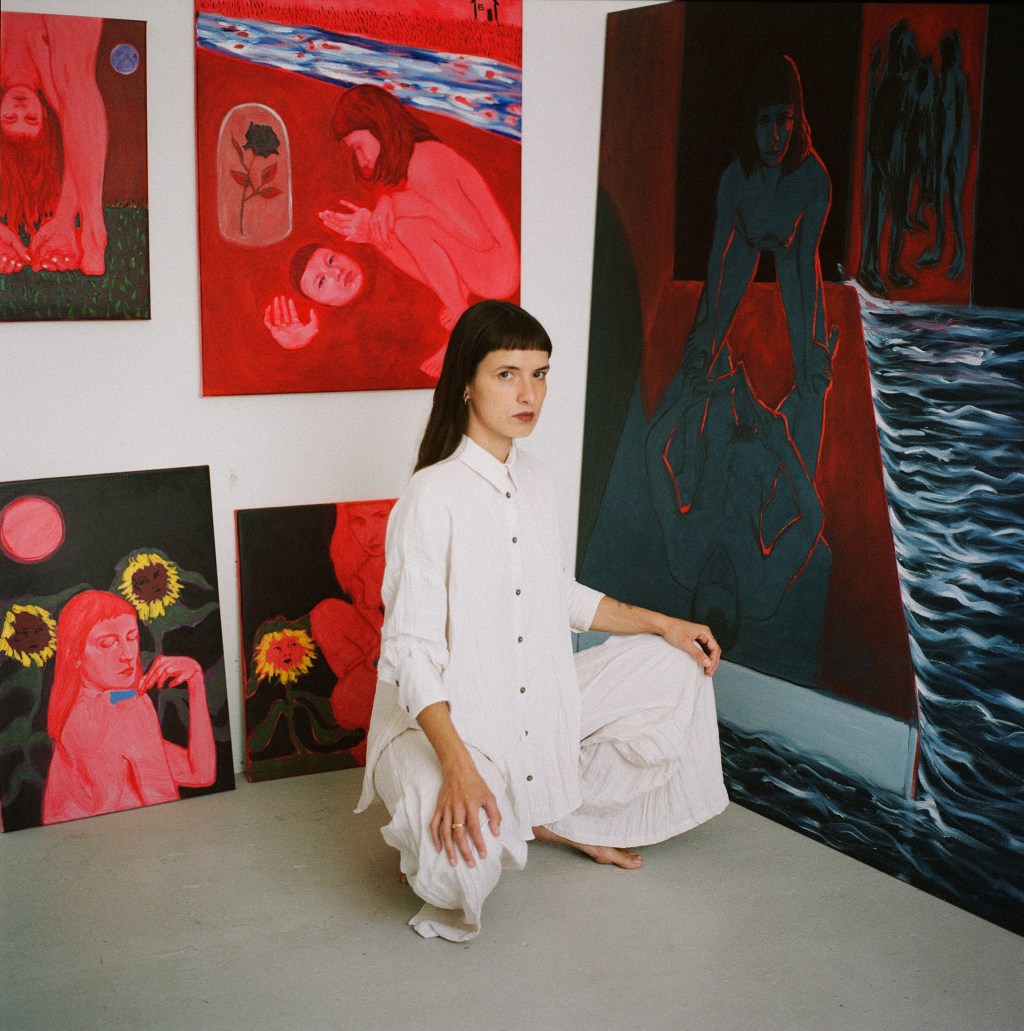
Mafalda Figueiredo (b.1991, Lisbon) is a figurative painter. She graduated from the Fine Arts University of Lisbon in 2013 and has subsequently lived and worked in Berlin, London and recently Vienna where she’s now based.
Can you tell us about your journey as an artist and what initially drew you to figurative painting?
I started painting when I enrolled in the painting bachelors program at the Faculty of Fine arts of the University of Lisbon in 2009. Before that and since my early childhood I’d always drawn obsessively. I drew stories about what I was experiencing, my fears and desires, with characters who embodied these feelings. When the time came to choose what I wanted to study my first choice was design – I wanted something creative but “realistic”, and I had no idea “artist” was even in the cards. I ended up in my second choice (which I picked randomly, or so I thought) – painting. It quickly became clear to me that that was what I was supposed to do, even though I had no idea how – I had never painted before. I realized I wanted to express what I was feeling so I started with abstract painting where I used movement and gesture to represent what I was experiencing (which as an 18 year-old was very difficult to verbalize and understand). As the time went by and especially after I finished university figures started appearing in my work, I started becoming more aware of myself and my interest in depicting “feeling” needed a body, as I slowly came to realize that’s where it’s all contained. In a way I returned to figuration, the visual language I was intuitively drawn towards in my formative years.

How has living and working in diverse cultural environments such as Berlin, London, and Vienna influenced your artistic style and themes?
I think these cities mark very specific moments in my personal development. in Berlin I was searching – for myself, and for a way to communicate through painting, a language. It was there that my work turned into figuration and that I put a foot in the art market. Berlin is a city that I feel allows for this search as it’s very open and non-judgmental, there’s space for everyone to be whatever they want to be.
London, as a busy city, full of incredible art and incredible artists, but also marked by its high prices, low quality of life and social inequalities, brought out a highly productive side in me which allowed me to go deeper into the process of painting and start thinking more about how I wanted to paint. It also became very important to me to be able to explain my work and my process better, as it seemed easy to get overlooked in the competitive art scene, so I wanted to present myself as best as possible.
Now in Vienna I feel like there’s more space and time to “be” – this has allowed my paintings to become more open in meaning, more poetic, which is something I’ve been searching for and I believe I will continue to. The symbolism in the work has become more subtle and the figures less confrontational, my relationship to the audience has also shifted from trying to provoke something to gently, kindly sharing.
Your work deals with the matter of identity and aims to bridge the subconscious and conscious mind. Can you explain your process for exploring these themes in your paintings?
I’ve always wanted to understand myself better, and believed that was the key to understanding others and the world around me – I still do. Painting has reflected parts of myself I wasn’t able to see otherwise. It helped me make sense of who I was and who I’ve become, and then became a reflection on what I’ve learned and keep learning about myself. It showed me who I was and now I show myself through it.
I believe every choice we make is informed by a multitude of subconscious processes, which may become conscious at times, sometimes partly, sometimes fully. Not everything needs to be verbalized and understood through language – and image making allows that – combining what is understood with what cannot be explained.

How do personal experiences and self-analysis shape your creative process and the subjects you choose to depict in your work?
My personal experiences and the way I process them inform my paintings – I reflect on them constantly.
It’s not always easy to identify what one feels, even before the elaboration of “why”. It often requires a lot of looking, a lot of time, and a lot of pain. The process of identifying what I’m feeling or rather thinking about what I’m feeling and then feeling it is contained in my paintings. More so, the inner conflicts and conversations I have with myself through this process are impersonated by the subjects, although in silence.
I’m very interested in dream-interpretation, which I think is such an interesting tool for self-analysis. The figures and objects which appear in dreams represent parts of the dreamer, referencing and associating past and present emotional experiences – in my paintings I attempt to do the same.

Your paintings address contemporary themes such as gender, femininity, and collective fears. How do you approach these complex topics in your art?
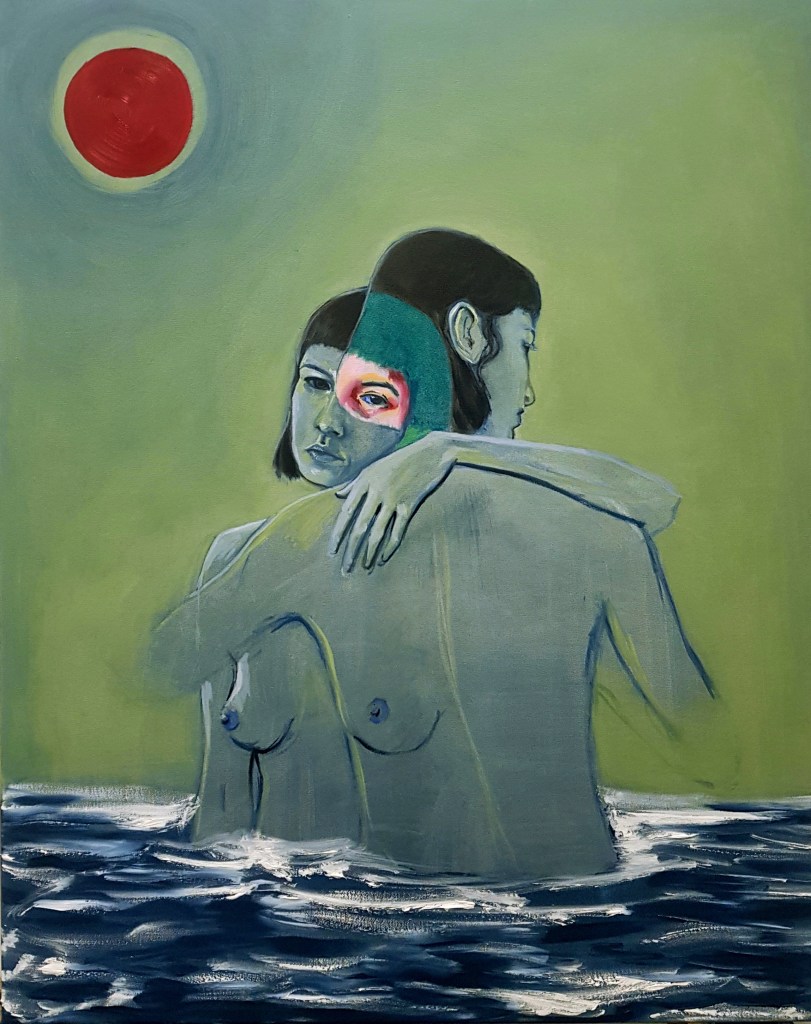
I think being a woman who paints herself naked automatically raises questions. How she sees herself, how accurate the depiction of her body looks, people make assumptions about what sort of person would take pleasure in representing herself repeatedly. The standards in which society regards women and the female body are very harsh. I paint myself naked because I want to feel exposed in my own terms and I want to accept vulnerability. I think femininity is a construct on how women are supposed to look and behave, a box that was made to fit all, and I always found this very confusing.
In many ways my paintings exist in a place where these ideas don’t matter or are rejected – a place where the female body is naked and free and that is not problematic or even relevant – but the fact that this is contrasting to the reality for women around the world inevitably raises questions on why and how.

In what ways do ancestral trauma and uncertainty about the future influence the narratives in your paintings?
I think trauma is such an informative part of one’s identity – whether it’s something we’ve experienced ourselves or something that has been passed on for generations, unprocessed. I’m very interested in this idea of narrative, finding the foundation, the beginning, understanding a personal history as a whole. Equally I’m interested in how the idea of “future” as “the unknown” can be so terrifying, and as personal as that may feel to me, I’m certain every single person has experienced it one way or another – all these ideas feel so individual, so unique and at the same time so universal.
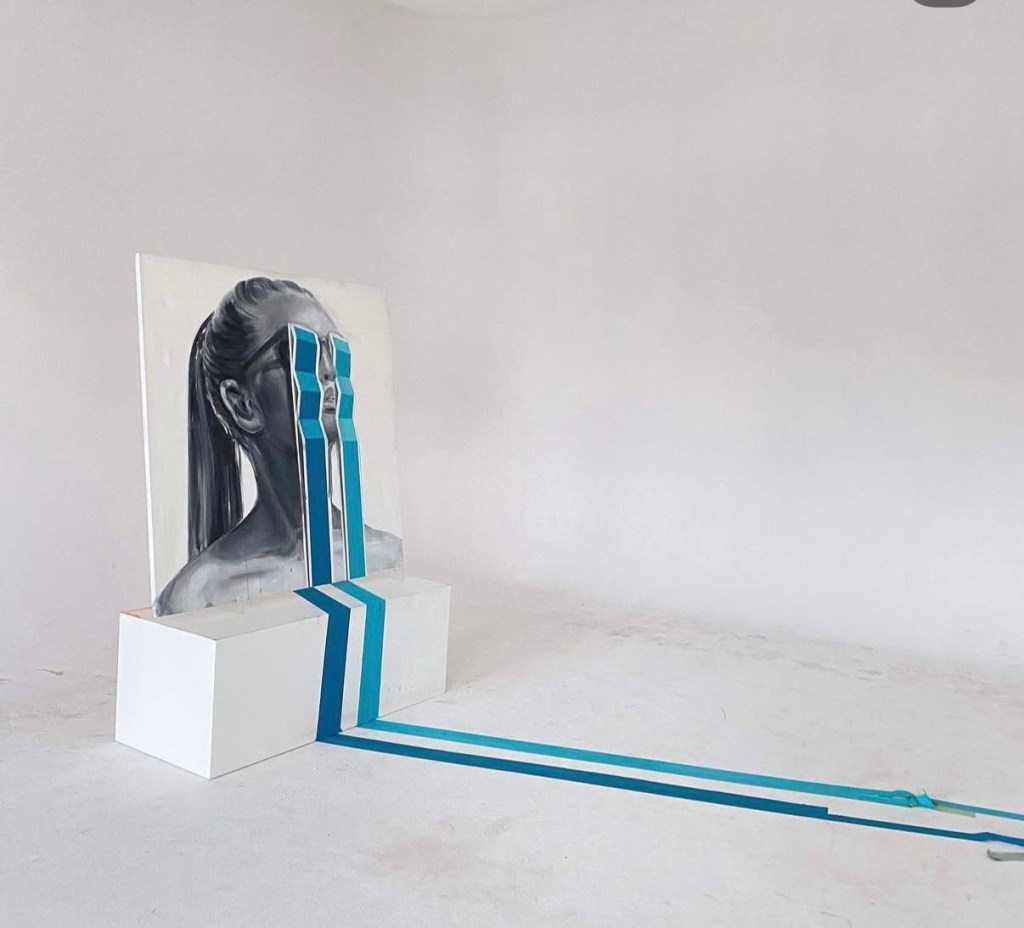
The figures I depict are almost translucent, as if they are there but also not quite, between existence and imagination – between past and present. They exist in a fluid place of memory and thought.
How do you balance the technical aspects of figurative painting with the emotional and psychological depth you aim to convey?
The suggestion of stillness and movement are very important to me – the subjects in my paintings are always somewhere between the two. I work from photographic references which are stills from videos where I film myself moving into positions I’ve roughly planned previously.
I’m always searching for “in betweens” or things that look unclear.
I try to use figuration in an open way: I use images as symbols and associate what I’m trying to convey to objects, movement, body language. I also choose the way I represent the figures and the backgrounds according to importance, as if guiding the eye through the painting. I use transparency and color to accentuate this hierarchy and represent a mood.
I often represent the same person several times, as if they are parts of the same subject interacting within the painting. This way it’s as if I can map out the conversations in my head and observe these different characters from a distanced perspective.

What advice would you give to emerging artists who are exploring themes of identity and self-analysis in their work?
It can feel very lonely working about these deeply personal and intricate themes, so I think it’s very important to look back at art history to the artists who did the same – it’s good to feel like we are part of something, that there was always a need to think about these themes and although they are so personal, they reflect everything that’s happening around us – I see this as a sensitive documentation of history. We know today that memory is flawed, that often what we remember is colored by our emotional responses rather than facts, so the way I see it, there’s a lot of truth in that – in being able to position ourselves as individuals and observe and register how the world passes through our bodies and minds.

 ART HUB
Leave a comment