

In the vast tapestry of art history, tragic losses often punctuate the narrative, leaving behind an ache for masterpieces consigned to the ravages of time. Among these casualties stands Velázquez’s Expulsion of the Moriscos, a poignant portrayal lost in the consuming flames of an 18th-century inferno. Yet, nearly three centuries hence, a remarkable convergence of artistry and technology has kindled the embers of this lost opus, breathing new life into its faded glory.

At the helm of this ambitious endeavor is artist Fernando Sánchez Castillo, a modern-day alchemist wielding the tools of Artificial Intelligence (AI) to resurrect Velázquez’s masterpiece from the ashes of history. His laborious undertaking finds fruition in a mesmerizing four-minute video, a digital tapestry that transcends the boundaries of time and medium to evoke the essence of the lost painting.
Commencing with the faint semblance of a charred relic, the video gradually coalesces into a vivid tableau, depicting King Felipe III’s solemn decree expelling the Moors from Spain—a pivotal moment etched in the annals of the nation’s history. It is a testament not only to Velázquez’s artistic genius but also to the enduring power of technology to bridge the chasm between past and present.
Central to Sánchez’s quest for authenticity is a meticulous exploration of historical accounts and archival remnants. Among these invaluable resources is the detailed description penned by historian and artist Antonio Palomino, a narrative thread that guides the AI algorithms towards fidelity. Palomino’s words, akin to a map through the labyrinth of time, offer glimpses into the composition, characters, and thematic underpinnings of Velázquez’s lost masterpiece.
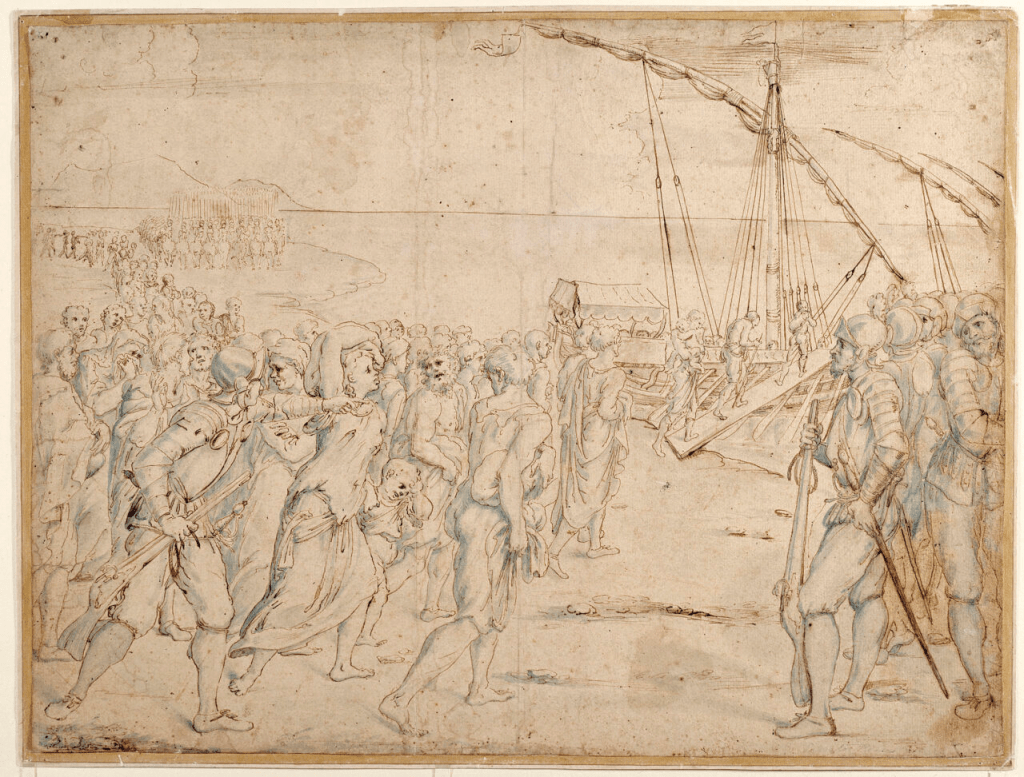
Yet, serendipity too plays a pivotal role in this digital resurrection. A rediscovered preliminary sketch by Velázquez, once relegated to obscurity, emerges as a crucial linchpin in the reconstruction process. Thought to be a mere curiosity, this sketch becomes a vital conduit linking the past with the present, providing invaluable insights into Velázquez’s artistic process and vision.
Further enriching this artistic odyssey are the remnants of a long-forgotten competition convened by King Felipe IV—an endeavor that showcased Velázquez’s prowess beyond portraiture. Armed with these fragments of the past, Sánchez and his collaborator, Paula García, embark on a laborious journey spanning over a hundred hours—a testament to their dedication and passion for resurrecting lost art.
Their partnership yields a hybrid creation wherein AI contributes its ingenuity alongside human artistry. Yet, the road to resurrection is fraught with challenges, as the AI, though formidable, proves fallible. García recounts the arduous process of coaxing coherence from the algorithm—a delicate balancing act of precision and patience that underscores the intricacies of merging art and technology.
However, beyond the realm of artistic revival lies a landscape of skepticism and regulatory constraints. Spain’s Ministry of Culture, wary of the encroachment of technology, enforces strict limits on AI-generated art—a stance mirrored by institutions such as the European Fine Art Fair. Yet, amidst these debates, one truth emerges—intelligence, whether human or artificial, holds sway over the destiny of art, its nuances and complexities transcending the confines of time and convention.
As the digital reimagining of Velázquez’s masterpiece emerges from the crucible of innovation, it beckons viewers to contemplate the intersection of past and present, tradition and technology. In its pixelated brushstrokes and algorithmic flourishes, it embodies the enduring quest of humanity to resurrect the relics of bygone eras and breathe new life into the canvas of history. And in this convergence of art and AI, we glimpse not just a recreation but a renaissance—a testament to the indomitable spirit of creativity that transcends the boundaries of time and circumstance.


 ART HUB
Leave a comment