
First, you need to create the visual environment for the film by interpreting the script and determining the atmosphere and look of each scene. Then you try to find a real location that matches the director’s vision and fulfills all possible requirements such as architectural style, lighting, accessibility, permits and financial conditions. If something is not feasible, there’s a plan B – the production designers work with the set builders to construct sets on sound stages or studio lots to recreate anything of value for inspiration. To breath life into it, the set designers decide on aesthetics, color palette, texture and lighting…
Here we get to the point where the scenography gives the architecture a story, history and often emotions. When we think of the Oscars, it is almost impossible to forget the visual factors in cinematography.
Starting with the Skybreak House from Clockwork Orange (1971) by Stanley Kubrick, one of Team 4’s first projects, designed by Norman Foster, features prominently in a significant scene depicting the brutal rape of Mrs. Alexander and the subsequent beating of her husband that left him paralysed. Jaffe House, which is the building’s second name, is characterized by its flexibility for different social occasions and the incidence of natural light. It is divided into three parts with main public area, kitchen, bathrooms and bedrooms connected by sliding panels to improve the spatial quality.
As the residence of a writer and his elegant wife, Skybreak House initially symbolizes marital success and refined taste. As the film progresses, however, the house becomes a source of discomfort for the paraplegic Mr. Alexander, for whom moving between different platforms and heights is a daily struggle. The interior itself is equally intriguing, combining minimalist spaces with extravagant elements, emphasizing the complexity of the writer’s character and his relationship with his surroundings. The dominance of white color contrasts with futuristic details that convey a sense of dystopia and isolation. The furniture, inspired by the works of artists such as Eero Aarnio, Eero Saarinen or Peter Ghyzy, is remarkable.
Another great script released in a beautiful location is the French-Italian drama Le mépris. New Wave director Jean-Luc Godard and Brigitte Bardot as Camille Javal, with La Casa Malaparte in the background. Designed by Italian architect Adalberto Libera in collaboration with its owner, writer Curzio Malaparte, the house is a remarkable example of modernist architecture on the east coast of Capri, Italy. Its architecture is known for its innovative design and bold, geometric shapes that harmonize with the rugged landscape. One of the most striking features of La Casa Malaparte is its red brickwork, which contrasts with the blue sea and sky.

The interior of La Casa Malaparte is equally impressive, with open and airy spaces that maximize natural light and ventilation. Large windows and glass doors frame the panoramic sea views and create a sense of connection with the surroundings. This is the perfect backdrop for the film’s exploration of human emotions and existential dilemmas.
Switching to a slightly more humorous movie, Ferrie’s Bueller’s Day Off from the late 80s – the viewer can appreciate the look of Ben Rose House. Designed by modernist architect A. James Speyer, the house is a stunning example of mid-century modern architecture located in Highland Park, Illinois. Its sleek lines, expansive glass walls and integration with the surrounding nature makes it an impressive background for the film’s story.
In the Ferrie’s Bueller’s film, the Ben Rose House symbolizes the affluent but emotionally distant upbringing of Cameron, Ferrie Bueller’s best friend. The minimalist design of the house reflects Cameron’s inner struggle and the sense of isolation he feels within his own family.
Throughout the film, the house serves as a visual metaphor for Cameron’s inner conflicts and his eventual journey to self-discovery and liberation. The contrast between the immaculate exterior of the house and Cameron’s inner turmoil adds depth to his character and underscores the film’s themes of youthful rebellion and the search for authenticity.
High-quality architecture can also be seen in the 2015 science fiction film Ex Machina, directed by Alex Garland. It won an Oscar in 2016 for Best Achievement in Visual Effects and a nomination for Best Original Screenplay. It is a thought-provoking film with the Juvet Landscape Hotel as the main location. The building is located in rural Norway and was designed by architects Jensen & Skodvin.
The architecture of the Juvet Landscape Hotel is characterized by its minimalist design and seamless integration into the natural environment. The hotel consists of cabins with clean lines, simple geometries and a muted color palette that blend harmoniously into the rugged Norwegian landscape.

Each cabin is strategically positioned to maximize views of the surrounding wilderness while maintaining privacy and seclusion for guests. The use of floor-to-ceiling glass walls not only creates a sense of transparency and openness, but also allows guests to fully immerse themselves in nature while still enjoying the comforts of modern amenities.
Mark Digby, the film’s production designer, explains how they came up with the idea of using this location: ‘When you first approach the film you see what looks like a small wooden cabin and then it expands into a bigger house and a subterranean world as well. And they have breathless views, which you see in some of the rooms. . . . it made more sense on this occasion to do part build, part location. And I think that’s the perfect balance. You get the best of both worlds.’
As the film’s protagonist, Caleb, grapples with questions of identity and morality, the remote location of the hotel serves as a metaphor for the isolation and existential uncertainty inherent in humanity.
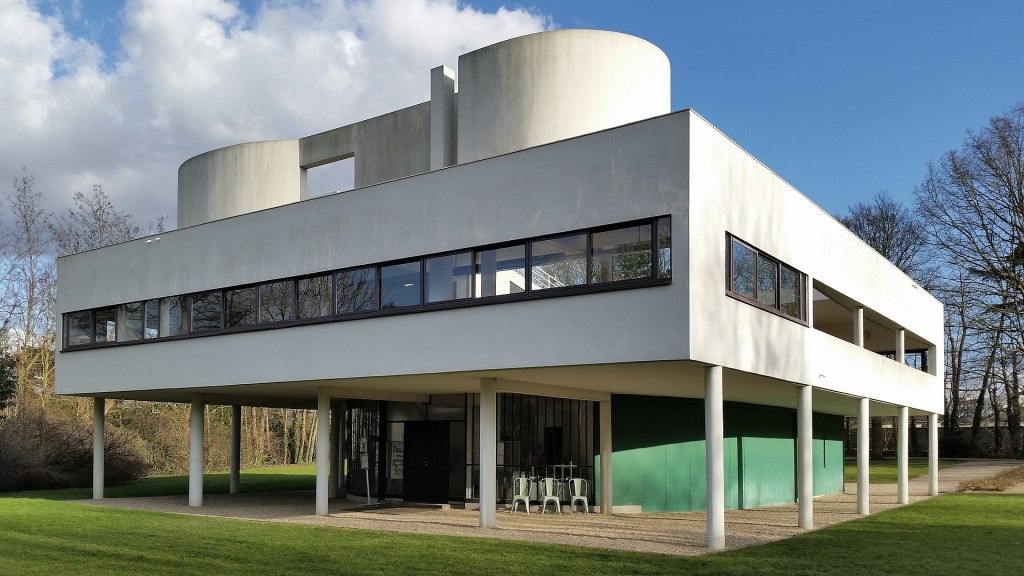
At the very end, Le Corbusier and Villa Savoye ‘starring’ in the French Postcards. This is another production from the late 1970s, showing one of the architect’s most renowned work situated in Poissy, France. Directed by Willard Huyck, the film follows a group of American college students as they spend a summer in France and grapple with love, friendship and cultural differences.

The Villa Savoye, completed in 1931, is a masterpiece of modernist architecture. It is famous for its clean lines, open-plan layout and innovative use of reinforced concrete. The villa’s architectural features, such as the pilotis, flat roof terrace and ribbon windows, are featured in the film, highlighting the villa’s iconic design and timeless appeal.
In the French Postcards, the Villa Savoye symbolizes modernity, sophistication and the spirit of the avant-garde. Its elegant, geometric design contrasts with the traditional French landscape and reflects the clash between old and new, tradition and innovation, which is a central theme of the film. Corbusier’s building also represents a luxurious and privileged lifestyle, embodying the aspirations and desires of the characters in the film.

 ART HUB
Leave a comment