
Introduction
Last month, I had the privilege of immersing myself in the captivating world of the Polymythologies exhibition, featuring the works of Leo Robinson, Ivan Forde, and Richard Ayodeji Ikhide. This dynamic showcase brought together three artists whose creative practices delve into mystical and cultural themes, offering viewers a glimpse into the depths of their imaginative realms. In addition to experiencing the artworks firsthand, I had the opportunity to interview the artists themselves, delving into the nuances of their creative processes and the inspirations behind their works. I extend my gratitude to Leo Robinson, Ivan Forde, and Richard Ayodeji Ikhide for their collaboration and generosity in sharing their perspectives. I invite you to join me in discovering the rich tapestry of narratives woven by these talented artists.
About Tiwani Contemporary
Nestled in the heart of Mayfair on Cork Street lies Tiwani Contemporary, a gallery with a mission to showcase the diverse voices of artists from Africa and its global diaspora. Founded by Maria Varnava, whose upbringing in Lagos, Nigeria, imbued her with a deep appreciation for the rich artistic heritage of the region, Tiwani Contemporary has emerged as a beacon of cultural exchange and artistic exploration. The gallery’s inception was catalysed by the encouragement of Bisi Silva, a Nigerian curator renowned for her dedication to promoting contemporary African art. It was Silva who proposed the name Tiwani, derived from the Yoruba language, meaning “ours” or “it belongs to us,” encapsulating the gallery’s commitment to celebrating and championing African artistic identity. Since its establishment, Tiwani Contemporary has been at the forefront of showcasing contemporary art from Africa and its diaspora, providing a platform for both emerging and established artists to share their stories and perspectives with a global audience. In a testament to its commitment to fostering connections between London and Nigeria’s vibrant art scenes, Tiwani Contemporary expanded its activities to Lagos in 2022, establishing a second location that serves as a bridge between two dynamic cultural hubs.
Leo Robinson
Leo Robinson, a native of Newcastle-under-Lyme born in 1994 and currently residing and working in Glasgow, unveiled a captivating collection of artworks that delve deep into his exploration of ancient and contemporary visual texts, cosmological drawings, and artefacts. With a profound fascination for rituals and the evolution of belief and knowledge systems across diverse cultures, Robinson’s works offer a mesmerising glimpse into the intricacies of human spirituality and cultural heritage. Inspired by a recent pilgrimage to the Osun-Osogbo Sacred Grove, a UNESCO World Heritage Site nestled in Osun State, Nigeria, Robinson’s creative vision takes on new dimensions.
Osun-Osogbo Sacred Grove in Osun State, Nigeria
His series of new collages, born from this transformative journey, exude a mystical allure that immediately captivates the viewer. Each artwork is imbued with a sense of intrigue and mystery, inviting observers to immerse themselves in a world where tradition and modernity intersect. In Robinson’s hands, each collage becomes more than just a composition of images; it creates a portal to a realm where ancient wisdom and contemporary consciousness converge. His works serve as a testament to the enduring power of art to provoke thought, evoke emotion, and foster meaningful dialogue about the human experience. When asked about the recurring themes in his works, Leo Robinson elaborated on his exploration of mystical themes, stating, “The imagery within the work arises from an exploration of universal archetypes and how they appear within my own specific personal journeys, for example within my spiritual practice, dream analysis, or explorations of ancestry, heritage and identity.” He emphasised his interest in searching for narratives and symbols that integrate these aspects into a cohesive logic while acknowledging the inherent complexity of such endeavours. Robinson also noted, that “This acknowledgement is what is leading the work to become increasingly fragmented, as I allow the tension of incompatibility to play out upon the page, or within an installation or sculpture.” Regarding his creative process, Robinson described a method that lacks a defined starting and ending moments. He explained, “The way I work often doesn’t have a moment of ‘conception’. The work usually comes into being through processes of collecting a vast amount of material – physical, digital and conceptual – and translating it, creating arrangements where new meaning is uncovered.” He further elaborated on refining these conceptual and visual relationships until they convey a moment of understanding within the ongoing journeys and cycles he explores. Robinson concluded, “I continue refining these conceptual and visual relationships until they begin to communicate a moment of understanding within these journeys and cycles that I am constantly exploring.”


Ivan Forde
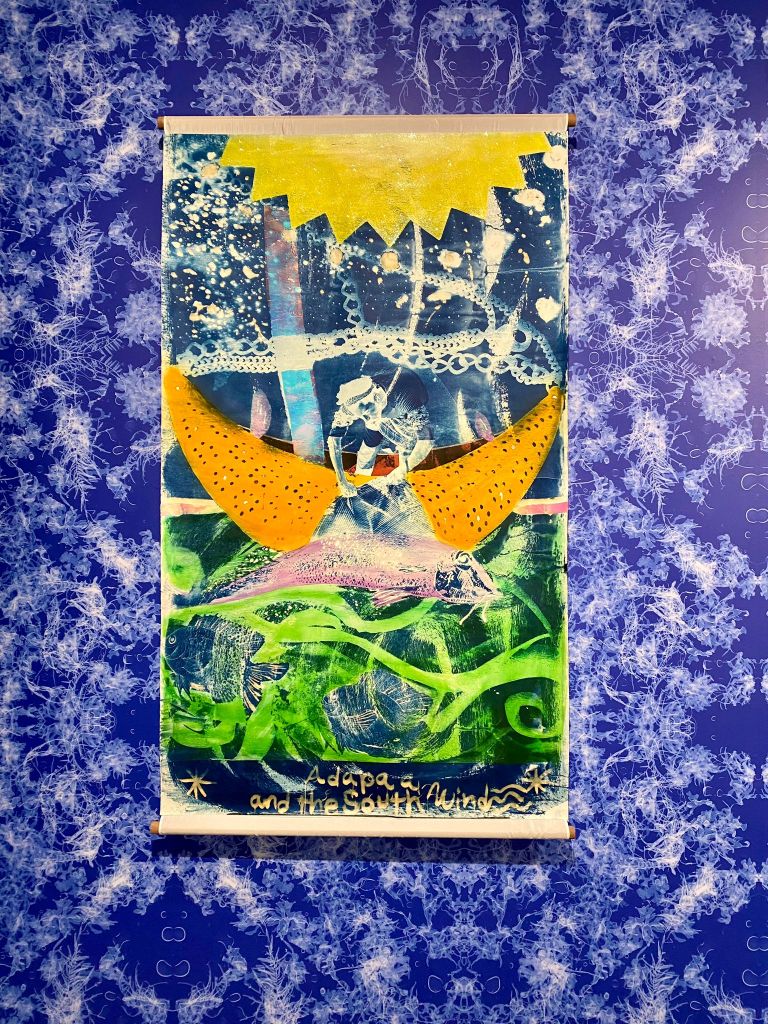
Ivan Forde’s artistic vision is deeply rooted in the tradition of the epic narrative, where the protagonist embarks on a transformative journey guided by celestial skies and primordial waters. When asked about the recurring themes in his works, the artist delved into his exploration of mystical themes. He explained, “The seascape motif in epic poetry is a concept I’ve been exploring in my work since 2020. The sea is eternal, it is one of the oldest and defining features of our planet and aligns with our origin and identity as human beings.” Forde further elaborated on the symbolism of the colour blue in his works, stating, “I think about Blue, not only as a colour containing multitudes in my works but also as a light, as an imaginative, musical, and emotionally resonant space and in my opinion as a Rosetta stone providing a bridge between global and local experiences across language, identity, time, and national borders.”
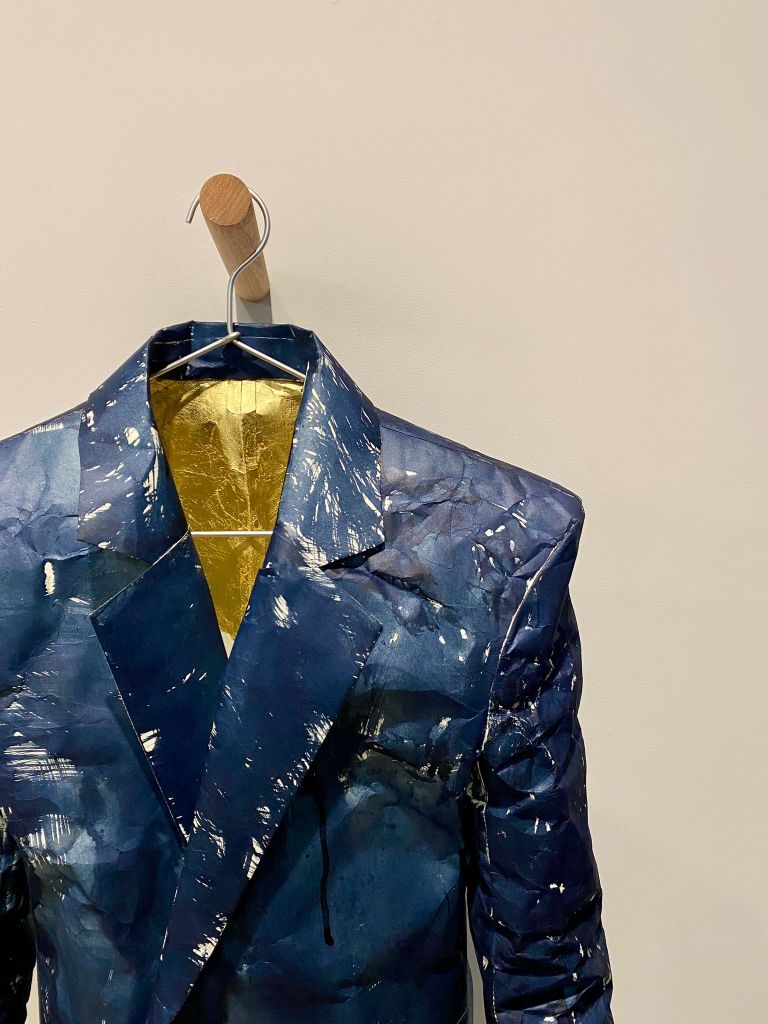
Through his work, Forde serialises scenarios, presenting them in various dimensions ranging from two to three-dimensional, often hanging compositions. These compositions include hanging paintings on linen, murals, moving images, silk, Kozo paper scrolls and expanded forms of photography. One of the notable features of Forde’s exhibition is a tailor-made paper suit, meticulously crafted to be wearable. This suit serves as a canvas for a cyanotype, a photographic printing process that captures the essence of London’s sky. Throughout the duration of the exhibition, the suit undergoes a transformation, gradually developing into a long exposure portrait of the ever-changing London firmament. This unique and dynamic artwork invites viewers to contemplate the interplay between human experience, nature, and the passage of time, while also highlighting Forde’s innovative approach to storytelling through visual art.

Regarding his creative process and subject matter selection, the artist explained, “The subject matter for a piece usually develops and is realised after I begin working with new potential relationships between the characters.” He described his process of collaging self-portrait performances captured over the years, noting how these characters interact and relate to each other in imagined space. Forde highlighted the influence of narrative structures such as the katabasis and seascape motif from the epic genre in guiding his creative exploration. When analysing the connection between his artistic practice and personal life, Forde expressed, “My position is that the subject of my work is connected to everything inside and outside, It depends on where you enter.” He likened his artistic practice to a Japanese garden, where layers of meaning unfold gradually through specific encounters with the artwork.
When asked about his creative process from idea conception to completion, Forde described how he approaches inspiration when he feels drawn to it. He emphasised the importance of his hand in creating direct relationships with the natural world, particularly through techniques like cyanotype photography. Forde confirmed his use of cyanotype, an alternative photography process invented in 1840. He expressed his satisfaction with his contribution to the exhibition POLYMYTHOLOGIES and the opportunity to engage in meaningful conversation with fellow artists Richard Ayodeji Ikhide and Leo Robinson.

Richard Ayodeji Ikhide
Richard Ayodeji Ikhide’s artistic journey is a tapestry woven with themes that delve deep into the human psyche and ancient mythologies. In an interview, Ikhide sheds light on the recurring concepts that resonate with him, offering insights into his creative process and the driving forces behind his artistic decisions. One of the central themes in Ikhide’s work is the exploration of the inner life of individuals. He explains, “The interest in the inner life of the individual is something that is a constant in my work.” Drawing inspiration from the teachings of Joseph Campbell and Carl Jung, Ikhide sees mythology as a means for the subconscious to communicate with the ego self. He elaborates, “How this communication arises is something my practice seeks to illuminate, as I think this aspect of the individual understanding oneself is important for us all as human beings.” Through his art, Ikhide aims to encourage individuals to mythologize their own lives and perceive their journey through life as their own grand epic.


Ikhide’s subject matter often arises from personal life situations, observations of the world around him, and his fascination with the ancient world. He believes that the past informs our future and that certain archetypes within the human psyche recur throughout history. Whether drawing from personal experiences or ancient symbols, Ikhide’s art reflects a profound exploration of the human condition and the timeless themes that shape our lives.
In his contribution to Polymythologies, the artist defies conventional paper dimensions, opting instead for irregular and varied formats in mid and large-scale watercolours. These pieces evoke the appearance of ancient Sumerian cuneiform clay tablets or amulets, infusing his artwork with a profound sense of historical resonance. Ikhide’s choice of paper is deliberate and multifaceted. He explains, “Paper is a material I was naturally drawn to,” citing its accessibility and potential for viewer engagement. Experimenting with the format of paper, Ikhide liberates himself from conventional rectangular or square shapes, embracing the sculptural possibilities that varying shapes offer. He notes that within the European canon, watercolour works are traditionally considered preparations for oil paintings. However, his preference for watercolour over oil stems from the tactile experience and ease of use it provides. Matte pigments, in particular, play a significant role in Ikhide’s work, allowing him to achieve layers of transparency and opacity reminiscent of his background in textile design and screen-printing.
As Richard paints, he considers how viewers’ eyes will interact with his pieces, guiding their gaze through a dance of exploration. He reflects, “When I’m painting, I’m thinking of ways the viewers’ eyes would interact with a piece,” highlighting his intentional composition to draw viewers in and encourage deeper engagement. Through his art, Richard Ayodeji Ikhide invites viewers on a journey of introspection and exploration, weaving together personal narratives and universal themes with skillful craftsmanship and profound insight.
Summary
Bringing together three artists whose creative pursuits delve into mystical and cultural realms, this dynamic showcase offers viewers a tantalising glimpse into the depths of their imaginative worlds. Joining the conversation between art and artist, exhibition POLYMYTHOLOGIES serves as a portal into the boundless creativity and thought-provoking narratives woven by these talented individuals, inspiring contemplation and appreciation for the power of artistic expression.
Reference
- “Bisi Silva – About – Independent Curators International,” n.d. https://curatorsintl.org/about/collaborators/4351-bisi-silva.
- “CV — Leo Robinson,” n.d.
- https://leorobinson.info/CV.
- Ivan Forde. “About — Ivan Forde,” n.d.
- https://www.ivanforde.com/about.
- Tiwani Contemporary. “Leo Robinson, Ivan Forde, Richard Ayodeji Ikhide | 18 January – 17 February 2024 – Overview,” n.d. https://www.tiwani.co.uk/exhibitions/87-leo-robinson-ivan-forde-richard-ayodeji-ikhide-polymythologies/overview/.

 ART HUB
Leave a comment