
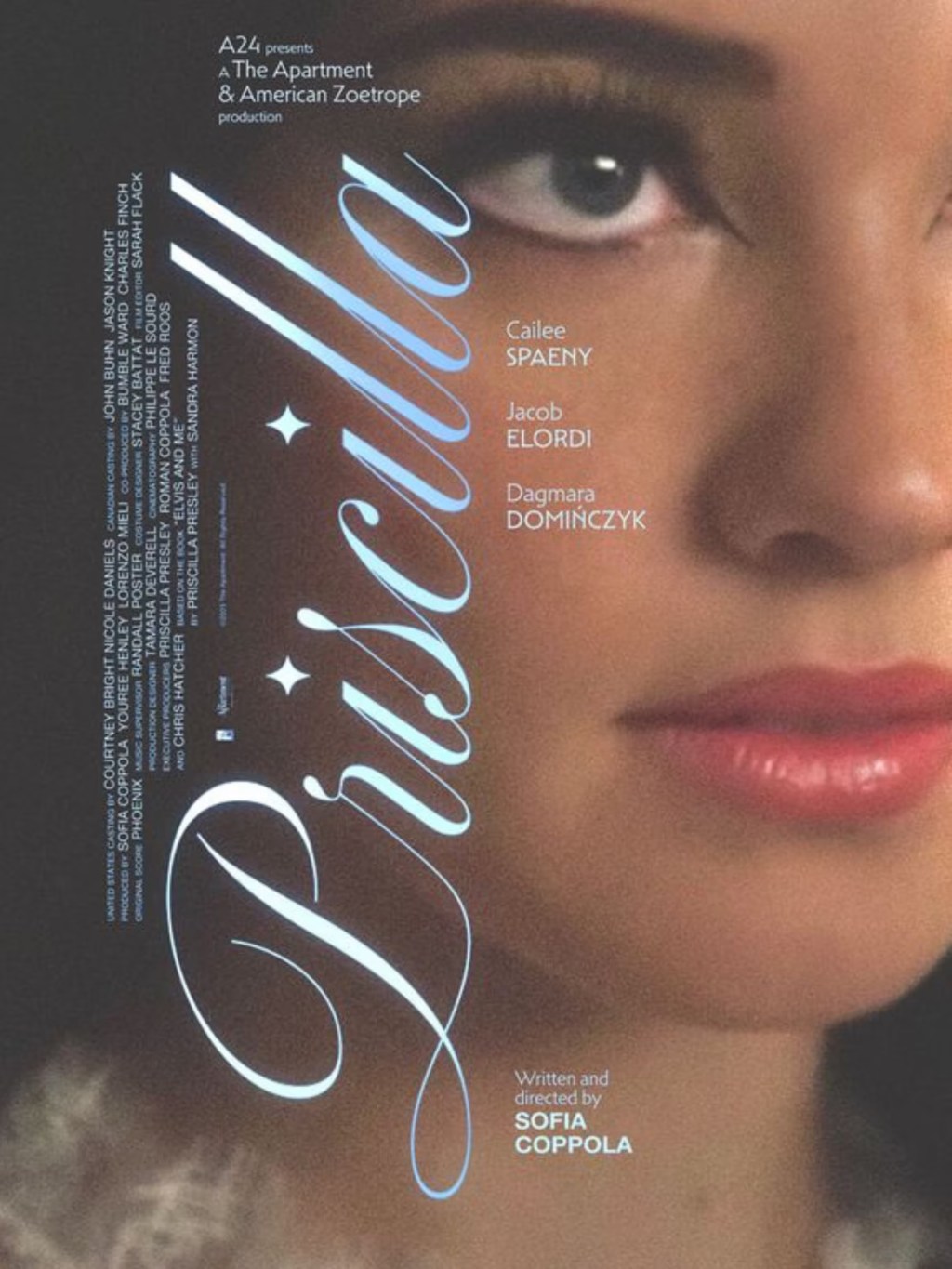
To anyone familiar with the works of director Sofia Coppola, her latest film is no surprise. This time her main female heroine becomes Priscilla Presley. Complicated female characters seem to be something Coppola knows best. Here we recommend recalling her interpretation of the story of Marie Antoinette (2006), the film Lost in Translation (2003) or The Virgin Suicides (1999). This time, the decidedly sad and lonely Priscilla reflects the alienation, full of the hustle and glare of her husband’s spotlight.
14-year-old Priscilla (Cailee Spaeny) meets rock’n’roll superstar Elvis Presley (Jacob Elordi) at a party in his home near the US army base in West Germany. As we delve deeper into the narrative, it becomes evident that young Priscilla possesses an innate ability to captivate the attention of the superstar. Just like in real life, Elvis’s magnetic presence and striking charisma are impossible to resist. The chemistry between Cailee Spaeny and Jacob Elordi breathes life into their characters, creating a believable and interesting connection.
The film contrasts normal life of a young schoolgirl with the lavish life of Presley, who despite interest from other women, chooses the innocent and beautiful Priscilla. He establishes the premise that this bond shall operate within his preferences – discerning matters of Priscilla’s physical appearance and her individual flair. It’s clear that Elvis calls the shots in crafting his chosen one’s image. He suggests that she will look nice in raven-black hair and strong makeup, firmly forbids wearing patterns – in which she supposedly disappears, due to her short height. She sacrifices her personal style to please her man, showcasing how the pursuit of greatness stifles individual expression. Yet, the results are breathtaking, as Elvis’ demands and her compliance create an unmatched visual spectacle.
In this cinematic experience, the film artfully delves into the complex dynamics of a couple deeply influenced by their specific time and place. Priscilla, suppressed by the societal expectations of the 50s, strives to embody the quintessential woman envisioned by none other than Elvis himself.
The portrayal of teenage Priscilla is very well done. She is trapped within the confines of meticulously tailored ensembles, constricting her spirit and individuality. Her high-heeled shoes, intentionally oversized, hint at a young girl yearning to fill an adult role she hasn’t fully grasped. It’s comparable to trying on our mothers’ or grandmothers’ clothes when we were playing as kids, except that Priscilla isn’t playing – it’s her life. However, it is through her sartorial metamorphosis that we witness her slow emancipation. As Priscilla bravely embraces the very patterned prints that Elvis strictly forbids to wear, we feel satisfaction and a surge of joy. In that electrifying moment, a profound desire to cheer her on envelops us, for she is boldly defying the confining expectations imposed on her.
It is within these small but transformative choices that Priscilla acknowledges her own strength and begins to carve her own path. The triumph lies not merely in her rebellion against Elvis’s rigid ideals, but in her reclamation of self-expression. Priscilla’s decision to leave her husband catches us off guard, yet we can’t help but feel a sense of admiration for her choice. In this remarkable visual narrative, we witness the birth of a woman who stands unapologetically true to herself.
The couple’s journey, delicately woven into the fabric of this exquisite film, invites us to reflect upon the profound impact of societal norms and the liberating power of self-discovery. Priscilla’s evolution, expressed through her splendid sartorial choices, allows us to celebrate the inherent strength found in embracing one’s individuality.
Priscilla offers a uniquely personal and intimate perspective on the life of Priscilla Presley. Drawing from her own published memoirs, the narrative takes us on a captivating journey through her years with Elvis, as remembered by Priscilla herself. This is what distinguishes Priscilla from a traditional biopic – it is more of a heartfelt memoir that holds considerable significance in our current times.



 ART HUB
Leave a comment