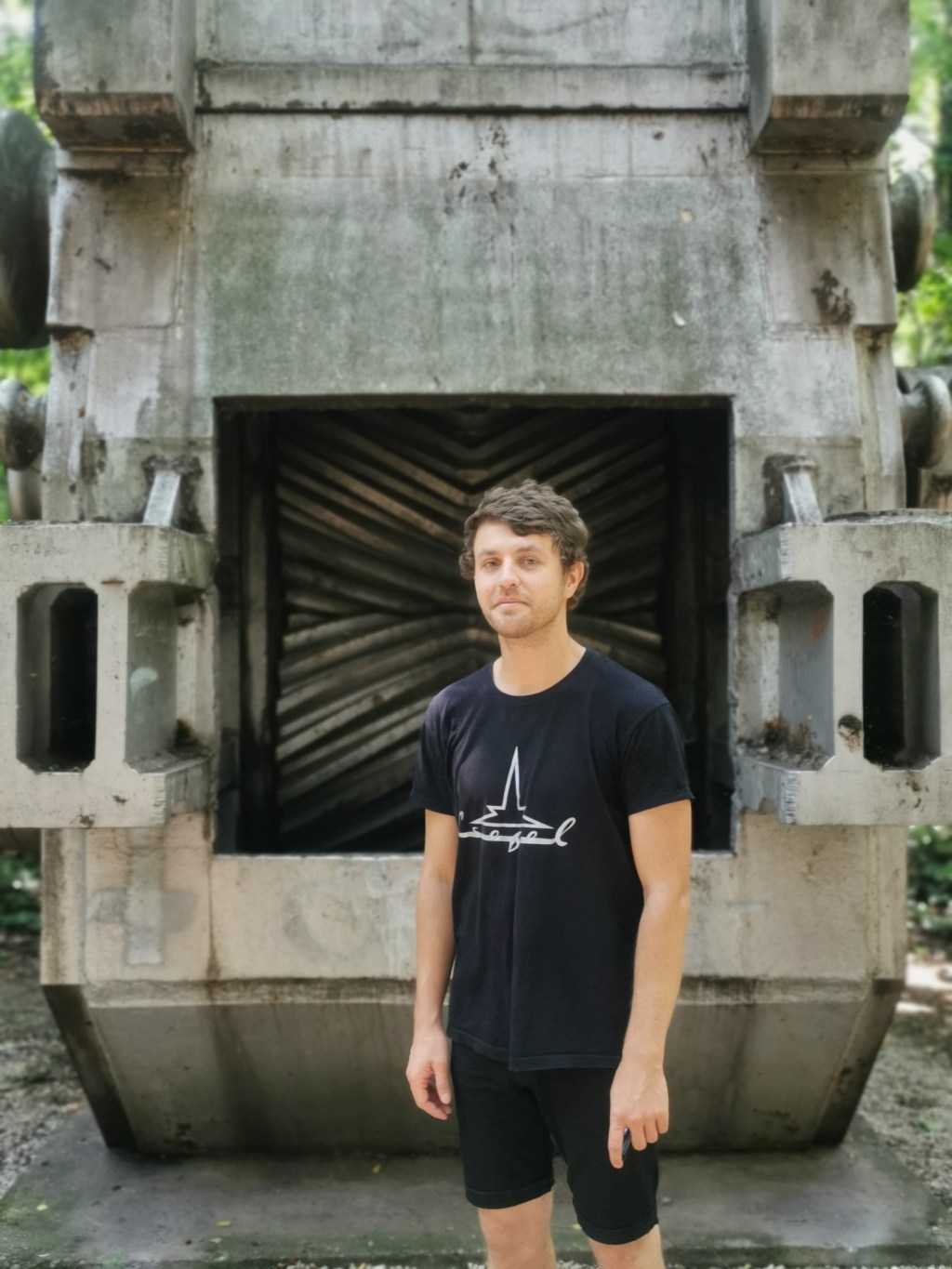
It was a spring day in 2010 when me and Refik Anadol were seated at my art studio in Istanbul’s Çukurcuma district, chatting about my upcoming Expanded Cinema exhibition which was also my graduation project. As a friendly acquaintance and fellow media artist, he was regularly stopping by and enthusiastically engaging in critical dialogues, while kindly giving me advice for my show’s curation. He was fond of my Cave, a site-specific installation which I had created in the form of a distorted infinity room, using the wall’s own texture as a base for a flow of light spread from tiny low-tech projectors – casting videos as sources of moving light. The overall was wrapped in a cave-like structure, distorting the space through its triangular and mirrored inner surfaces. As its name and form clearly suggested; the piece which was the first of what later became an evolving series, was referring to Plato’s famous Allegory of the Cave; questioning outer reality and our limited ways of perceiving it.

My works were admittedly very raw and still in their early stages at that time. As a then young artist specializing in an area which very few seemed to grasp its potential, Refik’s advices were always inspiring yet contradicting with the way I engaged with my work. One particular topic we were discussing was the ways in which we both used technology as raw material. Video cast as a source of light was my raw material as his would later become data. He, then an architectural photographer, successfully crossing towards the field of video mapping, was generously sharing his research with me, while pointing out that my works would excel if I ever started using high-tech tools and interfaces he was experimenting with.
Yet to me, gathering tactile, tangible and analogue elements with digital realms, and observing their intersection was the key drive for my creative research. My interest mostly lied in understanding the effects of the many realms being already created by the many digital and immersive interfaces invading our daily lives. Foreseeing this future in which parallel worlds built in order to mesmerize audiences would be an absolute hype, I did honestly not want to take part in it and carried on with my own intimate ways of interacting with the digital. Yet one thing that I did not fully realize back at the time, was that this enthusiastic young man seated at my humble basement studio, talking about new potentials of a specific artistic field, would one day become the one pioneering it.

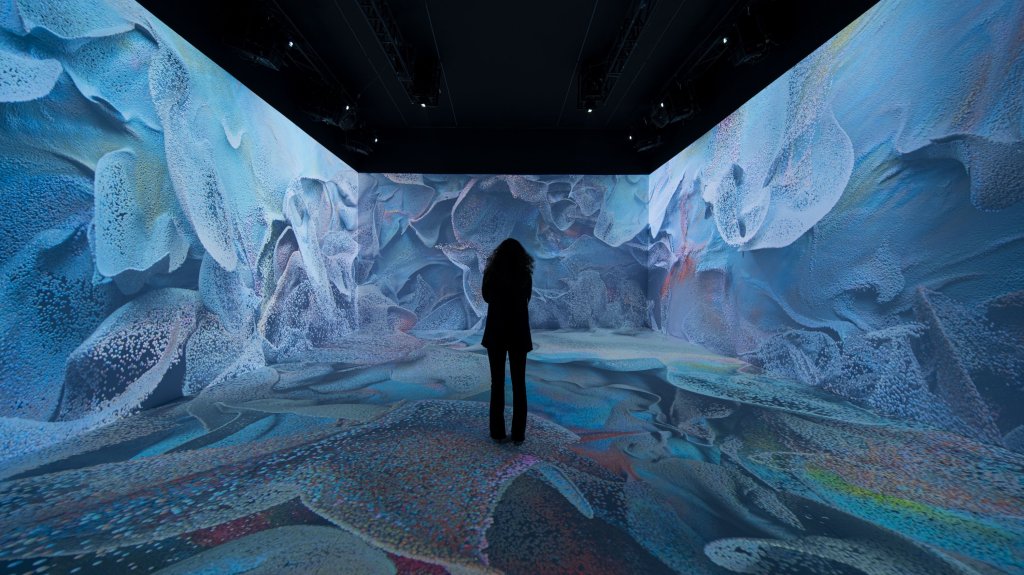
Today, Refik is a worldwide famous media artist using Artificial Intelligence in order to create what he calls ‘Data Paintings’. Having given inspiration to his many admirers, he also revives Andy Warhol’s ‘The Business Artist’ concept and becomes part of a paradox in which art and entertainment entangle to create a popular element of consumption. In this case; the consumption of experience through immersion. Looking to his introductions and to the ones of many artists who follow in his steps, we carry on seeing grandiose terms such as ‘Aiming for the Sky’, ‘The World’s First’, ’Groundbreaking’ or ‘Cutting-Edge’. Luxury brands won’t seem to get enough of these works as the promise of an exclusive experience forms their main identity and vision as well.
To me, what is very interesting at this point is not how glorious these works using many technological and innovative novelties promise to be, but how current technological communication platforms, social media and invasive data affect our ways of perceiving reality. The question is imminent and what seems as a technological progress, though questionably progressive, is clearly accelerating its influence with any passing minute. These hypnotic image-spaces perfectly depict today’s visually and sensually invading world by highlighting the way in which representation and tangible reality have completely shifted axes.
At the end of the day, these widely influential artists are the ones using current technologies in their most vulnerable forms by – unknowingly – creating physical metaphors for what technology is really doing to us; alienating while immersing. Thus, through immersion, the experience of a space becomes an element of consumption. Immersive art is an art form which could very well be displayed in a gallery environment and become a ground for much needed critical debate in the field, while also holding the potential to become a mere spectacle of colors, forms and light. Refik Anadol’s example is a good and familiar one as I have witnessed his genuinely hard-working, investigative and innovative nature. And today, it is through his work which a world-wide debate has risen from its ashes – As in Shakespear’s words; ‘’It’s pretty, but is it art?’’

For a long period such as decades or even roughly a century, despite pioneers such as Thomas Wilfred and many others who followed, media artists were almost considered as ‘secondary artists’. Although part of our lives, it took a while for the digital world to become a dominant element in our cultures. Thrown into a tornado of endless possibilities, we are now talking about text-to-video technologies while Chat GPT is creating meticulous academic essays. Machines apt to record our dreams are currently being perfected to soon enter our daily lives… All this may seem too fast and furious though its footsteps have been carefully and gradually graved into our paths – and yes, accelerated by the pandemic. This shift between the real and the virtual was evidently inevitable, as it all started much longer than we think it has.
Virtual spaces designed as experiences, through their transcendent nature, have and always will have the potential to put masses into awe. It is as old as the the dawn of our civilization that the concepts of both, art and transcendence have been widely present and significant in our lives. Starting with Homo-Sapiens adapting behavioral modernity followed by pre-historic spirituality, these ethereal topics have been greatly explored through-out our spiritual and cultural development as a species.
The immersive nature of the world experienced through our senses led to its depiction through art and eventually, humans built spaces to worship the invisible in which they could be immersed by the imaginary; carving stones and creating shamanic experiences through painted caves which they even lit and animated with the help of fire. As one of the oldest known forms of art, immersion has always been part of our existential quest.
While at our present time, immersive technology is going through its long-awaited golden age and inundates our mundane presence by engulfing our banal realities into algorithmically self-tailored mesmerizing ones, it also leads to its long-awaited and inevitable paradoxical dead-end; As Paul Eluard once asked in his poem and as it is most-probably echoing in the cinephile reader’s mind through Anna Karina’s famous monologue from Godard’s Alphaville, the question to ask would still and gradually even more so be; ‘’Are we near or far from our conscience?’’.

Our everyday lives are fundamentally invaded by technological communication platforms, shiny interfaces and cyber worlds. The perceptual consumption age in which we now find ourselves in is the product of well-tailored, partially organically produced yet mostly intentionally developed ways of attention mongering. It is through this slip into the echo chamber, that in the quest of finding ourselves, we are ending up by losing it. The dystopic nature of utopian elements consistently bombarding us through commercials, images, hashtags, selfies, spams, trolls – highly artificial and mostly meaningless – marks an era in which reality loses most of its natural properties and transforms itself into a virtually dull spectacle.
It is worth remembering that it is our very nature, core essence, the poetic imagination that created mythologies on which our reality is profoundly based upon. And it is this same poetic imagination which lost its track inside a loop of endless replicas – ceaselessly distorting while randomly reproducing these myths. The human psyche, always inclined to look beyond; through telescopes, microscopes, cameras and lenses – has the unavoidable urge for searching and exploring higher and deeper realms. As if inside Plato’s Cave – oddly, both aware and unaware of it, semi-consciously – we search for an ultimate truth, an omniscient point of view in which we could, at last, take control of our very own existence and being. This ‘beyond’ could as well be life on outer space or inside the Metaverse, a world inseminated through virtual reality or created by Artificial Intelligence. Today, it would be no exaggeration to say that stimulation through simulation (and vice versa) has become a world-wide pandemic or an incurable addiction.
As a digital artist strongly yet inquisitively using immersive elements in her works, I thus found myself earnestly asking the question of how immersive art created and broke our culture, all-the-while distorting our reality and perception of it. Looking at its progression through-out history, I can now observe a term, field or concept which instantly destroys itself merely through its very creation. Immersive artworks are increasingly becoming like mirages. As in Baudrillard’s words; ‘’When you begin to believe in them, they are already disappearing’.
Eventually, who would have though that a quest for the transcendent would end up leading to an absolute nothingness? Not in the spiritual sense, yet as not-a-thing, no thingness; non-existent – representational yet non-elemental, sensual yet ungraspable. Our ever-long search for the other-worldly has thus most paradoxically led to the loss of our current one. Since we have become its creators, reality has gotten as fragile as it could get. The world is steadily heading towards personalized realms which through mental and physical immersion – as if at last doomed for playing gods – will eternally echo in a chamber of looping no thingness.


 ART HUB
Leave a comment