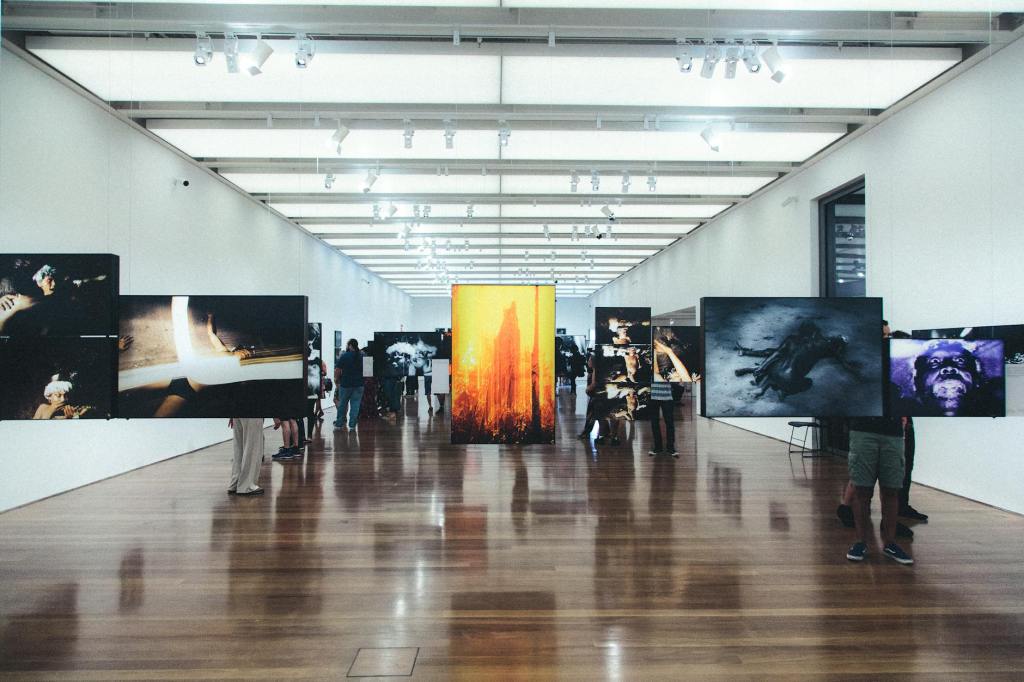
📍LUDOVICA CARBOTTA, VERY WELL ON MY OWN. The MAMbo, Bologna. February 1 – May 5, 2024.
The MAMbo – Museum of Modern Art in Bologna inaugurated the exhibition program of the Sala delle Ciminiere for the year 2024 with the Ludovica Carbotta exhibition. Very Well, on My Own, curated by Lorenzo Balbi with curatorial assistance by Sabrina Samorì, is open to the public from February 1st to May 5th, 2024.
The opening took place on Wednesday, January 31st, at 6:00 pm, as part of ART CITY Bologna, the institutional program of exhibitions, events, and special initiatives promoted by the Municipality of Bologna in collaboration with BolognaFiere on the occasion of Arte Fiera.
Ludovica Carbotta. Very Well, on My Own is a project made possible with the support of the General Directorate of Contemporary Creativity of the Ministry of Culture within the framework of Italian Council (11th edition, 2022), the program for the international promotion of Italian contemporary art.
The first anthological exhibition dedicated to the artist Ludovica Carbotta (born in Turin, 1982) in Italy, is a project that starts from a reflection on individuality and its relation with public space, addressed in its tangible sense of city and, in its abstract and infrastructural sense, of institution.
The title Very Well, on My Own refers to a specific idea of privacy and individual space where each person seeks refuge to deal with the intrusions of the external world and their own psyche. In a society characterized by an overexposure of our subjectivities, which are daily weighed through categories linked to “performance” and “visibility,” the exhibition suggests a different stance in which individual space and its care become generative both on a subjective and collective level.
Throughout her artistic journey, Carbotta has observed how cities define our field of action by performing true physical exercises that attempt to destabilize the common proxemics of the inhabitant and to draw new choreographies of the individual body in the urban environment.
This investigation has been expanded over the years on an imaginary and narrative level, articulating into complex systems of works. The narrative has thus made possible the prefiguration of dystopian and futuristic images of the urban fabric and, simultaneously, has become an open field of experimentation where to expand the reflection on individuality by showing the potentials and risks of its radicalization in society.
Monowe, the artist’s most extensive cycle, tells a story of an imaginary city inhabited by a single person. Divided into episodes, each dedicated to an institution-place (the watchtower, the house, the laboratory, the museum, the court), it uses the monadic status of the inhabitant to question, analyze, and rethink existing institutions.
Monowe, the Italian Council-winning project (2022), with the executive production of BoFilm, is destined for the Castello di Rivoli. The film, presented in preview at the exhibition, has as its narrative epicenter a trial that the inhabitant conducts on herself, staging an accusation and judgment process to which every subject is destined, as even in isolation the institutions internalized by society continue to manifest themselves. This series shows at the same time the inherent danger in withdrawal and the disappearance of collectivity, describing the progressive loss of consciousness of the inhabitant.
The individual’s relationship with social institutions also characterizes the most recent research, as visible in the Die Telamonen, a family of sculptures in which each is a reproduction of the other. Starting from different methodologies of sculptural production and the consequent formal results, each member of this family has generated its own history and psychological profile. Marked by a weight that comes from the past, the Telamons seem to reject their origin, questioning the biological bond that determines the model of the nuclear family.
It is another re-elaboration of what the artist defines as fictional site-specificity, a form of site-specific practice that elaborates imaginary contexts or materializes real places through the language of fiction, in which the work, structurally and conceptually, depends not so much on real space as on the fictional-narrative space it generates. A formal process that shows the generative capabilities of the imagination, in its ability to provide tangible alternatives to social order and the position that each person assumes in the environment that surrounds them.
📍SCOTT LAUFER, THE COPYIST. Barbati Gallery, Venice. February 3 – March 3, 2024.
Scott Laufer, born in 1988 in Philadelphia and currently based in Los Angeles, employs his mastery of traditional painting techniques to explore contemporary themes of representation and symbolism. With his debut solo exhibition at Barbati Gallery, Laufer invites viewers into a world where baroque grandiosity meets modern-day psychological inquiry.
Barbati Gallery is introducing The Copyist, a fresh series of paintings by Laufer, inspired by the ambiance of a magnificent palace in Venice, Italy. Laufer’s latest work engages not only with his previous artistic endeavors but also with a discourse initiated by Sigmar Polke through his Rasterbilder paintings. While Polke explored the impact of mass image distribution tools of the 1960s on media and capitalism, Laufer extends these ideas using contemporary technologies available through software like Adobe and Microsoft. These tools, with their blend modes and clip art, have replaced traditional markers of religion and royalty, prompting Laufer to establish both compositional and conceptual distance between his new paintings and their canonical references.
In this new suite of paintings, Laufer carefully selects artworks renowned for their Greek and Christo metaphorical significance, continuing Polke’s exploration of classical depictions juxtaposed with capitalist symbolism. Laufer’s approach delves into the information age, where truth is questioned, and verisimilitude is obscured in the digital realm. For instance, Laufer reimagines Johann Liss’ The Fall of Phaeton by cloning and rendering the painting repeatedly, exploring philosophical concepts of aura, repetition, and difference.
In another painting, 0.799.1.29, Laufer draws inspiration from Bronzino’s Deposition of Christ, known for its overt eroticism. By presenting mirrored samplings of centralized details in a secular context, Laufer exposes the censured intent behind Bronzino’s work, challenging notions of sanctity and propriety.
📍JUERGEN TELLER, I NEED TO LIVE. Triennale, Milan. January 27 – 1 April, 2024.
The German photographer Juergen Teller – active since the early 90’s – is known worldwide for his works depicting famous personalities, provocative editorials for important publications, and original fashion campaigns. Among the over 1,000 works exhibited in the show are both personal works and commissioned pieces, well-known images and new photographic series, as well as videos and installations. “i need to live” – a statement and at the same time a motivational phrase – summarizes the artist’s feelings in the face of the tragic incidents that have marked his life. Through his shots, he acknowledges the fragility of human existence and celebrates the importance of being alive.
Building upon its rich legacy, Triennale Milano embarks on an ambitious journey in 2024, offering visitors a glimpse into the profound legacies of influential figures in design, architecture, and fashion. Among the standout exhibitions already underway are tributes to Alessandro Mendini, Gae Aulenti, Roberto Sambonet, and Elio Fiorucci, each curated with meticulous attention to detail to provide an intimate exploration of their creative genius.

 ART HUB
Leave a comment