
Introduction
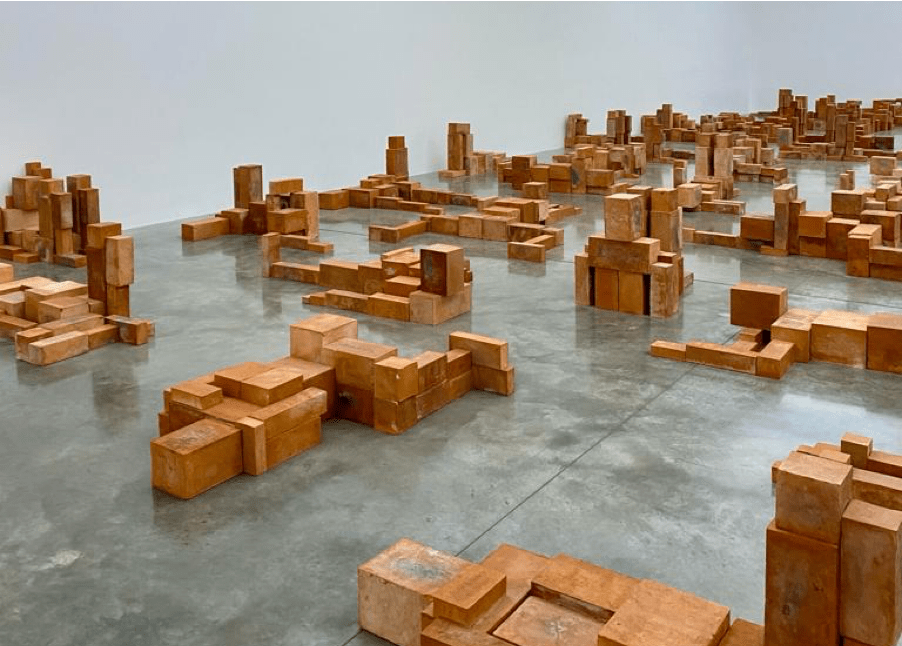
Art enthusiasts had the opportunity to experience Antony Gormley’s Body Politics exhibition at the White Cube Gallery in London from November 22 2023, until January 28 2024. As the exhibition draws to close this week, visitors are afforded a final chance to immerse themselves in the captivating mazes crafted by the renowned sculptor Antony Gormley. In light of this, I have chosen to share my thoughts and impressions through this review, focusing on the installation called Resting Place.
About the artist
Antony Gormley is an internationally acclaimed sculptor, most renowned for his large-scale sculptures, installations and public land art, that explores the relationship of the human body within a space. He claims that “the only place where we can find true freedom is within the infinite darkness of the body available to us once the body is still.” He plays with the idea that the human body behaves differently, depending on our emotional state and on the place we are in. We adopt different poses when we are relaxed, nervous, afraid, asleep or active. Gormley’s monumental artworks are mostly done by using materials such as metal, concrete and clay. He works with engineers and craftsmen who are helping to bring his artistic visions to life.
Resting place
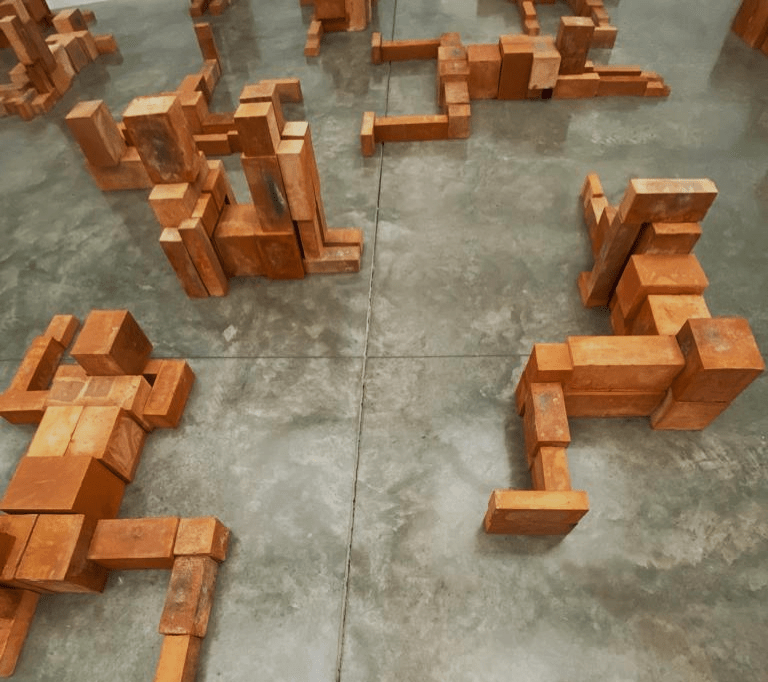
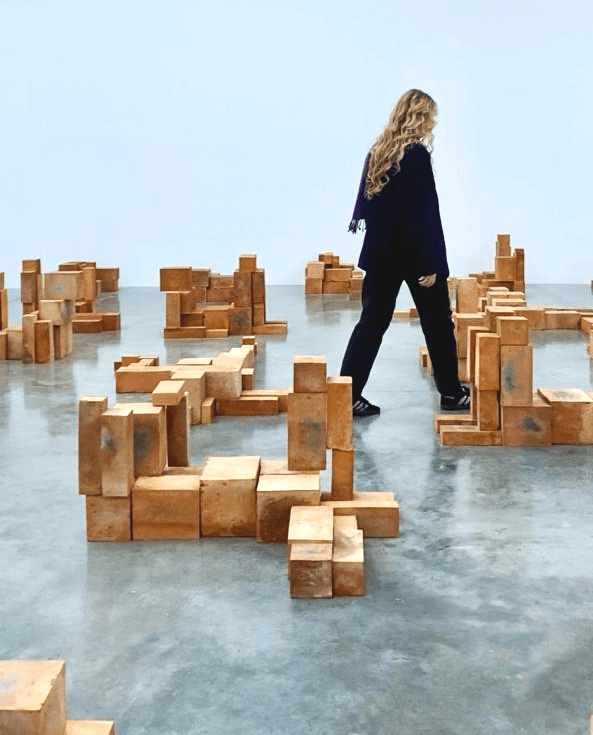
Resting Place is an installation of 244 sculpted forms resembling human bodies crafted from sustainably made bricks, made from scratch by Gormley’s team. These forms are arranged in various poses, lying, curling, resting, kneeling, and wriggling, forming a captivating labyrinth. They stir a spectrum of different scenarios, seen and imagined by the artist, ranging from the forsaken bodies on the beach to the struggles of individuals forcibly uprooted by conflicts, climate change, or resource scarcity. Observers have the freedom to navigate their path, choosing their preferred flow to view and experience the exhibition. Consequently, Resting Place stands out as an exceptionally interactive installation, actively involving and encouraging viewers to explore, become immersed in the labyrinth, and engage in contemplation.
Execution, logistics, curation
At the exhibition, a particular room showcased videos detailing the intricate process of crafting sculptures. I found this aspect to be truly captivating. My first encounters with the world of large-scale artworks opened my eyes to the thoughtful engineering that underpins these monumental creations. The realisation strucked me with the complexity involved in the entire process – from the design phase to the actual crafting of these enormous pieces, and finally, the logistical feat of delivering such colossal artworks to the gallery. Contemplating the curation of the space for monumental works raises questions about space planning. The logistic of transporting these substantial sculptures to the gallery adds another layer of complexity to the process. Additionally, I find myself wondering about the time and effort required to assemble these installations once they reach their destination. During the video spectators can see behind-the-scenes aspects of designing Resting Place, a mini version of an installation intricately composed by the artist to find the best solution. What is more, he is inspired by the process of making the materials for his installations. The amalgamation of clay, the art of welding and metal etching, the meticulous casting of limestone moulds, and the intricacies of grinding play pivotal role in his artistic process, each imbued with a somewhat meditative essence.
White cube gallery concept vs White Cube Gallery
The sheer size of the room adds to the overall impact of the installation. Upon entering, visitors are overwhelmed by a sense of amazement, highlighting the monumental scale of the undertaking. This effect is particularly pronounced in the context of White Cube Gallery, the largest commercial gallery in Europe, boasting an expansive 5440m² of interior space. The gallery’s large, raw-finished brutalist rooms, a modern architectural creation renovated and designed by architect Casper Mueller Kneer, significantly influence the way art is perceived within its walls.

Typically, when we enter the white cube gallery ‘the display model should have even walls and discreet artificial lighting with a modern design, a space undisturbed by time.’ This is also the case in the White Cube Gallery, however, we still feel invited and curious to discover the space. Rooms are huge and designed like a spaceship or a laboratory, but we do not feel bored and overwhelmed by the whiteness of the walls and the artificial layout of the space. This is not usually the standard in commercial galleries, where the emphasis is often on rapid sales rather than the thoughtful curation of the space to showcase the artworks. The White Cube Gallery curated the exhibition in a way that not only invited thevisitors to be involved but also a choice of Antony Gormley, affecting the way white cube space was perceived. It felt more like an interactive museum visit, rather than a commercial gallery one.
Summing up, in Antony Gormley’s Body Politics, the artist delves into humanity’s connection with its industrially constructed environment, the materials and the space. The investigation unfolds at a critical juncture, addressing the contemporary tension between our innate desire for refuge and the equally fundamental urge to explore and migrate out of common spaces. When you’re visiting London, be sure to add White Cube in Southwark or their second location in Mason’s Yard, Mayfair to your bucket list . It’s an experience you won’t regret!
Reference :
Carneiro, Ana Rita Pimenta. “The White Cube – Ana Rita Pimenta Carneiro – Medium.” Medium, August 11, 2023. https://medium.com/@arita111997/the-white-cube-8e5919d28dae.
White Cube. “White Cube Bermondsey | White Cube,” January 3, 2024. https://www.whitecube.com/locations/white-cube-bermondsey.

 ART HUB
Leave a comment