In 2023, a project by Ignacy Czwartos was chosen to represent Poland at this year’s 60th Biennale in Venice, the world’s biggest art event. On the 29th of December, an announcement about changing the artist was published on the website of the Ministry of Culture and National Heritage. Polish Minister of Culture Bartłomiej Sienkiewicz, who also currently serves as the commissioner of the Polish Pavilion, has decided to send a backup project instead of an exhibition featuring Ignacy Czwartos to the Venice Biennale. The announcement states that the Minister “accepted the decision not to implement the project Polish Exercises in World Tragedy. Between Germany and Russia” after studying the opinions and voices of the communities.
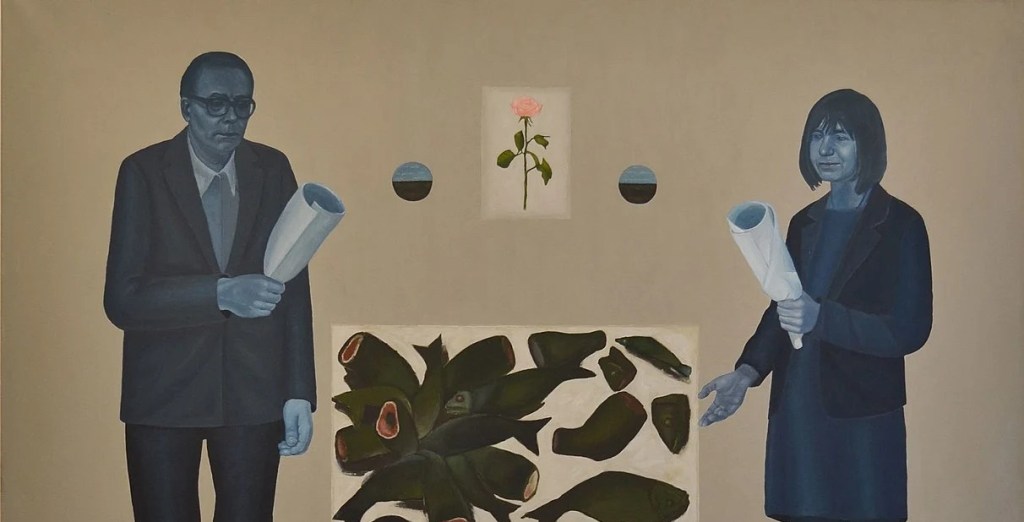
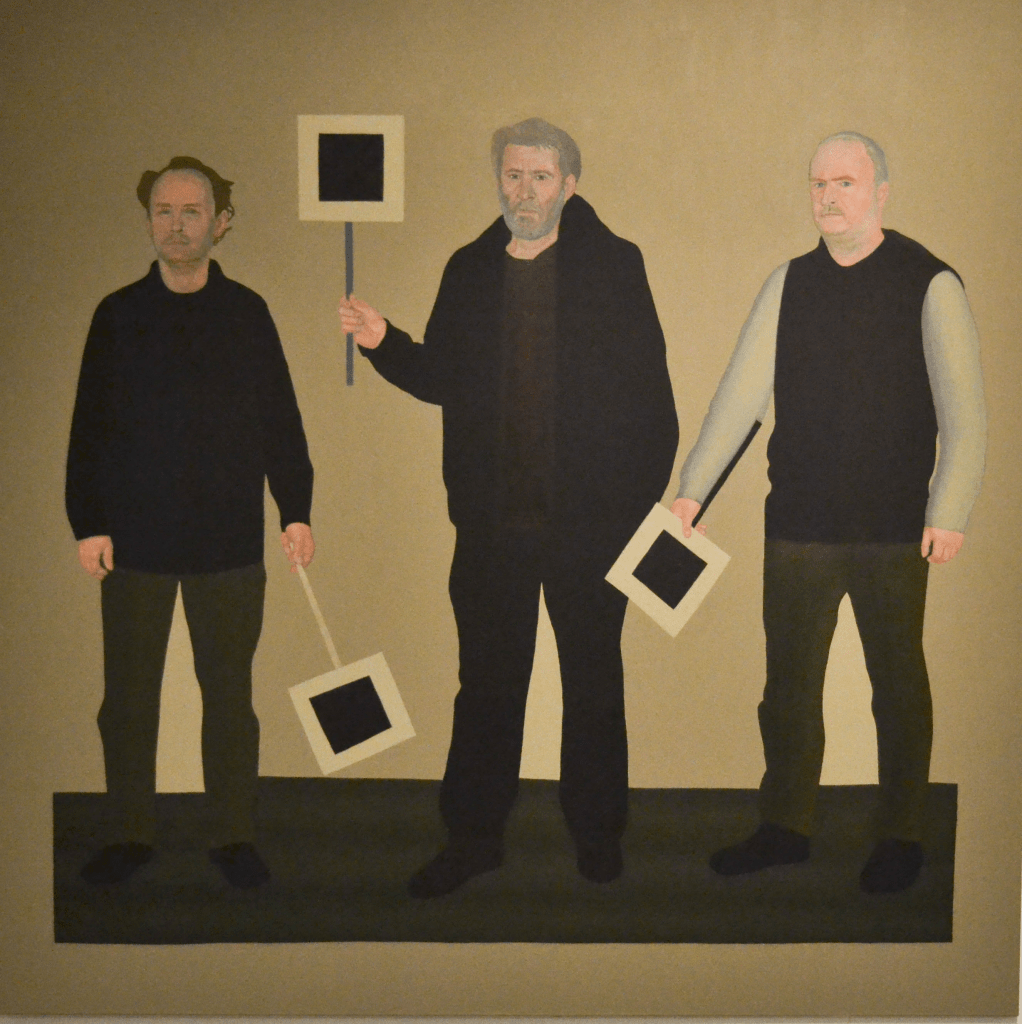
Let’s break this down. Ignacy Czwartos (b. 1966, Kielce, Poland) is a Cracow-based painter. His paintings are characterized by a limited cool color palette with subdued and quiet shades, dominated by beige, olive green, rotten blue, and beige.
His latest cycle focuses on the Cursed Soldiers, known as “Żołnierze Wyklęci” in Polish, who were anti-communist resistance fighters operating in Poland after World War II. The name “Cursed Soldiers” reflects the fate of these individuals, facing persecution, imprisonment, and often execution by the post-war communist authorities in Poland.
In his artistic endeavors, Ignacy Czwartos openly acknowledges his sources of inspiration, featuring portraits of influential figures in numerous paintings. Among those he pays homage to are Kazimierz Malewicz, Mark Rothko, Andrzej Wróblewski, Nikifor Krynicki, Jerzy Nowosielski, and Jarosław Modzelewski, whose works hold particular value for Czwartos. Additionally, he extends his appreciation to the anonymous creators of the Sarmatian coffin portraits, evident in the unmistakable homage paid to them through the portrayal of his artistic influences.
A distinct characteristic of Ignacy Czwartos’s art lies in its unique form, characterized by a captivating tension between life and death. This thematic exploration is reminiscent of the motif of Danse Macabre, a popular theme in Late Middle Ages art. This juxtaposition adds a layer of depth and intrigue to Czwartos’s work, further contributing to the distinctive nature of his artistic expression.
The first significant scandal surrounding this artist occurred when The Zachęta National Gallery of Art, a contemporary art museum in the center of Warsaw, Poland, opened an exhibition called The Landscape of Polish Painting. This exhibition was meant to be a wide-ranging and diverse presentation of the works of Polish contemporary artists, including 140 established contemporary classics, mid-career painters, emerging artists, and debutants, representing all current trends from realism to non-objective abstract art.
One of the rooms was devoted to the works of Ignacy Czwartos, and to the works of another Polish painter, Zbigniew Dowgiałło. The decision to include their works caused a stormy reaction among other artists whose works were included in the exhibition. Many Polish artists openly refused to make their works available for the exhibition, expressing opposition to the gallery’s director, Janusz Janowski, accusing him of imposing arbitrary changes on the Polish art landscape.
Janusz Janowski, appointed as director by the previous Minister of Culture Piotr Gliński, who curated this exhibition, has often been subjected to waves of criticism. Primarily, this is due to his lack of curatorial experience, and secondly, his nomination was perceived as politically motivated. In response to the artists, Janowski stresses that the works on display in the exhibition are the property of Zachęta and were acquired with public money.
But why did artists refuse to exhibit their works with Czwartos and Dowgiałło? Mostly because of their right-wing political point of view.
At the beginning of December, the Minister of Culture changed. Therefore, on the 22nd of December, Janusz Janowski was dismissed from his position as director of the Zachęta National Gallery of Art, and a couple of days later, the decision to change the project for the Venice Biennale was announced. Both the artists’ protest at Zachęta and the change of the artist representing Poland at the Biennale are linked to the change in the Polish government.
The exhibition in the Polish pavilion was intended to feature over 35 of Czwartos’s works, aiming to portray the historical struggles endured by Poland in the 20th century, marked by the actions of its neighboring nations, Germany and Russia. The carefully curated collection aimed to narrate the story of Poland as a state subjected to victimization. Among the showcased pieces was supposed to be a work titled Nord Stream 2, which remained an unfinished project. This particular piece was meant to delve into the intricate dynamics between the former German chancellor, Angela Merkel, and Russia’s president Vladimir Putin, symbolically represented by a flaming St. Andrew’s Cross that evoked thought-provoking imagery.
A lengthy wall, positioned opposite the pavilion’s entrance, was intended to showcase seven canvases portraying Poland’s Cursed Soldiers. Inside a room adorned with devotional figures on pedestals, other paintings were meant to be strategically arranged to establish connections between the military arm of Hitler’s private army, the Waffen-SS, and the late Russian mercenary leader Yevgeny Prigozhin. Additionally, correlations were intended to be drawn between the Holocaust and the Smolensk air disaster of 2010, during which the Polish president and PiS co-founder Lech Kaczyński tragically lost his life.

The exhibition overview positioned the event as a distinctive chance to garner global focus on what the curators interpret as Poland’s particularly poignant circumstances. According to the document, The Greeks invented tragedy; the Poles rehearsed it. Titled Polish Exercises in the Tragedy of the World: Between Germany and Russia.
Taking an uncommon stance, three members of the jury responsible for selecting the exhibition submitted a dissenting opinion, expressing their disagreement that Czwartos’s showcase strongly contradicted the official theme of the biennale. In their dissenting statement, they contended that the pavilion portrayed Poland as a “homogeneous, closed-off country solely centered on itself and speaking from a victimized standpoint.” They further argued that it “fails to represent in any manner Poland’s contemporary art scene.”
Joanna Warsza, one of the co-curators of Poland’s 2022 pavilion, expressed that the choice to select Ignacy Czwartos appears to signal the conclusion of eight years of right-wing governance. Warsza, along with Museum of Warsaw director Karolina Ziębińska-Lewandowska and critic-curator Jagna Domżalska, constituted the three dissenting voices on this year’s jury.
It is true that the controversial connections drawn within the exhibition, such as those between the Waffen-SS, Hitler’s private army, and Yevgeny Prigozhin, as well as the correlations between the Holocaust and the Smolensk air disaster, may be provocative, but they also present valuable opportunities for open discussions and reflections on the broader implications of historical events. Art, at its essence, has the power to challenge preconceived notions and prompt a reevaluation of our understanding of the past.

Czwartos’s works serve as a bold attempt to draw attention to the intricate historical complexities of the nation. Rather than viewing it in isolation, the exhibition should be seen as an enriching contribution to the cultural discourse, offering a platform for diverse perspectives and fostering a nuanced dialogue about Poland’s history.
That’s why Minister’s decision raises concerns about artistic freedom and diversity of expression. A spokesperson from the Lithuanian Foreign Ministry has refrained from commenting on a piece of art before its public display. The spokesperson emphasized that discussions about artwork, even if it presents a disputed interpretation of historical facts or figures from our shared history, should be initiated among historians and art critics first.
It is essential to recognize that an artist’s affiliation with a particular political party should not serve as a basis for restricting their artistic expression. Artists, like any individuals, are entitled to express their perspectives, even if these perspectives align with particular political ideologies.

 ART HUB
Leave a comment