Architecture seamlessly intertwines with art, creating a curious coexistence for numerous reasons. One key factor is the transformative power that allows a simple building to evolve into a sanctuary for artistic visions. When bricks, concrete blocks, or wooden pillars are shaped by creative minds, they unveil beauty, transforming an ordinary structure into architectural artistry.
The relationship between architecture and various art forms can be complex, ranging from chaos to allure or even devastation. This article narrows its focus to a specific connection exemplified by “Reading between the Lines” in Belgium.
In the realm where art meets architecture, the collaborative brilliance of Pieterjan Gijs and Arnout Van Vaerenbergh, known as Gijs Van Vaerenbergh, takes center stage. Their architectural vision harmonizes artistic expression, structural innovation, and the intricacies of human perception. Within their immersive installations, they manipulate light, transparency, and perspective to dissolve the boundaries between the tangible and the ethereal. Through their masterful use of grids, frames, and geometric patterns, Gijs and Van Vaerenbergh dismantle established architectural norms, designing spaces that captivate both the eye and the intellect. These evocative settings not only capture visually but also provoke contemplation, revealing a realm where traditional forms merge seamlessly with the abstract.
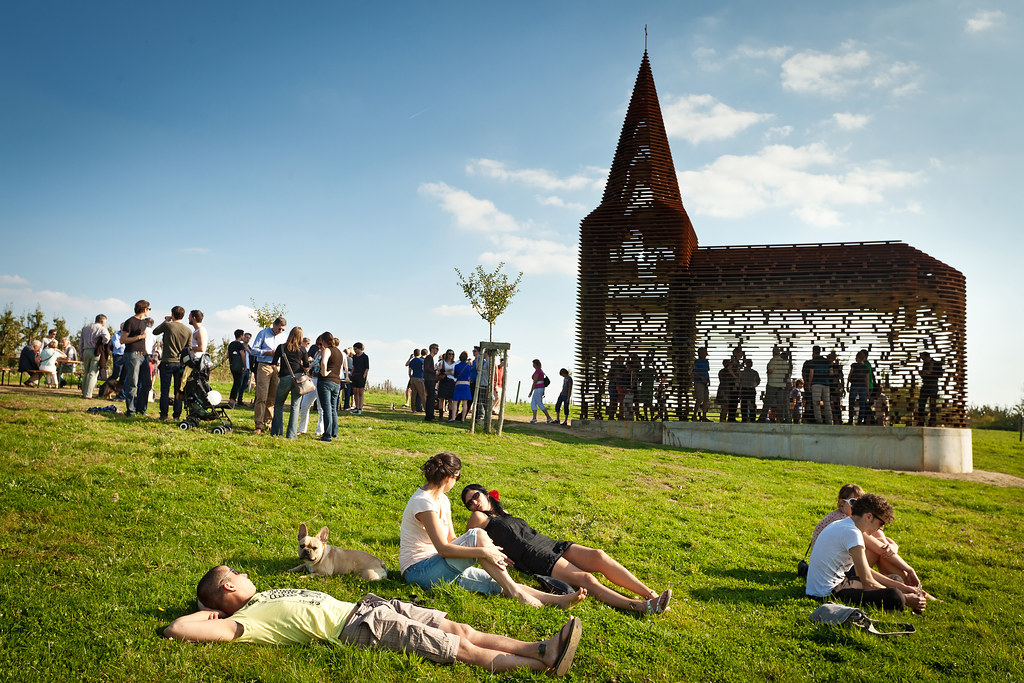
The captivating essence of “Reading between the Lines” becomes clearer as we delve into its design. Crafted by the Belgian architectural duo, the structure was completed in 2011, nestled in the Belgian province of Limburg, near Borgloon, just an hour drive from Brussels.
Limburg, one of Belgium’s ten provinces, boasts a blend of heritage and innovation in its architecture. From medieval landmarks like the Gothic Cathedral of Our Lady to modern structures like the Z33 Art Center, the region harmonizes historical townhouses with avant-garde designs. Limburg often embraces sustainability in renovations and green spaces, showcasing a dynamic mix of tradition and modernity in its architectural landscape.

Taking inspiration from a neighbouring church’s foundational shape and proportions, Van Vaerenbergh explains, “We wanted to refer to the most psychological form of a church.” Employing a laser scan to capture precise dimensions, the architects translated these measurements into both digital and physical models. “We started with the full form of the church and then began cutting it,” Van Vaerenbergh details. Maintaining a meticulous ratio of 1 centimeter of metal to 9 centimeters of opening, they preserved the typological essence of the church while ensuring the landscape could shine through.
Within seven weeks of submitting their designs, the team received 33 tons of laser-cut metal pieces. Sorting and organizing these numbered pieces, sometimes combined into layers, took a week. It then required three more weeks to weld the layers and spacers into groups for crane hoisting on-site.
The team’s detailed planning bore fruit on installation day, September 24, 2011. “We began early in the morning, all set with the pieces,” Van Vaerenbergh reminisces. “And we wrapped up before dinner,” he adds.
Constructed from 100 layers of steel strips forming a church-like shape, these elements intertwine and overlap, creating a remarkable, slightly translucent edifice. This design epitomizes the project’s core concept—an exploration of the interplay between architecture and its surroundings, delving into the intricate connections between substance and void, internal and external spaces.

As a work of art, its allure lies in its transformative nature, offering a distinct encounter contingent upon the observer’s viewpoint. From a distance, it resembles a church; up close, it transforms into a transparent structure, its character is shifting with light and weather.
Drawing inspiration from the history and architecture of Belgium’s region, Gijs Van Vaerenbergh reimagined traditional forms, infusing them with a novel and unexpected essence. Their emphasis lies in experimentation, reflection, physical engagement with the final product, and the crucial consideration of the viewer’s input. Integrated into Limburg’s art route, the structure prompts visitors to ponder the interrelationship between art, architecture, and the world surrounding them.
This ‘church,’ comprised of 30 tons of steel and 2000 columns, exudes an unexpected sense of weightlessness. Functionally undefined, it beckons people to gather, spend time, and share experiences. It’s neither a religious space nor a museum demanding silence and cautious movements. Here, one can freely experience and observe, anytime, alongside others. Perhaps, therein lies its unique purpose.

 ART HUB
Leave a comment