

Pictures usually hide something what we cannot see right away. Sometimes it is a symbol or small detail but it often happens that paintings have all the stories and countless feelings in them. Love has always been a perfect inspiration for the artists, however, it is not easy to notice it every time. That is the reason why I would like to show you more or less of hidden love in chosen works.
Two men called Dante but one Beatrix
We are starting our journey with Beata Beatrix by Dante Gabriel Rossetti. The subject of the painting is Beatrix “Bice” Portinari. She was Dante Alighieri’s love and source of inspiration. The poet fell in love with her when they were still kids. He has been loving her for years and he completely broke down after Bice’s death at the age of 25. Dante put his romantic feelings for her in one of his books of poems La Nuova Vita (The New Life). Her death was also one of the inspirations to write Divina Commedia (The Divine Comedy). In the text Bice became a Dante’s guide in the Paradiso. The poet has always seen her as an ideal of a woman and symbol of good.
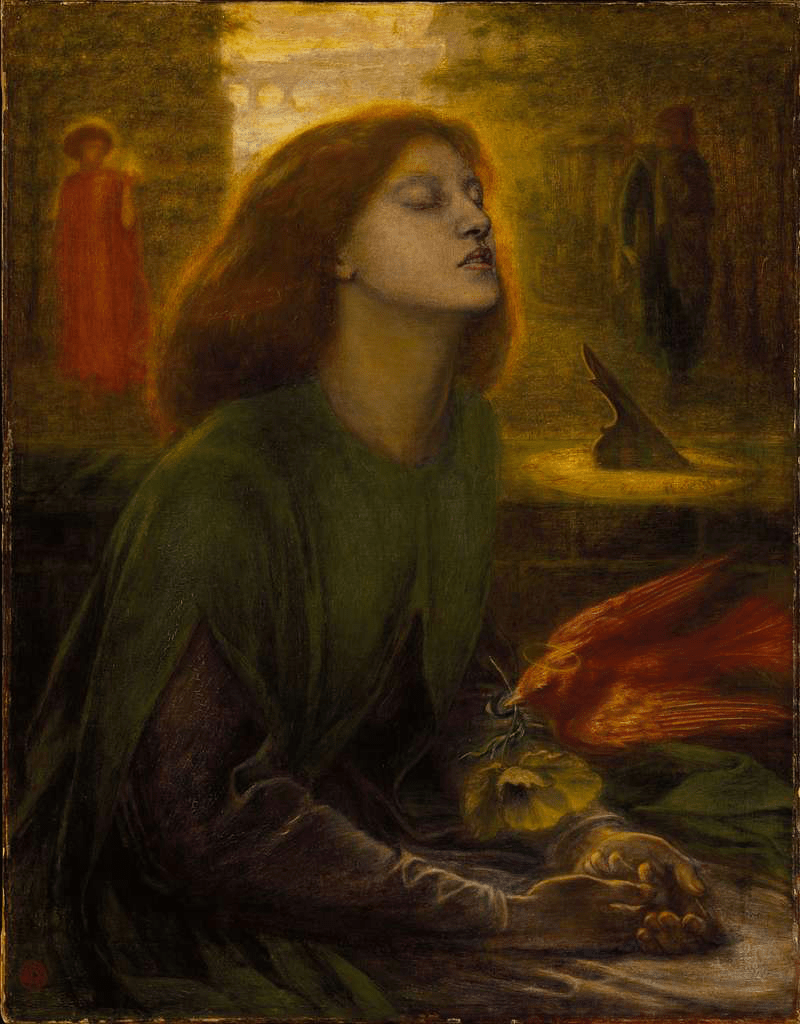
But what connects this story to Rossetti? The model to this picture was artist’s dead wife – Elizabeth Siddal. The painting was created in honor of her. She died young, same as Beatrix. Moreover, presentation of her as Alighieri’s symbol is not meaningless. In this way Rossetti has been trying to show his wife as pure as the poet’s source of inspiration.
In the picture the women’s face looks sleepy and calm, what can brings to mind Ophelia. It is also not meaningless. Elizabeth Siddal committed suicide, same as Shakespeare’s character. Apparently, the reason was that she had lost her child due to miscarriage and husband’s infidelity. She was as powerless and broken as Ophelia.
Moreover, not only Beatrix attracts the attention in this masterpiece. Next to her there is flying pigeon, which is holding white red weed. The flower has two meanings: sleep and narcotic. Of course sleep means her death. Narcotic is related to her way of killing herself. She overdosed drugs. Behind her a sun clock is showing nine – the hour when she fell asleep forever.
In the background there is two persons – allegory of Love and Alighieri. The poet is looking at Love, which is holding the flame of Elizabeth’s life. Rossetti really liked identifying with Italian poet. As same as Dante Alighieri, artist cannot forget about his love whose flame went out. He also used to write poems about her. He was feeling guilty for the rest of his life. Rossetti became depressed and after his works critic he tried to kill himself by using laudanum – this narcotic was used by Elizabeth Siddal.
From girl in white to nocturne in dark
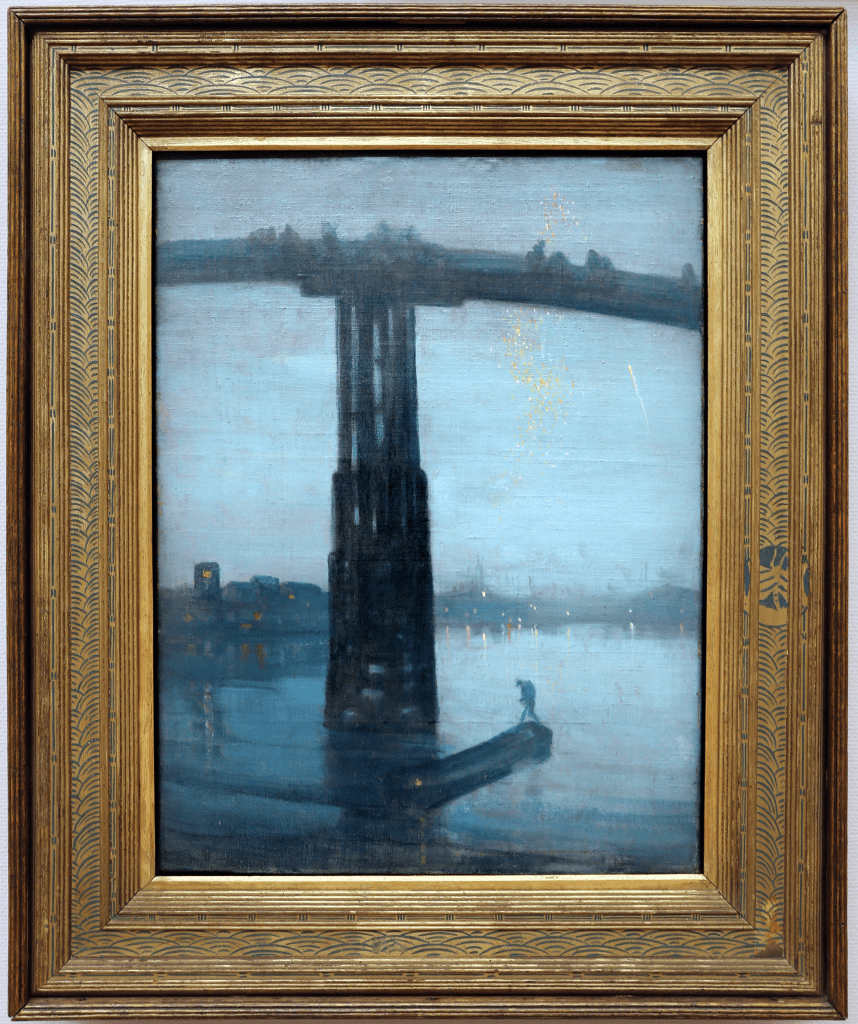
Loneliness. If someone asked me what I see in this painting, I would say that this work is about loneliness. The painting (Nocturne: Blue and Gold – Old Battersea Bridge) is one of a whole series of nocturnes painted by James McNeil Whistler. As you can see, despite poor colours, this masterpiece is hypnotizing by melancholy. But where are those feelings from? Another work, which starts the series (Nocturne: Le Solent), is presenting Le Solent, a boat on which the artist sailed to South America. Actually, we do not know why he left London for sure. Some people think he did it because of his breakup with Joanna Hiffernan.
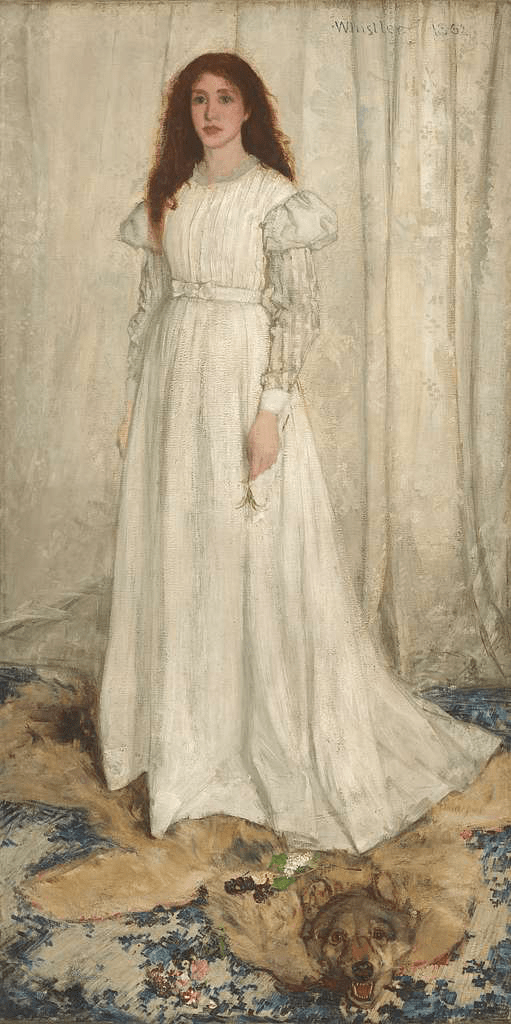
Hiffernan was a model to a lot of his paintings and later Whistler’s lover. The most popular series with her is Symphony in White, which emanate delicacy and melancholy. While their relationship was still lasting, she modeled naked to Courbet’s paintings and she has probably cheated on Whistler with him and it was the reason why the couple broke up. But curiously, after all that he left her everything in his will.
When he had returned to England, he was still creating a new nocturnes and other works. Whistler became a famous artist and he got married again a few years later. What about Hiffenan? Well, we do not know much about her, however supposedly she lived in Nice and she was still calling herself “Mrs. Abbot” (after Whistler’s second name).
The last person who mentioned her is Charles Lange Freer. He was an art collector who recognized her on the Whistler’s funeral. She spent an hour in front of her old lover’s coffin.
Although Whistler told that he went to Valparaiso in Chile for political reasons, there is no proof to confirm that. Moreover, he also said that he was always interested in night. But is it not curious that he started painting them after breakup with Hiffernan? From his Symphony in White he went to creating nocturnes.
Who is the women on the horse?
The last story I want to tell you is related with one of the greatest scandals in polish history of art. The painting Szał Uniesień (Frenzy of Exultations) by Władysław Podkowiński has been aroused controversy since the beginning. The painting was exhibited in 1894 in popular gallery in Warsaw. Conservatives were thinking that this is awful, naked woman on this horrible horse. But there is also a lot of forward-thinking and young people who love this painting. Unfortunately, before the exhibition ended, Podkowiński had decided to cut the masterpiece in the gallery.
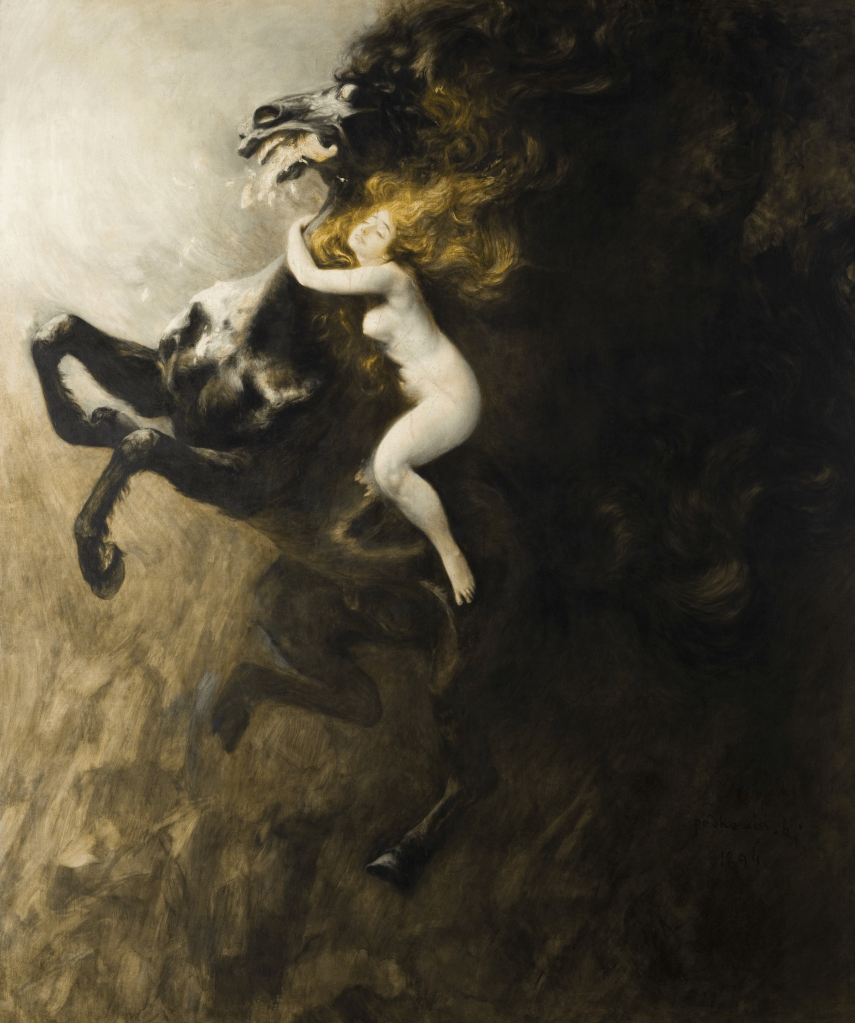
There are a few theories why author did this. Some people think he wanted publicity. The author said that he destroyed his work, because nobody had bought it and he was feeling obligated to destroy the work. But there is an opinion that the reason to cut the painting was a woman who Podkowiński had feelings for. Ewa Kotarbińska got recognized in model’s face by her family what made them mad at the artist.
Proof to this solution could be a fact that cuts were generally on the woman’s figure. The letters by the artist also can make us think. Podkowiński wrote that killing this painting was a really hard experience and when he cut it, he did not only murder that work but maybe his whole creativity. A few months after that episode Podkowińki died.
But if someone is worried about the painting, it would comfort you that the painting got fixed and now you can see it at the Sukiennice in Cracow.
As you can see, every painting hides something. We cannot always say what exactly happened in an artist’s life. That is why we should be looking for stories and symbols on our own, however it is still useful to get to know the life story of author. Maybe we will find something that nobody else before or we find out that someone felt the same as us. Art is not only works on walls, but there is usually a whole moving story, which is waiting for discovery.



 ART HUB
Leave a comment