
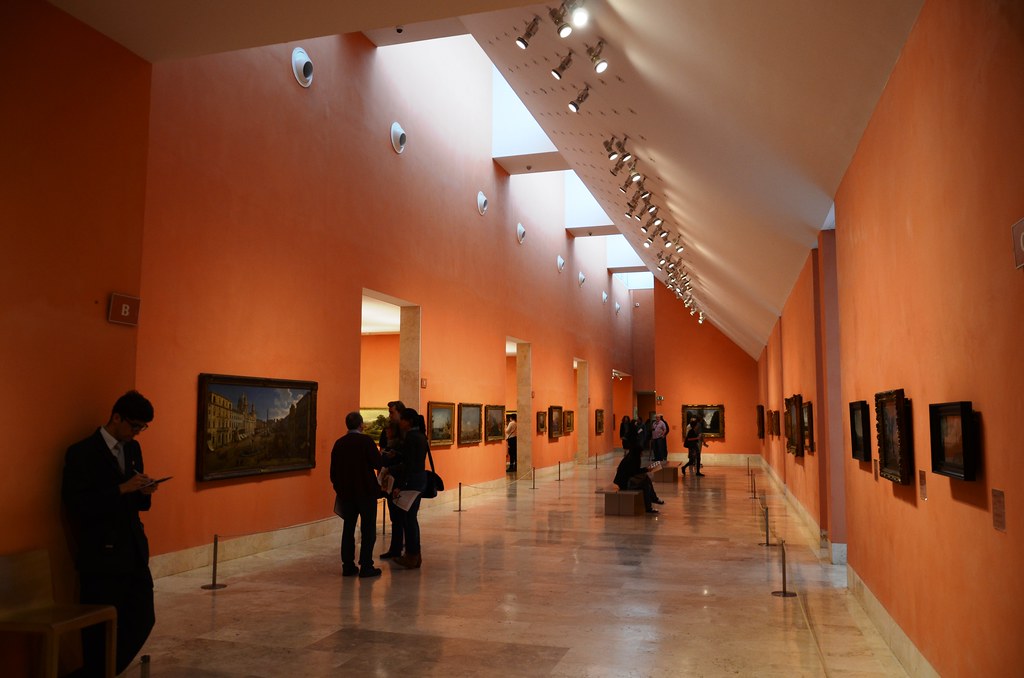
Female artists, once celebrated in their time but later forgotten or overlooked by history, are now coming together in an impressive exhibition at the heart of the Spanish capital.
The new and significant exhibition at the Thyssen-Bornemisza Museum in Madrid challenges the traditionally male-dominated narrative of art history. Titled “Maestras” or “Women Masters,” the exhibition presents a fascinating collection of nearly 100 paintings, lithographs, and sculptures, unveiling the stories of women artists who achieved recognition from the late 16th to the early 20th centuries, since faded into obscurity.
Works by artists such as Artemisia Gentileschi, Angelica Kauffmann, Clara Peeters, Rosa Bonheur, Mary Cassatt, and María Blanchard are prominently featured. Many of these women were esteemed academics, winners of prestigious awards, and their artistic creations were highly sought after. Some even had dedicated exhibitions to showcase their masterpieces.
Guillermo Solana, the artistic director, emphasizes that this exhibition reveals great talents that haven’t been forgotten but rather erased from history. Many of these artists were successful in their own time, yet in the 19th century, they were scrapped from art history textbooks and museums.
Solana notes that the art of women masters covered diverse themes and genres. The exhibition challenges the misconception that women artists were limited to specific genres, such as painting only flowers, fruits, or portraits. It highlights the breadth of their artistic exploration, starting with Artemisia Gentileschi, an outstanding painter of historical, biblical, and mythological themes.
Historically, women faced exclusion from art institutions, with limited access to official art schools and academies. They were even restricted from participating in live nude model drawing.
Art historians argue that the true erasure of women from art history occurred in the 20th century, particularly as women gained universal suffrage and access to education, including universities.
Rocío de la Villa, the curator of the exhibition, describes this period as one where the works of women artists were relegated to storage because they were deemed not brilliant or worthy of the official canon being articulated at the time.
Thanks to advances in feminist art theory and art history, many works by women have been recovered from museum archives. Esther Romero Sáez, an art historian and gender studies researcher at the Complutense University of Madrid, points out that until recently, women’s art was mistakenly perceived as homogeneous.
The “Women Masters” exhibition is divided into eight sections, spanning from the late 16th century to the early 20th century. Each section explores significant aspects of women’s history and how female artists engaged with various ideas and causes.
The first section delves into 16th-century Italy, showcasing paintings of biblical, mythological, and heroic themes where women are portrayed as proactive participants in the narratives. The second section highlights natural motifs and still-life paintings, underscoring the extensive botanical knowledge of these artists.
Other sections feature portraits from European courts and depictions of women from different cultures during the colonial period.
De la Villa, the curator, notes intriguing differences in how men and women portrayed the female sex, citing examples of male artists often sexualizing and eroticizing women in themes like Orientalism, while women artists approached these subjects with dignity and respect.
The “Women Masters” exhibition will be on display in Madrid until February 4, 2024, after which a condensed version will be exhibited at the Arp Museum in Remagen, Germany.


 ART HUB
Leave a comment