
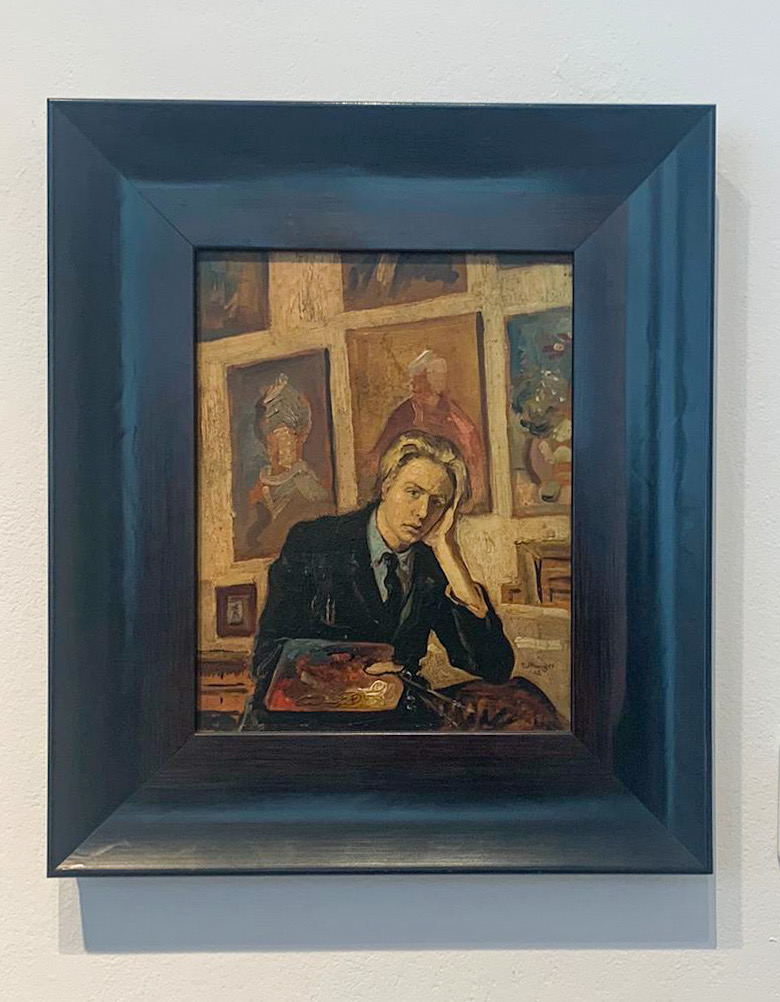
Wojciech Fangor (15 November 1922 – 25 October 2015) was a remarkable artist, adept at painting, sculpture, and poster design. Co-founder of the esteemed Polish School of Posters, Fangor’s journey into the world of art was profoundly influenced by his early travels across Europe during 1936-1938. During this period, he visited renowned museums in Paris, Vienna, Venice, Florence, Rome, Naples, and Istanbul, a voyage that proved instrumental in shaping his artistic inclinations.
An encounter that left an indelible mark on Fangor was Picasso’s Guernica, witnessed during its first public exhibition at the Spanish Pavilion during the 1937 Paris Expo. This powerful artwork, a protest against the brutal bombing of Guernica by German warplanes under General Franco’s orders, deeply resonated with Fangor. It spurred him to take up art as a means to convey powerful messages and foster social dialogue.
Fangor’s artistic journey began with private instruction under Tadeusz Pruszkowski and Feicjan Szczęsny Kowarski. Following this, he honed his skills at the Academy of Fine Arts in Warsaw, obtaining his diploma in 1946. Not only did he make significant contributions to the art world through his creations, but he also served as an assistant professor at the Academy from 1953 to 1961.

Post-World War II, Fangor dedicated himself to depicting everyday life with a unique perspective. Notable among his works is Figures, an exemplary piece illustrating the contrasting post-war lives in the United States and Poland. Through this artwork, Fangor aimed to motivate society to focus on their own achievements and contribute to the nation’s reconstruction.
In the 1950s, Fangor extended his creative talents to poster art and was instrumental in founding the influential Polish School of Posters. This group garnered international acclaim for their impactful political, social, and cultural posters. One such outstanding work was Fangor’s poster for “The Walls of Malapaga,” which received prestigious awards and even found a place in Martin Scorsese’s private collection.
In the 1960s and 1970s, Fangor embarked on a transformative artistic exploration, particularly captivated by the realms of minimalism and op-art. Notably, he gained widespread acclaim for his pioneering series featuring characteristic circles and undulating waves. These works were a visual marvel, showcasing his mastery in manipulating geometric forms and creating mesmerizing optical illusions. The circles, meticulously arranged and meticulously shaded, produced a sense of movement and depth, inviting viewers into an immersive experience. Fangor’s utilization of vibrant colors and precise juxtaposition of shapes within these circles was revolutionary, challenging traditional perspectives and expanding the boundaries of art. Through these visionary pieces, Fangor left an indelible mark on the op-art movement, inspiring future generations of artists to explore the potential of geometric forms and optical effects in their own artistic endeavors. His circle series remains a testament to his innovative spirit and his ability to harness the power of art to intrigue, engage, and transcend conventional artistic norms.

His innovative approach to art was also reflected in spatial exhibitions, a domain in which he collaborated with eminent architects. Notably, he joined forces with Stanislaw Zamecznik, Oskar Hansen, Zbigniew Ichnatowicz, and Jerzy Sołtan to create “A Study of Space,” a groundbreaking exhibition comprising twenty optical paintings.
In the 1960s, Fangor set out on an international journey, leaving Poland to explore art opportunities abroad. Teaching at prestigious institutions such as Farleigh Dickinson University and Harvard University in the United States, Fangor expanded his artistic horizons and shared his expertise with aspiring artists.
Fangor’s lasting legacy includes op-art mosaics at the Warszawa Śródmieście railway station and the op-art gallery in the Warsaw metro. His pioneering contributions have left an indelible mark on the world of art, demonstrating that possibilities in art are boundless, irrespective of one’s origins. He remains an inspiration to artists and art enthusiasts, highlighting the power of art to transcend boundaries and communicate profound messages that resonate through generations. Through his varied and influential body of work, Fangor has made an everlasting impact on the art world, solidifying his place as a true visionary.

 ART HUB
Leave a comment